

Mario had a bee in his bonnet this morning. Apparently, the chorus of German voices pointing to the obvious - that his policies are killing savers, insurance companies, pension funds and banks - got his dander up:
“We have a mandate to preserve price stability for the whole of the euro zone, not only for Germany,” he said. “We obey the law, not the politicians, because we are independent.”
There you have in brief the whole rationalization for the monetary madness that Draghi and his kindred central bankers have unleashed on the world. They claim that their rubbery statutory mandates to pursue the equivalent of economic apple pie, such as ‘price stability’, leads in a straight, unbreakable line of logic and monetary science to the lunacy of (0.4%) money market rates and $90 billion per month of bond-buying.
No it doesn’t.There is no scientific linkage whatsoever - just an ideological leap based on a Keynesian demand model that conveniently delegates all power to the central bankers’ soviets.
Just as in the case of the Humphrey-Hawkins Act in the US, the ECB’s enabling statute does not define price stability in quantitative terms - nor does it specify the inflation index to be used or the duration to be measured. Even when the ECB’s Governing Council attempted to formulate a quantitative definition of ‘price stability’, it only got slightly more specific in defining it a something between zero and 2% over the course of a year.
“Price stability is defined as a year-on-year increase in the Harmonised Index of Consumer Prices (HICP) for the euro area of below 2%.”
By its own definition, therefore, the eurozone does not have a “deflation” problem or even a “lowflation” threat. For the last 16 years, the core HICP has averaged 1.5%, and during the last year when allegedly the deflationary sky was falling, the core consumer inflation index has risen by 1.0%.
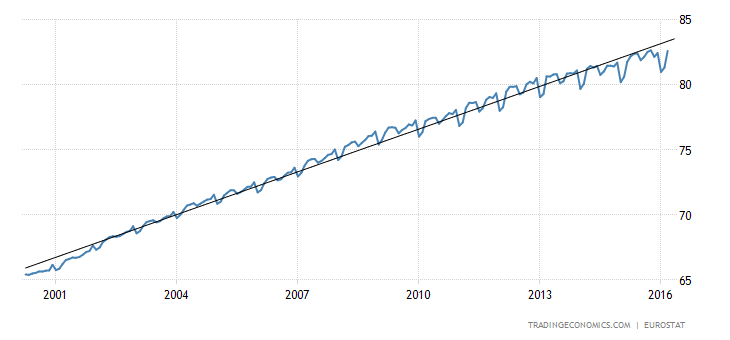
So all of Draghi’s arm-waving about the “law” is just risible obfuscation. Surely “Mario and the NIRPs” are not suggesting that monetary policies so radical that they were not even conceivable a decade ago are warranted because core inflation is temporarily tracking at a mere 50 bps below its long-term trend; or that it should be measured in weeks and months, not a year; or that the ECB should be fighting the huge blessing to EU consumers of the globally originated collapse in imported oil and materials inflation.
Indeed, the truth is real simple. Virtually all of the sub-trend performance of the consumer price index during the last year is due to the nearly 3% drop in import prices. And that has been an unequivocal benefit to the European economy!
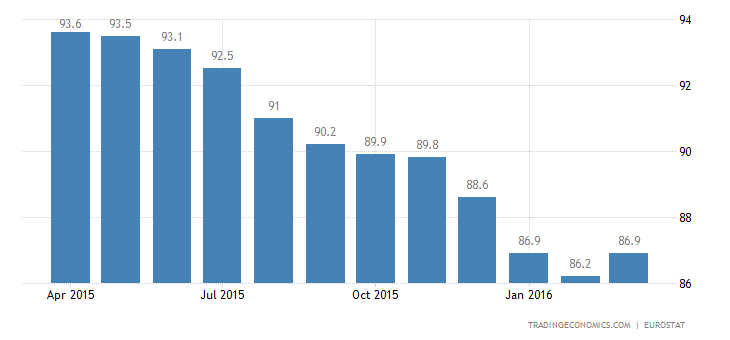
So not only was Mario pouting because the phony threat of deflation has not blinded the Germans to the destructive impact of his policies, but he actually let loose a wild pitch that needs no amplification. To wit, Draghi is on a power trip so naked that he actually threatedeven greater monetary mayhem if people don’t stop questioning his authority:
“Any time the credibility of a central bank is perceived as being put into question, the result is a delay in the achievement of its objectives — and therefore the need for more expansion,” the ECB president told reporters in Frankfurt, raising his voice. “Our policies work, they are effective. Just give them time.”
There you have it—–school yard bluster. And its all in the name of a primitive economic notion that only someone nurtured in the Italian Treasury and sent off to finishing school at Goldman Sachs could actually believe. To wit, that more debt everywhere and always is the elixir that will create economic growth and wealth.
In fact, Mario believes himself to be in the economic growth business via the agency of pumping more credit into the eurozone economy whether warranted or not. Apparently, there are no interest rates too low if they spur more credit growth:
“Our monetary-policy measures have been supporting growth……. With rare exceptions, monetary policy has been the only policy in the last four years to support growth………Overall, the monetary policy measures in place since June 2014 have clearly improved borrowing conditions for firms and households, as well as credit flows across the euro area…….Credit continues, it’s pretty solid,” he said. “Together with a dramatic fall in rates and increasing volumes, this shows are measures are indeed quite effective.”
Let’s see. Private sector loans outstanding in the eurozone totaled EUR 10.69 trillion in February compared to EUR 10.60 trillion a year earlier. That computes to a gain of exactly……..0.6%!
So even if European households and businesses needed to lug around more debt, which they clearly don’t, the ECB has literally savaged savers and pensioners in the name of a hardly measureable fraction.
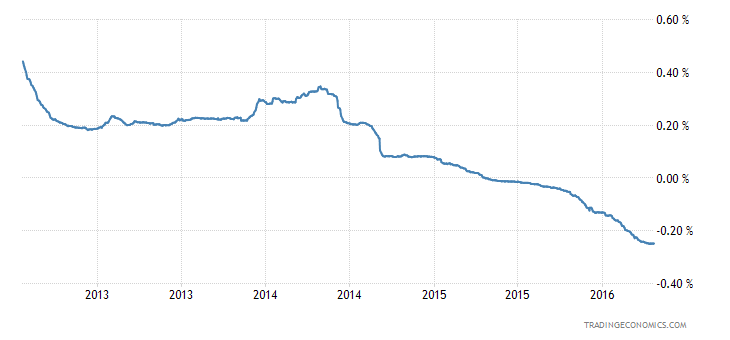
Obviously, there is an altogether different issue here. The European private sector is not borrowing because two years ago interest rates were too high, or even four years ago when Draghi delivered his “whatever it takes” ukase. In fact, since mid-2012 euro LIBOR has essentially been pegged at a rounding error. The notion the difference between +0.2% on the lending reference rate and -0.2% makes any difference to any actual business or household is preposterous.
The fact is, lending growth is tepid because the eurozone private sector is impaled on Peak Debt. The boom in lending happened 7-15 years ago. And even after plateauing at Peak Debt, the growth rate since the year 2000 still computes to 6% per annum.

So there is another reason why Europe isn’t growing and its one the central bank can do nothing about. Namely, the 19 government of the eurozone and the super-state in Brussels have essentially outlawed it.

Comments
Log in or sign up to join the conversation.