
If you look closely at the technology driving our world, you will notice a massive shift. From the cloud servers hosting our favorite apps to smartphones, supercomputers, and an increasingly large number of everyday desktop PCs, Linux is everywhere.
Once viewed as an intimidating, command-line-only playground strictly for hardcore programmers and system administrators, Linux has evolved into a global phenomenon. Its desktop market share has climbed steadily, and its dominance in tech infrastructure is absolute.
Why is Linux experiencing such a massive surge in popularity today? Let’s break down the driving forces behind this open-source revolution.
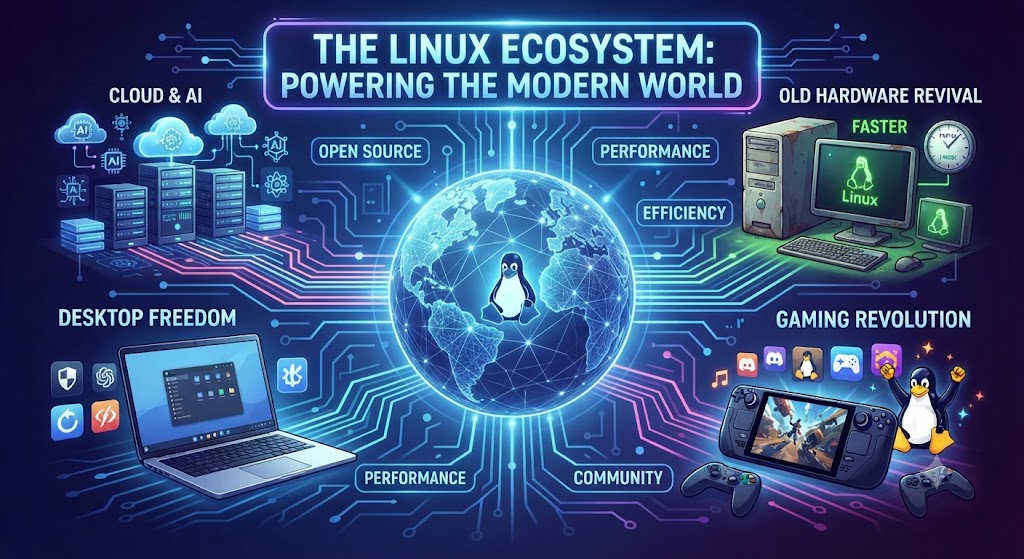
1. Frustration with Traditional Operating Systems
One of the biggest catalysts for the recent spike in Linux adoption on desktops is growing consumer dissatisfaction with mainstream proprietary operating systems like Windows.
Bloatware and Heavy AI Integration: Many users have grown frustrated by aggressive pushes toward resource-heavy AI features, mandatory cloud sign-ins, lock-screen ads, and background telemetry that eats up system performance.
Rigid Hardware Requirements: When older versions of Windows reach end-of-life or introduce strict hardware compatibility barriers, millions of perfectly functional computers are suddenly labeled "obsolete". Linux offers a breath of fresh air—giving users full ownership, zero telemetry, and deep privacy control.
2. Giving Old Hardware a Second Life
In an era of rising hardware costs and electronic waste concerns, sustainability matters more than ever.
Traditional operating systems demand heavier specs with every major update.
Lightweight Linux distributions (like Linux Mint, Zorin OS, or Lubuntu) can make a sluggish, aging laptop run lightning-fast again. By breathing new life into old hardware, Linux provides an economical, eco-friendly alternative for students, budget-conscious users, and institutions.
3. The Gold Standard for Cloud Computing and AI
Behind the scenes, Linux is the undisputed backbone of the modern internet.
The Cloud Infrastructure: Virtually all major cloud platforms (AWS, Google Cloud, Microsoft Azure) and containerization tools like Docker and Kubernetes run primarily on Linux.
The AI Boom: As artificial intelligence and machine learning engineering expand globally, the infrastructure used to train and fine-tune large language models (LLMs) heavily relies on enterprise Linux environments. For developers and tech companies, knowing Linux isn't just a bonus anymore—it's a fundamental career requirement.
4. Gaming on Linux Has Come of Age
For a long time, gaming was the ultimate barrier preventing everyday users from switching to Linux. That barrier has effectively crumbled.
Thanks to Valve’s Steam Deck and the incredible power of compatibility layers like Proton, thousands of Windows-native games now run seamlessly on Linux out of the box.
Linux gaming market share on platforms like Steam has reached milestone highs, proving that gamers no longer need to stay locked into a single proprietary ecosystem for high-performance entertainment.
5. Modern Linux is User-Friendly and Accessible
If your mental image of Linux is a blank black screen with flashing text, you haven't looked at a modern distribution recently.
Modern desktop environments feature sleek, gorgeous user interfaces that mimic or even surpass traditional OS layouts.
With intuitive app stores, seamless driver installations, and user-friendly setups, you don't need a computer science degree to install and daily-drive Linux. Distributions are built specifically to welcome beginners with familiar workflows.
Final Thoughts
Linux is no longer just a niche alternative; it is a symbol of digital freedom, performance, and efficiency. Whether it's driven by a desire for privacy, the need to optimize hardware, or the demands of modern software development, millions of people worldwide are realizing that open-source software simply builds a better digital experience.
Have you ever experimented with a Linux distribution like Ubuntu or Linux Mint, or what is holding you back from giving it a try?
Comments
Log in or sign up to join the conversation.