

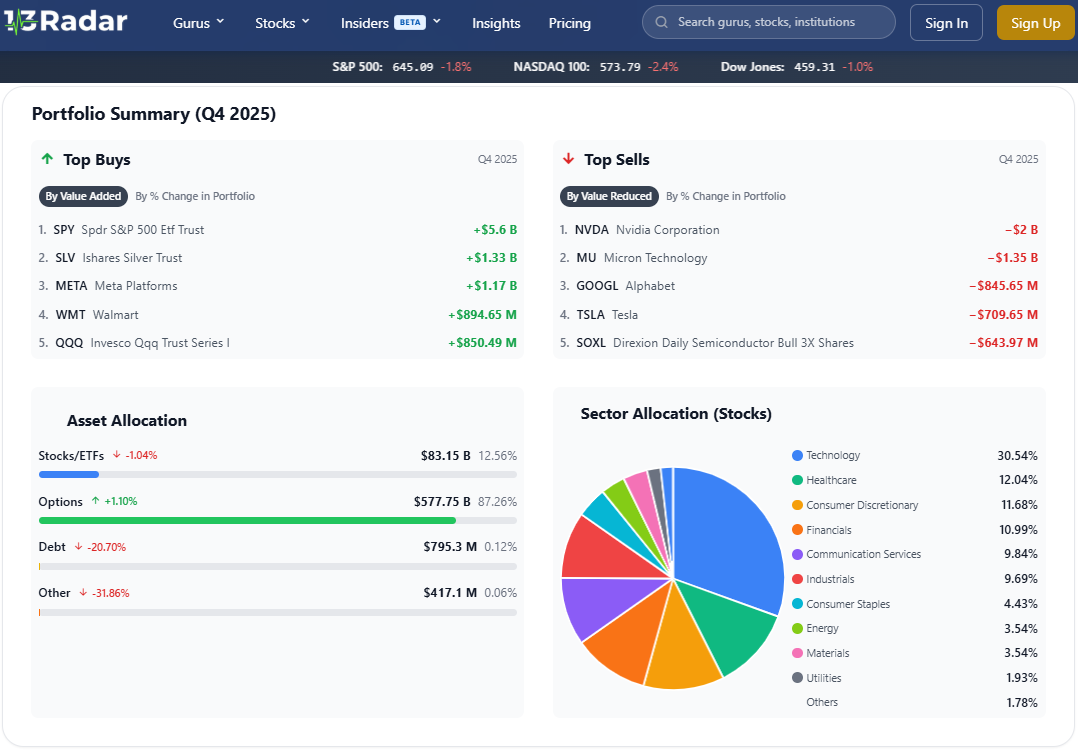
Let’s be real: trying to copy-trade the Jane Street Portfolio is a fool’s errand for most retail traders. With over 10,000 positions and a gross value north of $662 billion, Jane Street isn't just "buying stocks"—they are essentially the house in the world’s largest casino.
But if you dig past the surface-level noise of their latest 13F filing, a few high-conviction signals are screaming for attention. This isn't your standard "Big Tech" accumulation; it’s a masterclass in volatility arbitrage and proxy betting.
The "Gamma Trap" in the Jane Street Portfolio
Most headlines will tell you that Jane Street is "bullish" on the S&P 500 because their top holding is $45 billion in SPY Call options. That’s a lazy take.
If you look at the Jane Street Portfolio structure, the real story is the staggering symmetry between their $45.7B in Calls and $43.4B in Puts on the SPY. This isn't a directional bet on the market going up; it’s a massive "straddle" on volatility. They aren't betting on where the market goes, but that it will move—and they’ll be there to capture the spread on both sides. For the average investor, this is a reminder that the "smart money" is currently paying a premium for protection, not just chasing the rally.
The $MSTR Elephant in the Room: Arbitrage or Conviction?
The most aggressive pivot in the Jane Street Portfolio this quarter wasn't in AI chips—it was in MicroStrategy ($MSTR). Increasing their common stock position by a massive 473% is a move that should make every crypto-skeptic do a double-take.
Is Jane Street suddenly a Bitcoin maximalist? Highly unlikely.
More likely, their quants have spotted a massive dislocation between $MSTR’s premium and the underlying BTC spot price. By ramping up their stake, they are likely playing the arbitrage gap that has defined $MSTR’s volatility over the last six months. It’s a sophisticated "insider" play: using a high-beta stock to gain leveraged exposure while keeping the exit door wide open.
Tech Concentration: Beyond the NVDA Hype
While everyone else is obsessing over NVIDIA, the Jane Street Portfolio shows a more nuanced rotation into "Infrastructure 2.0." We’re seeing significant builds in names like Broadcom ($AVGO) and Meta ($META).
The takeaway here is clear: the trade has shifted from "who makes the chips" to "who owns the ecosystem." Jane Street is positioning itself in the companies that have the strongest balance sheets to weather a high-rate environment while still capturing the AI tailwinds.
The Bottom Line
You can’t trade like Jane Street, but you can certainly learn from how they hedge. Their current portfolio suggests a market that is pricing in extreme swings. In a world where everyone is chasing the next 10x, the world’s most successful quants are busy building a $600 billion fortress that profits regardless of the direction.
Maybe it’s time we stop asking "what" they’re buying and start asking "how" they’re protecting it.
Comments
Log in or sign up to join the conversation.