

Dry hair ends, oily scalp, hair growth shampoo men, and the best hair loss shampoo for menare common concerns for men trying to build a better hair-care routine. But why can the roots look greasy while the ends feel dry, rough, or damaged at the same time?
It may seem like these two problems should cancel each other out. They don't.
Your scalp naturally produces oil, while the ends of your hair are older and have been exposed to washing, sunlight, heat, friction, styling, and environmental damage for much longer. As a result, you can have an oily scalp and dry ends simultaneously.
The good news is that this usually comes down to balancing your hair-care routine rather than simply washing more or using heavier products.
Quick Answer
Your roots can become oily because your scalp produces sebum, while your ends can become dry because they receive less natural oil and experience more physical and environmental damage. Over-washing, harsh shampoos, heat styling, chemical treatments, long hair, and excessive product use can make the difference more noticeable.
The solution is to clean the scalp properly while protecting and conditioning the lengths and ends.
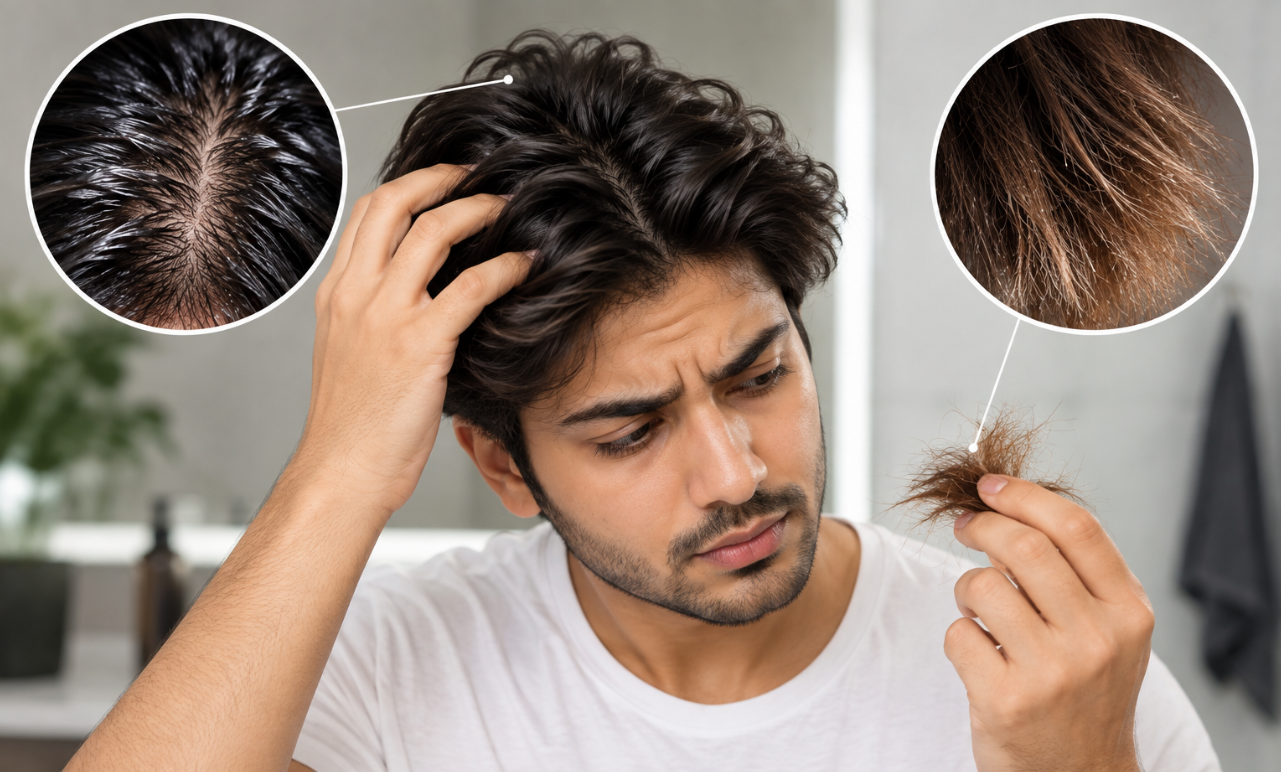
Why Are My Roots Oily but My Ends Dry?
The simplest explanation is that your scalp and hair ends have different needs.
Your scalp contains sebaceous glands that produce sebum. This natural oil helps protect the skin and hair near the roots.
But the further you move away from the scalp, the less effectively that natural oil coats the hair shaft.
Your ends are also the oldest part of your hair.
A hair strand can remain on your head for years, meaning the ends have experienced repeated exposure to:
Shampooing
Sun exposure
Heat
Hair dryers
Styling products
Friction from pillows and towels
Brushing and combing
Environmental pollution
Chemical treatments
This can create the classic combination:
Oily roots + dry ends.
What Causes an Oily Scalp?
Several factors can contribute to excess oil around the roots.
Natural Sebum Production
Some people naturally have oilier scalps.
Sebaceous glands produce sebum to protect the skin. If your scalp produces more oil, your roots may start looking greasy relatively quickly after washing.
Washing Too Frequently
It is tempting to wash your hair repeatedly when your scalp becomes oily.
But aggressive or excessively frequent cleansing can leave the scalp feeling dry or irritated in some people, encouraging an unhelpful cycle of cleansing and oiliness.
Instead of automatically washing more often, consider how oily your scalp actually becomes and choose a routine that fits your hair type.
Heavy Hair Products
Wax, pomade, creams, oils, leave-in products, and other styling products can accumulate around the roots.
This can make your hair appear oily even when your scalp itself isn't producing excessive amounts of sebum.
Sweat
Exercise and hot weather can make the scalp feel oily and sweaty.
If you train regularly, sweat and styling products can combine with scalp oil and make your roots look greasy faster.
Why Are the Ends of My Hair So Dry?
Dry ends are often related to cumulative damage.
The ends are older than the hair near your scalp, so they have had more time to experience wear and tear.
Heat Damage
Frequent use of:
Blow dryers
Straighteners
Curling tools
High-temperature styling
can contribute to dryness and breakage.
You don't necessarily need to stop using a hair dryer. Instead, avoid excessive heat and prolonged exposure to one area.
Rough Towel Drying
Aggressively rubbing wet hair with a towel can create friction.
Wet hair is more vulnerable to mechanical damage, so rough handling can contribute to breakage and frizz, particularly toward the ends.
Gently squeezing excess water from the hair is generally a better approach.
Sun and Environmental Exposure
Your hair is exposed to the environment every day.
Sunlight, pollution, dry air, wind, and other environmental factors can gradually affect the condition of the hair shaft.
The ends experience this exposure repeatedly because they remain on your head for the longest period.
Split Ends
If the ends are extremely dry, rough, or visibly splitting, you may be dealing with split ends.
Once a hair has split, hair products cannot permanently fuse the strand back together.
Conditioning products can temporarily improve how damaged ends look and feel, but trimming is the reliable way to remove severely split ends.
Can Shampoo Make Your Ends Dry?
Yes, depending on the shampoo, how you use it, and your hair type.
One common mistake is applying shampoo aggressively throughout the entire length of the hair.
Shampoo is primarily intended to clean the scalp.
When you massage shampoo into the scalp and rinse thoroughly, the cleansing product naturally travels through the lengths.
For many people, this is sufficient.
Repeatedly scrubbing already-dry ends can remove too much surface oil and make them feel rougher.
A Better Shampooing Technique
Try this approach:
Wet your hair thoroughly.
Apply shampoo mainly to the scalp.
Massage gently with your fingertips.
Let the lather rinse through the lengths.
Avoid aggressively rubbing the ends.
Follow with conditioner if your hair needs it.
This allows you to address oily roots without unnecessarily stripping the ends.
Should You Use Conditioner on Oily Roots?
Usually, conditioner is more useful on the lengths and ends.
If your roots become oily quickly, applying a heavy conditioner directly to the scalp can make your hair feel even flatter or greasier.
Instead, apply conditioner primarily from the mid-lengths toward the ends.
This gives the dry sections the conditioning they need without unnecessarily adding weight to oily roots.
Could Your Hair Type Be Causing the Problem?
Yes.
Hair texture plays an important role.
Straight hair can allow scalp oil to travel down the hair shaft more easily. This can make the roots appear oily quickly.
Curly or tightly textured hair may make it harder for natural scalp oil to travel toward the ends. As a result, the scalp can feel oily while the lengths and ends feel considerably drier.
Hair length also matters.
The longer your hair, the further the ends are from the scalp.
Is Your Hair Too Long for Your Current Routine?
Longer hair requires more attention because the ends have been exposed to environmental and mechanical stress for longer.
If your ends are consistently dry despite conditioning, you may need to:
Reduce heat exposure
Use a suitable conditioner
Minimize friction
Avoid aggressive towel drying
Trim damaged ends
Reduce unnecessary styling products
Sometimes the problem isn't your shampoo at all.
It is simply accumulated damage at the oldest part of the hair.
Does Oily Hair Mean You Should Avoid Hair Oil?
Not necessarily.
The important thing is where, how much, and whyyou are using oil.
If your scalp is already very oily, adding large amounts of hair oil directly to the scalp may make it feel heavier and greasier.
If the ends are dry, a small amount of a suitable hair oil or leave-in product may help improve the feel and appearance of the lengths.
However, more oil isn't automatically better.
Start with a small amount and avoid turning your hair-care routine into a cycle of applying oil and then aggressively shampooing it out.
What About Rosemary Oil for Hair Growth Men?
Rosemary oil for hair growth menis a popular search term among men interested in natural hair-care routines.
Rosemary oil is often discussed in relation to scalp and hair routines, but it shouldn't be confused with a solution for dry ends.
If your primary problem is dry, damaged ends, applying more oil to the scalp may not solve the actual issue.
Your routine should address each part of your hair according to its needs.
Oily scalp → focus on appropriate cleansing.
Dry ends → focus on conditioning and reducing damage.
What About a DHT-Blocking Shampoo?
A DHT-blocking shampoois marketed toward men concerned about DHT-related hair thinning.
DHT, or dihydrotestosterone, is associated with male pattern hair loss in genetically susceptible follicles.
However, oily roots and dry ends do not automatically mean you have DHT-related hair loss.
If you're also experiencing:
Receding temples
Crown thinning
Progressive reduction in hair density
Finer hairs around the hairline
then it may be worth discussing the changes with a dermatologist rather than assuming they are simply a shampoo issue.
Can Hair Growth Shampoo Men Use Help With This Problem?
The search term hair growth shampoo mencovers a wide range of products.
A hair-focused shampoo can be useful as part of a grooming routine, particularly if it helps you keep the scalp clean without making the lengths excessively dry.
But don't expect a shampoo alone to correct every type of hair problem.
A good routine should consider:
Scalp oiliness
Hair texture
Hair length
Dryness
Breakage
Product buildup
Actual hair loss
If your primary problem is oily roots and dry ends, the goal should be balance, not simply finding the strongest cleansing product available.
What Is the Best Hair Loss Shampoo for Men?
The phrase best hair loss shampoo for mencan make it sound like one shampoo is capable of solving every type of hair loss.
That's not how hair loss works.
Different causes require different approaches.
If your hair is shedding because of temporary factors, treating the underlying trigger may be important.
If you have male pattern hair loss, evidence-based treatments may be more relevant.
If your hair simply looks thinner because it is oily and flat, improving your washing and styling routine may make a significant cosmetic difference.
So instead of asking which shampoo is universally the best, ask:
What is causing my hair problem?
That question leads to a much more useful routine.
Could Product Buildup Cause Both Oily Roots and Dry Ends?
Yes.
This is an easy problem to overlook.
You might use several products to improve your hair:
Shampoo
Conditioner
Hair oil
Serum
Wax
Pomade
Leave-in conditioner
Styling spray
Over time, residue can accumulate.
The roots may look greasy or weighed down while the ends feel coated, rough, or difficult to manage.
If your hair suddenly feels different despite using the same products, simplifying your routine can help you determine whether buildup is contributing to the problem.
How Should You Wash Hair With Oily Roots and Dry Ends?
A balanced routine can look like this:
1. Shampoo the Scalp
Concentrate shampoo where oil is produced: the scalp.
Use your fingertips rather than your fingernails.
2. Don't Aggressively Scrub the Ends
Allow the shampoo to rinse through the lengths naturally.
The ends generally don't need the same level of cleansing as your scalp.
3. Condition the Lengths
Apply conditioner mainly from the middle of the hair toward the ends.
Give the dry sections more attention.
4. Rinse Thoroughly
Product residue can contribute to buildup and make hair feel heavy.
5. Dry Gently
Avoid aggressively rubbing wet hair.
6. Reduce Excessive Heat
Use moderate heat and avoid keeping a hot dryer concentrated on one area.
How Often Should You Wash Oily Hair?
There isn't one universal schedule.
Some people need to wash frequently because their scalp becomes oily quickly.
Others can comfortably go several days between washes.
Instead of following a rigid "wash every X days" rule, consider:
How quickly your scalp becomes oily
Whether you exercise frequently
Your hair texture
Your styling products
Whether your scalp becomes itchy or uncomfortable
The objective is a clean, comfortable scalp without unnecessarily drying the lengths.
Can Stress Affect Your Hair?
Stress can affect the hair cycle and may contribute to increased shedding in some situations.
However, stress isn't usually the direct explanation for having oily roots and dry ends.
If you're experiencing significant shedding alongside changes in your scalp or hair texture, consider whether there have been recent changes in your health, diet, stress levels, medications, or lifestyle.
Persistent or sudden hair loss deserves professional evaluation.
What About Hair Loss and Dry Ends?
Dry ends themselves don't necessarily indicate hair loss.
Dryness primarily affects the hair shaft.
Hair loss involves the follicle and hair-growth cycle.
However, severe hair damage can cause breakage, which may make your hair look shorter, thinner, or less dense.
This is different from hair shedding from the root.
Hair Breakage vs. Hair Shedding
Breakage:The hair shaft snaps somewhere along its length.
Shedding:The entire hair strand falls from the follicle.
Understanding this difference can help you determine whether you're dealing with a hair-care problem or a potential hair-loss problem.
How Can You Keep Your Ends Healthy?
Focus on reducing unnecessary damage.
Use Conditioner
Conditioning can improve softness and manageability.
Reduce Heat
Avoid excessive temperatures and prolonged heat exposure.
Don't Overbrush
Aggressive brushing can increase mechanical damage.
Be Gentle When Wet
Wet hair is more vulnerable to damage.
Trim Severely Damaged Ends
Products can improve the appearance of damaged hair, but they cannot permanently repair a split hair shaft.
Don't Overload Your Hair With Products
More products can mean more buildup.
Keep your routine simple enough that you understand what each product is doing.
Myth vs Fact
Myth: Oily roots mean you need to shampoo your entire hair aggressively.
Fact:Shampoo is primarily needed on the scalp. Excessive scrubbing of dry ends can make them feel rougher.
Myth: Dry ends mean your scalp is dry.
Fact:Your scalp can be oily while your ends are dry. The two conditions can occur simultaneously.
Myth: Hair oil will fix every type of dry hair.
Fact:Oil can improve the feel and appearance of some dry hair, but it cannot reverse severe structural damage or permanently repair split ends.
Myth: Oily hair means you shouldn't use conditioner.
Fact:You can still condition oily hair. Apply it mainly to the lengths and ends rather than heavily coating the scalp.
Myth: Dry ends automatically mean hair loss.
Fact:Dryness affects the hair shaft, while hair loss involves the follicle and growth cycle. Breakage and shedding are different processes.
Best Solution Summary
If your roots are oily but your ends are dry, don't treat your entire head of hair the same way.
Think of your routine in two zones:
The scalp needs cleansing.
The lengths and ends need protection.
A practical routine is:
Shampoo mainly at the scalp
Avoid aggressively scrubbing the ends
Condition the mid-lengths and ends
Reduce excessive heat
Handle wet hair gently
Avoid unnecessary product buildup
Trim severely split ends
Adjust your washing frequency according to scalp oiliness
Monitor any genuine changes in hair density or shedding
For men building a complete grooming routine, TrySPARTAN hair-care products can be incorporated based on your individual scalp and hair needs rather than simply adding more products.
Oily Roots. Dry Ends. Build a Better Hair Routine.
Give your scalp and hair the care they actually need. Explore TrySPARTAN's men's hair-care collection and build a routine focused on cleaner roots and healthier-looking lengths.
FAQs
Why are my hair roots oily but my ends dry?
Your scalp produces natural oil, while the ends are older and receive less of that oil. Heat, washing, friction, styling, and environmental exposure can make the ends even drier.
Should I shampoo my hair ends if they are dry?
Usually, focus shampooing on the scalp. Allow the shampoo and water to rinse through the lengths instead of aggressively scrubbing the dry ends.
Should I put conditioner on oily roots?
If your roots become oily quickly, apply conditioner mainly to the mid-lengths and ends. Heavy conditioner directly on the scalp can make some hair types feel greasy or weighed down.
Can oily roots and dry ends cause hair loss?
Not directly. However, excessive dryness and damage can cause breakage, while genuine hair loss involves the hair follicle. If you're experiencing progressive thinning or excessive shedding, consider professional evaluation.
How can I make my dry ends healthier?
Use conditioner on the lengths, reduce excessive heat, handle wet hair gently, avoid unnecessary chemical or mechanical damage, and trim severely split ends.
Final Takeaway
Oily roots and dry ends aren't contradictory—they are often a result of how the scalp and hair shaft behave differently.
Your scalp produces oil, while your ends are older and have experienced more washing, heat, friction, styling, and environmental exposure.
Instead of trying to fix everything with one product, divide your routine by the actual problem:
Clean the scalp. Condition the lengths. Protect the ends.
And if dryness is accompanied by progressive thinning, excessive shedding, a receding hairline, or visible scalp changes, don't assume it's simply a hair-care issue. Identify the underlying cause before choosing a treatment.
Comments
Log in or sign up to join the conversation.