

Rxi Pharmaceuticals (RXII) is set to announce the results for its phase 2a hypertrophic scar trial at anytime in the coming months. The company uses a science that is emerging fast in the biotechnology industry known as RNAi or RNA Interference. The phase 2a trial that is set to release preliminary results deals with patients that have hypertrophic scars. Hypertrophic scars are raised scars that tend to grow for about 2 years and then start to level off after a certain period of time.
Current therapy, which includes scar revision surgery and silicone gel, only slightly lessens the appearance of scars. This is because, typically after scar revision surgery, the hypertrophic scar tends to grow back with a vengeance despite any effort to revise it. Using the silicone gel can slightly change the appearance of a scar, but doesn't level it off closely to the neighboring skin. This is where RXI-109 comes in, which actually attempts to reduce the amount of Connective Tissue Growth Factor (CTGF) on the scar itself. Typically a wound will heal properly on its own without any complications, but sometimes the wound healing process takes a major turn. In some instances, the body sends too much CTGF to close off the wound, resulting in CTGF build ups at the site of the wound and forcing a raised hypertrophic scar.
The importance of this upcoming phase 2 result is major because it will validate Rxi's sd-rxRNA platform. This is because RXI-109 is intended to be used for a multitude of skin and eye diseases in patients. The validation of the sd-rxRNA platform, with positive phase 2 results in hypertrophic scars, will showcase its ability to be utilized on any other gene target. For example, if the sd-rxRNA platform utilizes RXI-109 properly in hypertrophic scars, then it will work for PVR (eye detachment), which then causes scarring after surgery to repair retina, liver fibrosis (scarring/damager of the liver) and macular degeneration. Upon successful results with RXI-109 the company can continue to grow dramatically. Rxi has recently established patent protection for the sd-rxRNA technology platform until the year 2029. With successful results in the phase 2 hypertrophic scar study, the company will increase in value substantially because it can target any other unmet medical need by utilizing the sd-rxRNA platform.
Catalysts For RXI-109 In Anti-Scarring
- Phase 2 data results for hypertrohic scars before the end of 2014 (can come now or at anytime before end of 2014)
- Initiate 3rd phase 2 trial using RXI-109 for hypertrophic scars in other parts of the body before end of 2014/beginning of 2015
- Phase 2 data results for keloid scars beginning/middle of 2015
One thing to note is that while we can't hypothesize the future results, we can always look at hints as to how well the clinical studies are going. For example, the 3rd phase 2 study for hypertrophic scars in breast reconstruction surgery was set to start Q3/Q4 of 2014 but will be pushed up slightly. The CEO, Dr.Geert Cauwengberg, mentioned in the Jefferies 2014 Global Healthcare presentation that they wanted to expand the study to not only target hypertrophic scars on breast reconstruction surgery, but other parts of the patient's body. That is one piece of evidence that RXI-109 is showing some substantial clinical efficacy. Another good note mentioned was that the CEO saw some early picture results from the phase 2 hypertrophic scar study and said that the company was impressed. Of course the results are double-blinded so they don't know which is placebo or RXI-109 but there is a very small chance that a placebo drug (saline or other placebo) was able to dramatically reduce hypertrophic scars to that extent. That's another key piece of evidence that RXI-109 is performing well in patients with hypertrophic scars.
Investors can also glance at recent developments with RXI-109 that also hint to a superior RNAi antisense oligonucleotide compound. For example, Rxi recently announced a positive pre-clinical dose range finding study in the eyes of monkeys. The study showed a reduction in messenger RNA (mRNA) in a dose dependent manner in the retina. That was not the amazing part of the RXI-109 compound though, because the company was testing the retina to begin with. The surprise came when the company noticed a reduction of mRNA in the cornea as well, when they were only targeting the retina. That just shows some of the true power of the RXI-109 compound and the ability for the sd-rxRNA platform to deliver it through the tissue without a delivery vehicle.
So why was this mRNA reduction in Cornea a big find compared to the retina only? Well this is because the RXI-109 compound is soluble because of the way it has been formulated by the company. Rxi can turn the RXI-109 compound into a topical cream that can be used in cornea scarring, which is much more common than retinal.
PVR - Proliferative Vitreoretinopathy
PVR occurs when retinal reattachment surgery fails. Sometimes the membranes contract after reattachment causing the retina to detach itself, causing more problems. Attempting to reattach the retina is difficult to do because the surrounding skin is detached. This detachment/damage can possibly cause scarring and potential vision loss. The hope here is that RXI-109 can repair the scarring of the retinal eye tissue that will allow a more successful reattachment of the retina, and improved vision. PVR occurs in about 8% to 10% of patients that undergo retinal detachment surgery. This is a nice target for Rxi because it can be requested from the FDA as an Orphan drug status since it is an unmet medical need with a small population of patients.
Catalysts For PVR
- Complete GLP toxicity study for RXI-109 intraocular injection 2014
- File IND for PVR to the FDA before the end of 2014/beginning 2015
- Trigger milestone payment from LPC upon successful IND filing for PVR
If you look at the catalysts above you will notice the only thing needed to file an IND for PVR is one more toxicity study. This is because all other pre-clinical testing for RXI-109 has already been done for the anti-scarring compound. Advancing RXI-109 for the ocular programs will be a smooth transition because all that is needed is ocular toxicity studies. In addition to that ocular toxicity test lies the ability for Rxi to trigger a milestone payment for filing the IND of the PVR compound. This deal comes into play back in April of 2014, when Lincoln Park Capital agreed to buy $20 million dollars worth of Rxi stock over a 30 month period. The primary reason for the deal was to help Rxi fund a lot of the pre-clinical ophthalmology products in the pipeline. The main function of the deal was that Lincoln Park Capital had agreed to purchase $1 million worth of Rxi common stock at prevailing market prices every time an IND compound is filed from the ophthalmology pipeline.
Macular Degeneration
Macular degeneration is a huge deal for a lot of biotech companies because of the potential revenue of a drug compound that can help patients regain vision in the eyes. Macular degeneration occurs with old age, and causes the tissues to thin or crumble into the macula of the eye. These deposits of tissues -- known as drusen -- lead to dry-macular degeneration because they are deposited into the macular area of the eye. Dry-macular degeneration is known as non-neovascular because it doesn't deal with leaky blood vessels. About 10% of the dry-AMD cases worsen and turn into a more advanced form of AMD known as wet-macular degeneration, where leaking blood vessels form beneath the retina, damaging the retinal cells. The damaging of these retinal cells lead to extreme vision loss far worse than that seen with dry-macular degeneration. There are about 11 million people in the U.S. with some form of macular degeneration, and it is expected to double to 22 million people by the year 2050.
To get a good idea on the potential revenue for a macular degeneration drug compound we can take a look at Regeneron Pharmaceuticals (REGN). One key thing to note is that this revenue generated by the Eylea drug injection is only for Wet-macular degeneration which only accounts for 10% of the macular degeneration population. For instance, net product sales in the fourth quarter of 2013 for Regeneron ended at $406 million dollars, which is way above the previous year's final fourth quarter net product sales at $286 million dollars. Surprisingly Regeneron's eye drug Eylea accounted for $402 million dollars of net product sales. This just shows how much revenue can be generated with only 10% of the macular degeneration market, and doesn't at all include dry-macular degeneration, which is a bigger market. Regeneron expects 2014 sales for Elyea to come in at $1.7 billion dollars. If Rxi Pharmaceuticals is able to establish itself in dry-macular degeneration then it can reap in billions of dollars. There are many trials currently underway to treat dry-AMD, but no drug has yet been approved by the FDA. Since there is no treatment yet approved by the FDA it is hard to estimate exactly the amount of revenue that can be generated, but many big pharmaceutical companies are estimating that treatments for dry-AMD can be in the multi-billions.
This is where Rxi comes into play with its macular degeneration drug. For starters, Rxi has two macular degeneration drug compounds in pre-clinical testing. This allows for reduced risk because if one is unsuccessful then the company can fall back on the other compound. For example, look at the graphic below with the compounds in the pipeline.
(click to enlarge)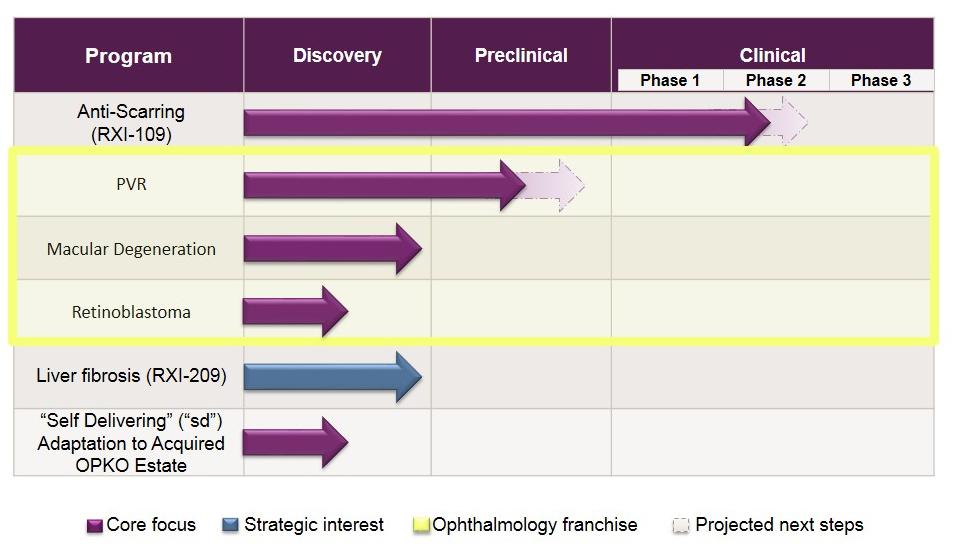
source: www.rxipharma.com/pipeline /
If you look at the image above you can see one macular degeneration compound underneath the PVR drug compound. This was Rxi's initial work of its own macular degeneration compound. Now if you look all the way to the bottom you can see "self delivering" adaptation to acquired Opko (OPK) Estate. The reason for Rxi acquiring this was because Dr. Geert Cauwenberg met with Dr. Frost CEO of Opko Health and formulated a deal . The macular degeneration drug acquired from Opko is known as Bevasirinib. Bevasirinib failed in the past in a phase 3 trial because the compound was and still is a naked siRNA molecule, meaning that the drug compound was not potent enough to be delivered locally into the eye to cause an efficacious effect. Frost knew that with this Bevasirinib RNAi patent and other RNAi patents there was nothing that could be done to deliver them to the patients properly. After Dr. Frost sat down with the CEO and noticed how Rxi had developed the sd-rxRNA delivery platform and could deliver any type of RNAi molecule without a delivery vehicle, he felt compelled to create a deal with Rxi. For this same reason, Rxi is taking the Bevasirinib molecule and rearranging the guide strand and passenger strand to enable it into its own sd-rxRNA technology platform. The trick here is that by utilizing Rxi's delivery platform it will allow the Bevasirinib compound to reach potency in the patient's eye instantaneously and help patients with the macular degeneration disease.
Bevasirinib is a VEGF inhibitor, which has been a genetic target for eye diseases for a long time. This is because when VEGF is over-expressed in a patient's eye, it causes vascular disease which leads to macular degeneration. Rxi can utilize Bevasirinib as a VEGF inhibitor, but it can also have a future advantage over other competitors because it can add one additional compound to the mix. The VEGF inhibitor can deal with the over expression of vascularization, but doesn't do anything for the damaging of tissue itself. This is where Rxi can combine RXI-109 -- anti scarring/tissue repair -- with the VEGF inhibitor and formulate it as one stand-alone compound, doubling positive effects.
How powerful can Rxi's Bevasirinib compound become? Well, if it proves clinical efficacy in later stage trials, it will revolutionize treatments for eye diseases. To get the proper support for bringing this program and other ophthalmologic programs forward Rxi had recently hired Peter Campochiaro M.D. to the Scientific Advisory board just this week. If we look more into the new hire, we can view this as a major positive because Peter serves on multiple scientific advisory boards for other pharmaceutical companies. Also, this M.D. has extensive experience with VEGF compounds at the John Hopkins Wilmer Eye institute. Matter in fact, he has more than 300 articles published in peer-reviewed medical journals, and was one of the scientists on early work with other VEGF compounds. As the Chief Development officer for Rxi Pamela Pavco states :
"We are honored to have Dr. Campochiaro join our Scientific Advisory Board. He Brings a Wealth of clinical research experience in ophthalmology to the Company that we will leverage to advance our ophthalmology program"
It is a huge positive that such a well known name in the science industry is interested in joining a small-cap biotech stock with big potential for the VEGF inhibitor.
Catalysts for Macular Degeneration
- Perform additional ocular toxicity studies with both VEGF together with RXI-109
- Faster pre-clinical results can be produced possibly by at least 2015 because RXI-109 ocular toxicity study is done. Also Bevasirinib has already been through clinical studies up to phase 3 before so limited testing will be needed to file an IND
- Eventual IND filing of Bevasirnib and other macular degeneration compounds can lead to another milestone payment from LPC
Retinoblastoma
Retinoblastoma is eye cancer that occurs in children under the age of 15. One thing to note about Retinoblastoma is that it is a rare disease which hardly has any treatment options. For instance current treatment of the retina includes chemotherapy and radiation treatment, both of which are unpleasant for patients of many types of cancer, especially for children under the age of 15. If the tumor is small it can be treated with chemotherapy, but complications can arise. Such complications include blindness and the necessity to remove the eye if current treatment fails. This is another part of the ophthalmology pipeline, so another milestone payment will be triggered upon the successful filing of this IND as well. We should note though that this disease will treat an unmet medical need in children so significantly that Rxi has received an NIH/NCI SBIR Grant for its Retinoblastoma compound. The funding from National Institute of Health (NIH) comes into play because the NIH is addressing to fund companies to lessen the burden of cancer with safer forms of treatment. Once again Rxi can also apply to the FDA for Orphan drug status for this compound as well.
Retinoblastoma occurs because of a gene known as the RB1 gene that is overexpressed in the patient's retina. Initial testing to date has shown dose dependent silencing of mRNA in Retinoblastoma cell lines just 48 hours post administration of the compound. Rxi used a gene known as Murine Double Minute Gene 2 (MDM2) because it acts as a negative regulator of the p53 pathway, which is responsible for cell proliferation -- cell growth and cell division. The goal for Rxi is to down regulate this gene using mRNA, thereby suppressing the tumor indefinitely. The company has seen remarkable results in the RB176 and RB177 cell lines, as sd-rxRNA platform was able to show mRNA reduction of Retinoblastoma cell lines even 14 days after a single intravitreal injection into a mouse. The Retinoblastoma compound is the company's first target against cancer, so there is also a huge precedence if the sd-rxRNA platform proves to reduce cancerous tumors.
Catalysts for Retinoblastoma
- Pre-clinical results for cell proliferation in vitro in 2014/2015
- Pre-clinical results of MDM2 gene utilizing sd-rxRNA platform in human Retinoblastoma cells in a xenograft model 2015
- Another milestone payment when an IND is filed possibly sometime in 2015
Opko Estate RNAi Patents And Beyond
Besides Bevasirinib, the deal with Opko allowed Rxi to expand upon its patent portfolio even more. Eventually Rxi can apply its sd-rxRNA technology to ICAM-1, Angiopoietin-2 and, most importantly, HIF-1a, which is expressed in a lot of cancerous tumors. Rxi is continuing to build itself into a strong biotechnology company, because it knows the potential value of all these compounds that it is working on. Matter in fact, just last week Rxi announced that it will be moving into an even bigger office location necessary for expansion. That should be another hint that RXI-109 is doing well with RXI-109 sales in Europe as a "Specials provision " and that the phase 2 double-blinded data looks encouraging in the pictures as mentioned above.
If all this data wasn't enough to impress, well, let's just say that there have been no insider sales recently and the CEO of Rxi continues to purchase RXII shares continuously on the open market. The CEO has been buying since August 22, 2013 all the way up until July 2, 2014. The CEO currently holds about 28,600 shares of Rxi Pharmaceuticals according to the SEC-Form 4 filing . We think it is bullish that the CEO continues to buy Rxi shares on the open market and has not sold a single share to date.
Financials To Last For Awhile
A lot of investors are typically worried about dilution with small-cap biotechnology stocks. The good news is that Rxi Pharmaceuticals doesn't have to worry about dilution for a very long time. As mentioned above, the Lincoln Park Capital deal will help Rxi to fund its Ophthalmology pipeline. Even with the anti-scarring RXI-109 compound thrown into the mix, the company has enough cash to run until Q2 of 2017. It was great that Rxi established the LPC deal, because without that deal the cash runway would have only lasted until Q2 of 2015. Now the company is set to operate freely with no cash or worries until 2017.
Partnering Opportunities
Although upon successful phase 2 hypertrophic scar results, the company will be able to partner out the other compounds in the pipeline, like its liver fibrosis compound, which is becoming a huge buzz in the biotechnology industry. A compound that is able to heal liver fibrosis could generate potential billions of dollars and Rxi would have no trouble partnering out the compound upon confirmation of its sd-rxRNA technology platform. Some pharmaceutical companies may even want to utilize Rxi's sd-rxRNA technology, so they can deliver their own RNAi oligonulceotides with no delivery vehicles required. The possibilities of this platform could be endless and this company could generate a lot of buzz on Wall Street in the coming months.
Conclusion
Rxi Pharmaceuticals has seen a 52-week high at $6.84 per share, and has since declined to its current share price of $2.68 per share. It is slightly above its 52-week low of $2.55 per share, so it is a good opportunity for investors to get in around this area and potentially profit off of the nearing phase 2 hypertrophic scar result catalyst. Although, investors should be aware of the risk that the data is still double-blinded and there is no guarantee of success. Investors should invest on the notion that a trial failure can result in a complete loss of their money and on their risk tolerance level. We believe that Rxi Pharmaceuticals has done something that has never been done before in RNAi space, and that is to create a self delivering RNAi compound without the use of a delivery vehicle. We feel that investors should do their due diligence and consider some type of position in Rxi before the catalyst comes that will change the future of the company forever.


Comments
Log in or sign up to join the conversation.