

We are going through exceptionally risky and uncertain times in the market. In this environment, it is more important than ever to strike the right balance between managing overall portfolio risk and capitalizing on opportunities to buy high-quality businesses trading at attractive valuations.
Square (SQ) has a lot of exposure to small businesses in general and restaurants in particular. The impact of the recession will be material, no doubt about that, and it is hard to tell what will happen to the stock price over the days and weeks ahead.
However, when looking at the big picture over the middle and long term, there is a considerable chance that Square stock will deliver compelling returns over the next 12 months. Even better, in a 3-year time horizon, the probabilities are that Square stock will look like a huge bargain at current prices.
Risk Management Comes First
The recession produced by the coronavirus pandemic will probably be deep and broad-based. If we do things right, maybe the duration of the recession will be relatively short, but it is still too early to quantify the overall economic impact.
Things could easily keep getting worse before they get any better, and it is important to understand the overall risk management framework before getting into the specific details of Square as a position.
Personally, I was holding 50% of my portfolio in cash because there was too much complacency in the market back in February before the crash started. As prices declined steeply I increased my exposure to 70%, and then I reduced positions again during the market rebound.
As of the time of this writing, I am holding 55% in stocks and 45% in cash, so I have abundant dry powder to continue buying stocks at lower levels if the market makes another leg lower. In addition to a large cash balance, I will consider some hedging positions via futures and ETFs if the market conditions merit some additional protection measures.
The main reason why I am making these disclosures is that the overall risk management framework is of utmost importance in a bear market. It is one thing to say that you bought Square and you still have 45% of your portfolio in cash versus being 100% invested and with no additional cash to invest.
Square is an outstanding business with enormous potential for growth, but the company is going to feel the pain from the recession, so buying Square right now means that you will be exposed to significant risk and volatility in the near term. Keeping your overall portfolio risk under control makes a big difference in terms of being able to tolerate this uncertainty in exchange for superior upside potential.
A Compelling Business Model
Payment processing is a remarkably profitable business that is dominated by a few large players on a global scale. But Square identified an underserved niche in small businesses and micro-merchants, and the company became a leader in this segment.
Even better, Square has consistently expanded its relationships with clients with new offerings in areas such as financial services and credit, marketing, inventory, and payroll management.
Square sells its hardware at low prices, and this is mostly a customer acquisition tool. Once the customer is on board, Square can broaden its presence into all kinds of services and software applications. These businesses are quite sticky, meaning that it is notoriously difficult, expensive, and risky for a client to leave Square and switch to another provider.
Since Square is focused on traditionally underserved clients, each new service offering makes the ecosystem increasingly attractive for those clients, creating a powerful flywheel that attracts even more clients and creates more cross-selling opportunities over the long term.
Not only that, but Square capitalizes on its data to make better business decisions. Having access to sales and payroll data from its customers, the company can make credit decisions in a much faster and more effective way than the competition.
Square is following the same playbook with its digital wallet Cash App, as the company keeps adding new functionalities such as the possibility to invest in fractional shares of stocks and even buying Bitcoin. Square reported 24 million Cash App monthly active customers as of December 2019, is up from 15 million in December of 2018, so this business is clearly growing at full speed.
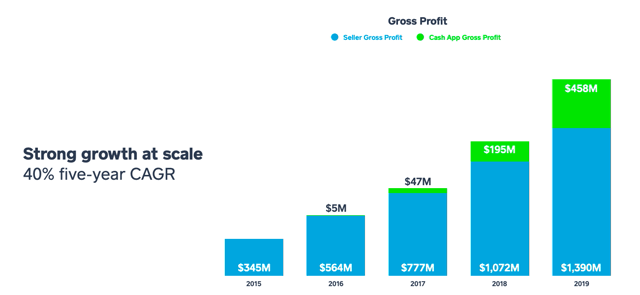
Management is executing well, and Square is both consistently gaining new customers and making more revenue per customer, which is driving sustained growth in gross profit over time.
Source: Square
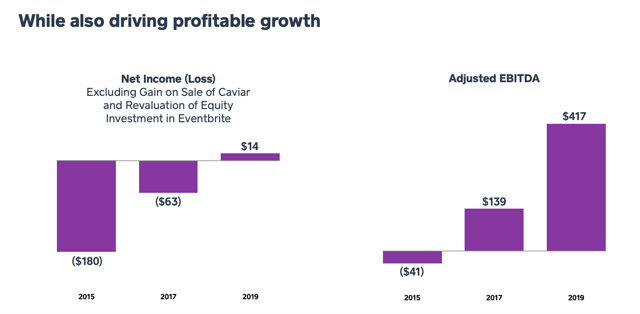
Square is aggressively investing for sustained growth, which obviously hurts profitability in the short term. However, the main profitability metrics have been moving in the right direction in the past several years.
Source: Square
The company's financial performance will clearly take a hit in the short term. At this stage, it is practically impossible to tell how large the hit will be and for how long the slowdown will last. However, it is important to acknowledge that the business model allows for attractive profitability at the core business level.
In areas such as payment processing and software, most of the costs are relatively fixed in comparison to revenue. Once the software has been developed and the technological infrastructure is in place, every new customer has almost zero marginal costs, so profit margins tend to increase over time.
Marketing and R&D expenses are a different consideration, and Square is making big investments in these areas. But the key point is that these investments are planting the seeds for sustained growth in the future.
The payback period measures the effectiveness of sales and marketing spend, and it's calculated as the number of quarters for a seller cohort’s cumulative gross profit to surpass the sales and marketing expense in the quarter in which the cohort was acquired.
Square's payback period is generally less than four quarters, which indicates that management is doing the right thing by aggressively investing for sustained growth, and those investments are being rapidly recovered by the company with the profits produced by the new customers.
Management estimates that the total addressable market could be worth as much as $100 billion in sellers and $60 billion in individuals. Besides, Square is barely scratching the surface in terms of international expansion, and this could open the door to outstanding opportunities in the future.
If management keeps playing its cards well, Square should benefit from gargantuan opportunities for growth over the middle and long term.
On Risk, Opportunity, And Timeframes
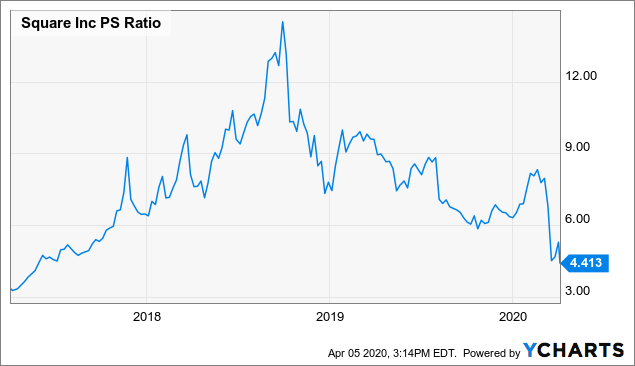
Square stock has declined by nearly 50% from its highs of the year, and the price to sales ratio is looking quite attractive by historical standards. Nevertheless, and depending on how long the recession lasts, it is not impossible to envision a scenario in which the stock continues going lower.
Data by YCharts
The company has already cut guidance for the coming quarter and it withdrew guidance for the year. It is interesting to note that the stock reacted positively after these announcements, indicating that the impact anticipated by management is not as bad as the market was fearing. But we still need to acknowledge that it is hard to know what kind of performance Square can produce over the coming months.
The stock market hates uncertainty, and there is plenty of uncertainty surrounding a company that serves mostly small businesses and micro-merchants in this economic environment. The main question for investors, however, is to what degree this uncertainty is a permanent factor versus a transitory reason for concern.
There will be some permanent damage, for example, some small businesses will not be able to survive the crisis. However, it is fair to say that most of the economic impact will be transitory by nature. This too shall pass, and the U.S. economy is going to recover from the recession caused by the COVID-19 pandemic.
Even if there are new waves of contagion in the future, we will be far better prepared in terms of reacting rapidly and taking the necessary measures to slow down the spread. Drugs, treatments, and potentially vaccines could be a game-changer in this area, and the healthcare system will have more capabilities and resources to deal with the crisis.
Investing is always a game of probabilities as opposed to certainties, because the future can never know, only estimated. Importantly, risk should be actively managed, but avoiding all risks would mean that you are also missing on the massive opportunities for wealth creation that the stock market provides over the long term.
In the case of Square, there is a lot of uncertainty weighting on the stock in the short term, but the probabilities are that this uncertainty will generate an exceptional opportunity for long term investors in the company over the years ahead.



Comments
Log in or sign up to join the conversation.