

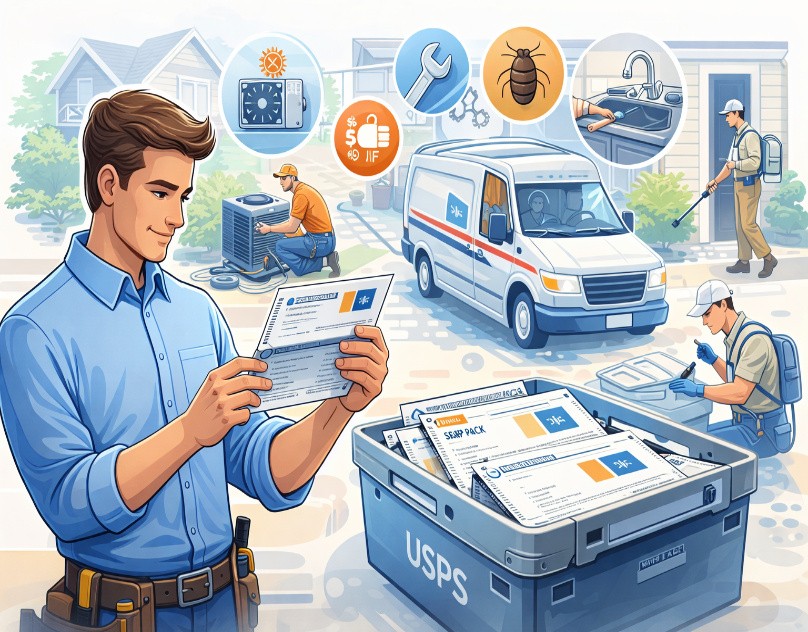
Your HVAC postcard lands on the kitchen counter next to a pizza coupon and a credit card offer. Three seconds later, all three hit the recycling bin. Sound familiar? Across the United States, home services companies spend billions on direct mail every year, yet most pieces never get a second glance. The format is the problem, not the channel.
That is exactly why roofing contractors, plumbers, pest control operators, and HVAC companies are switching to snap pack direct mail USA. These sealed, perforated mailers look like official documents from a utility company or government agency. Recipients tear them open out of instinct. Snap Packs and Letters reports a 96% open rate across their campaigns, a number that makes postcards and standard envelopes look like expensive wallpaper.
The Data & Marketing Association found that direct mail achieves a 9% response rate for house lists, far outpacing email at under 1%. When you pair that channel strength with a format built to get opened, you have a lead generation tool that fills seasonal pipelines in days, not months.
This article breaks down seven reasons home services companies are making the switch, plus how to get started without overhauling your entire marketing budget.
Key Takeaways
Snap pack mailers mimic official documents, which triggers near-automatic opening by recipients
Variable data printing lets you personalize each piece with the homeowner's name, address, and service history
A 2-3 day turnaround means you can launch campaigns fast enough to match seasonal demand spikes
Home services verticals like HVAC, roofing, plumbing, and pest control see strong ROI because the format carries authority
Combining snap packs with geographic targeting puts your offer in front of homeowners who actually need the service
What Makes Snap Pack Mailers Different From Regular Direct Mail?
Snap pack mailers stand apart because they are sealed, perforated documents that recipients must tear open, creating a physical interaction that postcards and envelopes never achieve.
A standard postcard sits face-up in the mailbox. The homeowner sees the headline, makes a split-second judgment, and either keeps it or tosses it. An envelope requires the extra step of opening, but most people recognize promotional mail by the bulk-rate stamp and generic window design. They skip it.
Snap packs change that equation entirely. The sealed format with perforated edges looks like a notice from a bank, insurance carrier, or municipal office. There is no visible promotional headline on the outside. The recipient has to tear it open to find out what is inside. That curiosity-driven interaction is why the open rate sits at 96%, a figure that Snap Packs and Letters has documented across thousands of campaigns spanning mortgage, insurance, solar, and home services verticals.
For home services companies, this matters because your competition is heavy. A homeowner in Phoenix might receive five HVAC postcards in a single week during June. A snap pack cuts through that noise by arriving in a format none of your competitors are using.
7 Reasons Home Services Companies Are Switching to Snap Packs
Here are the specific advantages driving the shift across HVAC, roofing, plumbing, and pest control businesses nationwide.
1. The Official-Document Look Gets Opened
This is the single biggest advantage. A snap pack mailer does not announce itself as advertising. The sealed edges and perforated tear strips signal importance. Homeowners open it before they even realize it is a marketing piece. By that point, your offer is in their hands and your message has been read.
Compare that to a glossy postcard with a stock photo of a smiling technician. The homeowner knows it is an ad before they finish pulling it from the mailbox. Recognition kills curiosity, and curiosity is what drives response.
2. Variable Data Printing Personalizes Every Piece
Generic "Dear Homeowner" mailers feel lazy. Variable data printing changes that by letting you customize each snap pack with the recipient's name, street address, neighborhood, and even equipment age if you have the data.
A furnace maintenance offer that reads "Your 12-year-old Carrier unit at 4821 Maple Drive is due for a tune-up" hits differently than "Schedule your annual HVAC checkup today." The United States Postal Service found that personalized mail generates a 135% increase in response rate compared to non-personalized pieces, according to their 2023 direct mail study.
3. Two-to-Three Day Turnaround Fills Seasonal Pipelines
Home services run on seasonal cycles. HVAC companies need leads before the first heat wave. Roofers chase hail damage windows that last two weeks. Pest control spikes when termite swarms hit in spring.
Traditional direct mail campaigns take weeks to design, print, and drop. Snap pack specialists like Snap Packs and Letters offer a 2-3 day turnaround from design approval to mailbox delivery. That speed lets you react to weather events, seasonal shifts, and competitive gaps instead of planning months ahead and hoping your timing works out.
4. USPS Compliance Is Built In
Mailing regulations trip up a lot of home services companies that try to handle direct mail in-house. Snap pack production requires specific paper weights, fold patterns, and addressing standards to qualify for automation postal rates. Getting any of those wrong means higher postage costs or outright rejection at the post office.
Full-service snap pack providers handle USPS compliance from the start. They format your mailing list, verify addresses through CASS certification, apply the correct barcodes, and sort by carrier route. You get the lowest possible postage rate without touching a single regulation document.
5. Measurable ROI Through Tracking
Every snap pack direct mail USA campaign can include unique phone numbers, QR codes, or personalized URLs (PURLs) that tie responses directly back to the mailing. You know exactly how many calls, website visits, and booked appointments came from each drop.
That tracking turns direct mail from a "spray and pray" expense into a measurable channel with a clear cost per lead. The Association of National Advertisers reports that direct mail delivers a median ROI of 112%, making it one of the most accountable offline marketing channels available.
6. Geographic Targeting Reaches the Right Neighborhoods
Not every neighborhood needs your services equally. Snap pack campaigns let you target by ZIP code, carrier route, or even individual addresses using Every Door Direct Mail (EDDM) or curated mailing lists.
A roofing company can target homes built before 2005 in a specific subdivision where shingle warranties are expiring. A pest control company can saturate neighborhoods adjacent to recent termite treatment jobs. A plumber can mail every home within a two-mile radius of a recent water main break. That precision means your budget goes to homeowners most likely to need your services right now.
7. Cost-Effective at Scale
Snap pack mailers cost more per piece than a standard postcard, but the math shifts when you factor in open rates and response rates. A postcard with a 2% open rate and 0.5% response rate costs you more per acquired customer than a snap pack with a 96% open rate and a significantly higher response rate.
Here is a simplified example. If you mail 5,000 postcards at $0.45 each ($2,250 total) and get 25 responses, your cost per response is $90. Mail 5,000 snap packs at $0.65 each ($3,250 total) and get 75 responses, your cost per response drops to $43. The higher per-piece cost pays for itself through volume of responses.
How Do You Launch a Snap Pack Campaign for Your Home Services Business?
Launching a snap pack campaign takes four steps, and the right provider handles most of the heavy lifting for you.
Step 1: Define your offer and audience. Pick a specific service (AC tune-up, roof inspection, drain cleaning) and the geographic area you want to target. The more specific your offer, the higher your response rate.
Step 2: Build or buy your mailing list. Use your existing customer database for retention campaigns or purchase a targeted list filtered by home age, home value, ZIP code, or homeowner status. CASS-certified lists ensure deliverability.
Step 3: Design the snap pack. Your provider creates the layout with your branding, offer, call to action, and any variable data fields. The sealed format gives you four panels of content, which is more space than a postcard but without the envelope barrier.
Step 4: Print, mail, and track. With a full-service snap pack provider, production and mailing happen within 2-3 business days. Unique tracking numbers or QR codes let you measure results from day one.
That entire process, from design approval to mailbox delivery, can happen in under a week. For home services companies chasing seasonal windows, that speed is the difference between catching the demand wave and missing it entirely.
Conclusion
Home services companies across the United States are discovering what mortgage lenders and insurance carriers figured out years ago: snap pack direct mail gets opened, gets read, and gets responses. The official-document look bypasses the mental filter that kills most advertising mail. Variable data printing makes each piece feel personal. And a 2-3 day turnaround means your pipeline stays full even when seasonal demand shifts overnight.
Whether you run an HVAC company prepping for summer, a roofing crew chasing storm damage leads, or a plumbing business targeting aging homes, snap packs give you a format that earns attention instead of begging for it.
The channel works. The format works. The only question is whether you will use it before your competitors do. Ready to Fill Your Home Services Pipeline? Snap Packs and Letters has helped businesses generate high-response direct mail campaigns for over 25 years. Get your campaign started in days, not weeks. Contact Snap Packs and Letters today!
FAQs
Q1: What is snap pack direct mail?
A snap pack mailer is a sealed, perforated direct mail piece that looks like an official document. Recipients tear open the perforated edges to read the message inside. The format achieves open rates as high as 96% because it mimics notices from banks, utilities, and government agencies. Home services companies use snap packs to promote seasonal offers, maintenance reminders, and special pricing.
Q2: How much does a snap pack mailer cost compared to a postcard?
Snap pack mailers typically cost $0.55 to $0.75 per piece, while postcards run $0.35 to $0.50. However, snap packs deliver significantly higher open and response rates, which lowers the cost per acquired customer. Most home services companies find that the higher per-piece cost pays for itself through more booked appointments per campaign.
Q3: Can I personalize each snap pack with homeowner data?
Yes. Variable data printing lets you customize every snap pack with the recipient's name, address, property details, and even service history. Personalized direct mail generates up to 135% higher response rates than generic pieces. Full-service providers handle the data merge, printing, and USPS compliance so you do not need to manage any of it yourself.
Q4: How fast can I get a snap pack campaign in the mail?
Leading snap pack providers offer a 2-3 day turnaround from design approval to mail drop. That speed is critical for home services companies that need to react to seasonal demand, weather events, or competitive gaps. Traditional direct mail campaigns can take two to four weeks, which often means missing the window entirely.
Q5: Which home services industries benefit most from snap packs?
HVAC, roofing, plumbing, pest control, and landscaping companies see the strongest results. Any service with seasonal demand cycles and geographic targeting benefits from the high open rate and fast turnaround that snap pack mailers provide. The format works especially well for time-sensitive offers like pre-season tune-ups, storm damage inspections, and limited-time discounts.
#SnapPackMailers #HVACMarketing #DirectMailForHomeServices #HomeServicesMarketing #DirectMailLeads
Comments
Log in or sign up to join the conversation.