

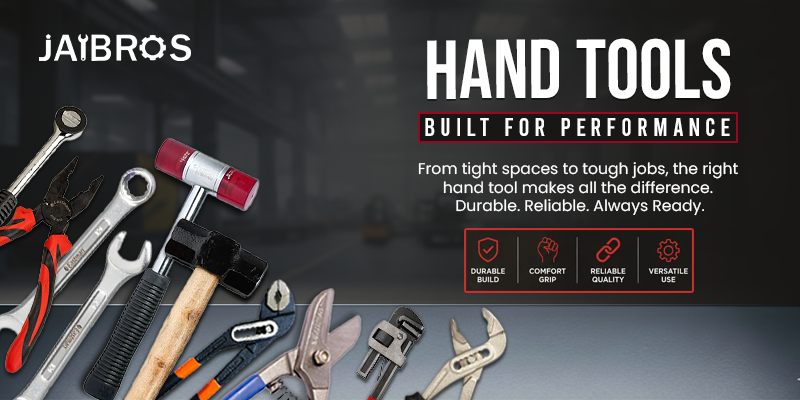
No matter which field one talks about – be it manufacturing, construction, automotive, maintenance, woodworking, or electrical work, all these require reliable tools to accomplish day-to-day operations efficiently. No matter what other equipment people use in their field of work, hand tools continue to provide the core of quality craftsmanship as they allow achieving accurate, controllable, and convenient results where machines cannot provide the necessary result. With a well-structured set of hand tools, a technician can conduct all repairs, installation, inspection, or adjustments with confidence. Despite the development of automation, people still prefer to utilize manual tools for numerous purposes. Companies looking for hand tools online should consider durability, ergonomics, and application of products rather than choosing tools by their price only.
The Importance of Manual Tools Across Different Industries
However sophisticated technology gets, manual equipment will always have a place in industry. There are certain tasks related to maintenance, calibration, repairs, and installation that can only be carried out through manual intervention which is beyond the reach of automation.
One needs quality tools due to their versatility in diverse conditions. Their design makes them suitable for use not only in industrial factories but also workshops.
Key reasons they remain important include:
Provide better precision for delicate repair work.
Help complete emergency maintenance quickly.
Require minimal setup before use.
Suitable for confined or difficult-to-access spaces.
Lower maintenance requirements compared to powered equipment.
Improve technician control during complex operations.
For industries where accuracy matters, dependable manual equipment often complements powered machinery instead of replacing it.
Supporting Productivity and Workplace Efficiency
Workplaces need to be provided with equipment that will cut down on unnecessary delays. A worker who uses the appropriate hand tool set can accomplish his or her maintenance tasks a lot quicker than someone looking for individual items during the process.
Organization will also help in maintaining workplace safety as the location of the equipment that is needed at all times is known to everyone. This ensures no confusion among employees in critical periods of maintenance.
The cost of hand tools comparison needs to take into account the fact that better quality products cost less when it comes to replacing them later on. Even though some of the best products might seem to be costly at first, their high durability makes them actually cheaper in the long run.
While making the hand tool search online, customers need to pay attention to certain aspects rather than the pictures of the products only.
Why Quality Matters More Than Cost
The performance of a tool directly affects work quality. Poorly manufactured products may wear out quickly, lose accuracy, or even create safety risks for operators.
Choosing premium hand tools offers several long-term benefits:
Better durability under heavy workloads.
Comfortable grip that reduces operator fatigue.
Improved precision for detailed work.
Stronger materials resistant to corrosion.
Lower maintenance and replacement frequency.
Consistent performance across different applications.
Many production facilities also use a CNC tool for automated machining while depending on manual equipment for setup, inspection, finishing, calibration, and maintenance. This combination ensures both efficiency and precision throughout manufacturing operations.
Rather than selecting products based solely on hand tools price, businesses should consider lifetime value, expected workload, and application requirements before making purchasing decisions.
Choosing the Right Tools for Professional Applications
Each sector has distinct requirements in terms of operation, which is why it is crucial to select the appropriate tool. Construction requires tough machinery, electricians look for insulation, automobile mechanics require repair tools, and manufacturers concentrate on precision and efficiency.
Before purchasing equipment, professionals should evaluate several important factors.
Consider these points:
Material quality and hardness.
Ergonomic handle design.
Intended industrial application.
Safety certifications.
Ease of maintenance.
Storage compatibility.
Brand reputation and after-sales support.
Selecting the correct equipment improves productivity while reducing operator fatigue and workplace accidents.
In modern manufacturing facilities, a CNC tool performs automated cutting operations, while industrial hand tools remain indispensable for machine servicing, equipment adjustments, quality inspections, assembly tasks, and preventive maintenance. Together they create a balanced workflow where automation and manual expertise complement each other.
The Future of Professional Work Still Depends on Reliable Tools
There is continued technological change in different industries using robotics, automation, artificial intelligence and smart manufacturing systems. Nevertheless, experienced people know for sure that the hands-on skill cannot be fully automated.
In terms of equipment maintenance, emergency repairs, installation, inspection and calibration, there is continued usage of hand tools in order to help in performing daily functions. Hand tools have many advantages despite all kinds of technological development since they are simple, portable and reliable.
The provision of durable equipment, training of employees and maintenance will provide safer working environment while increasing efficiency. With time, the significance of the use of dependable tools will not change as professional workers depend on effective solutions in order to get the desired results.
Conclusion
In any productive sector, there needs to be efficiency and accuracy, and that is precisely why hand tools remain critical in day-to-day operations. Whether when being utilized together with other sophisticated machines or when performing maintenance tasks, quality manual tools aid workers in doing their jobs effectively. Rather than concentrating on buying prices alone, companies should look into the durability and effectiveness of tools. Companies such as Jaibros have made sure that industries have access to products that will make professional jobs easy without compromising on quality.
FAQs
1. Why are hand tools important in every industry?
They provide precision, flexibility, and reliability for repair, maintenance, installation, and inspection tasks where machines alone may not be sufficient.
2. What should I consider before buying professional tools?
Look for build quality, material strength, ergonomic design, durability, warranty, and suitability for your specific application.
3. Are expensive tools always better?
Not necessarily, but higher-quality tools generally last longer, offer better safety, and reduce replacement costs over time.
4. Can manual tools and CNC machines work together?
Yes. CNC machines handle automated production, while manual tools are widely used for machine setup, maintenance, inspection, calibration, and finishing tasks.
5. How can I maintain tools for longer service life?
Clean them after use, store them in a dry environment, lubricate moving parts when required, inspect them regularly for wear, and replace damaged tools promptly.
Comments
Log in or sign up to join the conversation.