

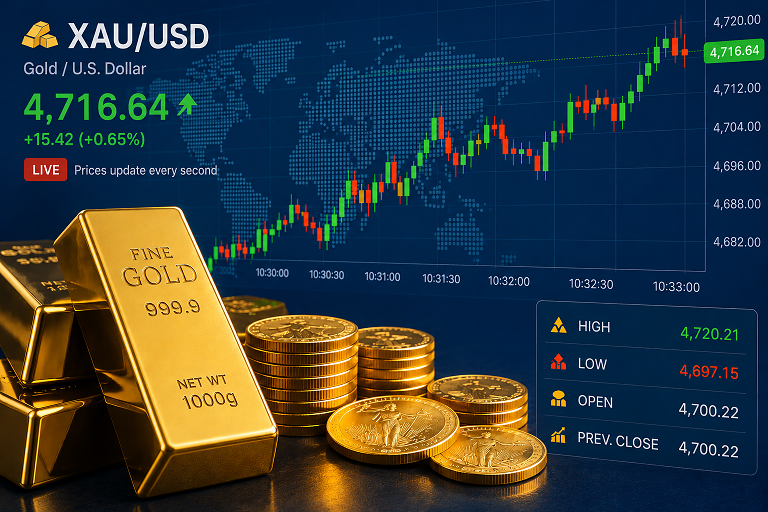
Gold entered 2026 having already rewritten its own record books. The metal crossed $3,000 per ounce in early 2024 — a level that had served as a psychological eiling in analyst forecasts for years — and then kept going. By the time most market participants had adjusted their models, XAU/USD was trading comfortably above $3,200 with institutional desks revising targets upward for the third consecutive year.
The question for 2026 is not whether gold is in a structural bull market. That debate is settled. The question is what kind of bull market this is — and whether the volatility that has characterised recent price action will persist, intensify, or eventually resolve into a more stable uptrend.
My view is that gold will remain unusually volatile throughout 2026. Here is the analytical case for that position.
1. The Federal Reserve: The Primary Variable Driving Gold Uncertainty
No single factor moves gold more reliably than Federal Reserve interest rate policy — and no single factor is more uncertain in 2026 than what the Fed will actually do.
Gold pays no yield. It generates no dividend, no coupon, no interest. This means it competes directly with yield-bearing assets for investment capital. When the Fed raises rates, the opportunity cost of holding gold rises and capital rotates toward Treasuries and money market instruments. When the Fed cuts rates, that competition disappears and gold benefits from capital reallocation.
The problem in 2026 is that Fed policy has become genuinely difficult to predict even over a 90-day horizon. Inflation data has been inconsistent — showing progress in some months and stubborn persistence in others. Labour market data has been similarly mixed, giving the Fed grounds to justify either continued caution or accelerated easing depending on which data series they choose to emphasise in any given meeting.
This policy uncertainty is itself a driver of gold volatility. Each Fed meeting, each Fed speech, each CPI release now generates outsized moves in XAU/USD because the market is continuously repricing the probability distribution of future rate decisions rather than confirming an established trend.
Traders who have been following gold through multiple Fed cycles recognise this pattern. The price action around data releases has become less directional and more reactive — sharp moves in both directions, often partially reversed within the same session. This is what a market pricing genuine uncertainty looks like, and it does not resolve until the Fed itself achieves greater clarity on its own path.
2. The Dollar-Gold Relationship: A Correlation That Is Breaking Down
Gold and the US Dollar have historically moved inversely. The mechanical logic is straightforward: gold is priced in dollars globally, so a stronger dollar makes gold more expensive for international buyers, reducing demand and pushing the price down. This relationship held reasonably well through most of the past decade. It has been breaking down in 2025 and into 2026 — and that breakdown is itself a source of volatility.
In several notable episodes over the past eighteen months, gold has risen simultaneously with the Dollar Index — a combination that the standard model says should not happen. The most credible explanation is that institutional buying — specifically sovereign wealth funds and central banks — is large enough to override the mechanical price relationship that retail forex models are built on.
When institutional flows break historical correlations, models built on those correlations generate false signals. Algorithmic trading systems programmed to sell gold when DXY rises are being repeatedly stopped out by buyers who are not responding to dollar levels at all. The resulting price action — whipsaw moves, failed breakdowns, unexpected recoveries — is a mechanical consequence of a market where multiple independent buyers with different objectives are competing simultaneously.
Until the dollar-gold correlation stabilises in one direction or the other, this dynamic will continue generating volatility that has no clear fundamental explanation.
3. Geopolitical Risk: From Episodic to Structural
For most of the post-2008 period, geopolitical risk events followed a predictable pattern for gold. A new conflict or crisis would emerge, gold would spike $50 to $100 on safe haven demand, the immediate fear would pass, and gold would give back a significant portion of the move within weeks. The pattern has changed materially since 2022. The geopolitical risk premium embedded in gold prices has not been given back in the way previous cycles suggested it would be. This is because the risk environment has shifted from episodic to structural.
The Russia-Ukraine conflict moved from an acute crisis into a prolonged, unresolved conflict with no clear endpoint. Middle East tensions have escalated and broadened rather than contained. US-China strategic competition has intensified across technology, trade, and military domains. The global order that provided relative geopolitical stability for two decades is being renegotiated in real time — and gold is the primary beneficiary of that uncertainty.
What this means practically is that the safe-haven bid underneath gold is not fading between crises as it did in previous cycles. The floor keeps moving higher because the background level of geopolitical risk has itself moved higher. But this does not mean gold moves in a straight line. Temporary de-escalations, diplomatic developments, and risk-on sentiment shifts still generate significant pullbacks. The structural safe-haven bid limits how far those pullbacks go — but it does not eliminate the downside volatility when risk appetite recovers temporarily.
4. Central Bank Buying: The Structural Floor Most Analysts Underestimate
Central banks have been buying gold at record pace since 2022. The World Gold Council documented purchases exceeding 1,000 tonnes in both 2022 and 2023 — levels not seen since the 1960s. Preliminary 2024 data suggests the pace has not materially slowed.
The motivation is portfolio diversification away from US Dollar reserves — a deliberate strategic shift by China, India, Poland, Turkey and dozens of other nations who have concluded that holding excessive dollar reserves carries geopolitical risk in a world where dollar weaponisation through sanctions has become a demonstrated policy tool.
Central bank buying creates a structural demand floor that is largely insensitive to price. These institutions are not trading gold for profit maximisation on a quarterly basis. They are building reserve allocations over years. A $50 or $100 pullback in gold price does not change their buying programme — it may actually accelerate it. This structural floor is why the pullbacks that occur during risk-on periods and dollar strength episodes have been shallower than historical models predicted. The discretionary sellers are being offset by sovereign buyers who view corrections as purchase opportunities — not exit signals.
5. The Gold/Silver Ratio: An Overlooked Signal for 2026
One indicator that deserves more attention in any 2026 gold analysis is the Gold/Silver ratio — the number of ounces of silver required to purchase one ounce of gold. Historically this ratio has averaged between 50 and 60. As of writing it remains significantly above that historical average, suggesting silver is historically undervalued relative to gold.
When the Gold/Silver ratio sits at elevated levels for extended periods, one of two things typically happens: either gold corrects downward toward silver, or silver rallies sharply upward toward gold. The second scenario — silver outperformance during a ratio mean-reversion — has historically coincided with periods of continued gold strength rather than gold weakness.
For 2026, an elevated Gold/Silver ratio adds another layer of complexity to the volatility picture. A rotation trade from gold into silver — which institutional precious metals investors execute at ratio extremes — could generate temporary gold weakness even within a broader bull market structure. Monitoring this ratio alongside XAU/USD price action provides earlier warning of such rotations than price alone.
6. Price Outlook for 2026: Volatility With an Upward Bias
Combining the factors above generates a specific outlook for gold in 2026: significant volatility in both directions, but with an upward bias supported by structural central bank demand and a geopolitical risk premium that is unlikely to fully deflate. The realistic trading range for XAU/USD in 2026, based on the factors analysed, sits between approximately $3,500 and $4,000. The lower boundary is set by the structural central bank bid and the risk premium floor. The upper boundary is constrained by the interest rate environment — a sustained rally above $4,000 would require either a significant acceleration in Fed rate cuts or a major escalation in geopolitical risk beyond current levels.
The specific events that will generate the most significant volatility within that range are Federal Reserve meeting outcomes and forward guidance statements, US CPI inflation data releases, DXY breakouts in either direction, and any material escalation or de-escalation in active geopolitical conflicts.
Conclusion: What This Means for Gold Investors and Traders
Gold in 2026 is not a simple directional trade. It is a multi-factor story where interest rates, dollar dynamics, geopolitical risk, central bank demand, and the Gold/Silver ratio are all operating simultaneously — sometimes reinforcing each other, sometimes working against each other.
For long-term investors, the structural case for gold remains intact. Central bank accumulation, persistent geopolitical risk, and a global monetary system under transition all support sustained demand at levels that previous cycles did not have. For traders, the volatility environment demands careful position sizing, wider stops than historical volatility models suggest, and close attention to correlation breakdowns that can invalidate technically clean setups.
For anyone tracking XAU/USD through 2026, monitoring the interaction between these variables in real time is more valuable than any static price target. Live XAU/USD gold price charts with multiple timeframes and a Gold/Silver ratio tracker are available free at FloatForex.com/gold-charts — real-time gold and currency market data for traders and analysts.
Comments
Log in or sign up to join the conversation.