

Why a Break of Structure Is Not Always a Breakout
Gold frequently produces some of its most convincing-looking moves around obvious technical levels.
Price pushes above resistance, momentum increases, breakout orders trigger, and the move appears to confirm a new directional phase. Yet within a few candles, XAUUSD can return below the same level and trap traders who entered on the initial break.
The problem is not necessarily the level itself.
The problem is treating a price crossing as confirmation.
A breakout tells us that price has traded beyond a boundary. It does not tell us whether the market has accepted prices beyond that boundary.
That distinction is particularly important in Gold, where visible highs and lows often become concentrations of liquidity.
Why Obvious Highs and Lows Matter
A clear swing high can attract several types of orders at the same time.
Short sellers may place protective stops above it. Breakout traders may place buy orders above it. Algorithms may also respond once that level is breached.
This creates a pool of liquidity.
When Gold trades into that area, the movement through the level can therefore represent either genuine repricing or simply the process of accessing available orders.
The first candle cannot reliably tell us which one is occurring.
What happens next provides the more important evidence.
The Difference Between a Sweep and Acceptance
A liquidity sweep occurs when price trades beyond an obvious level but fails to establish itself there.
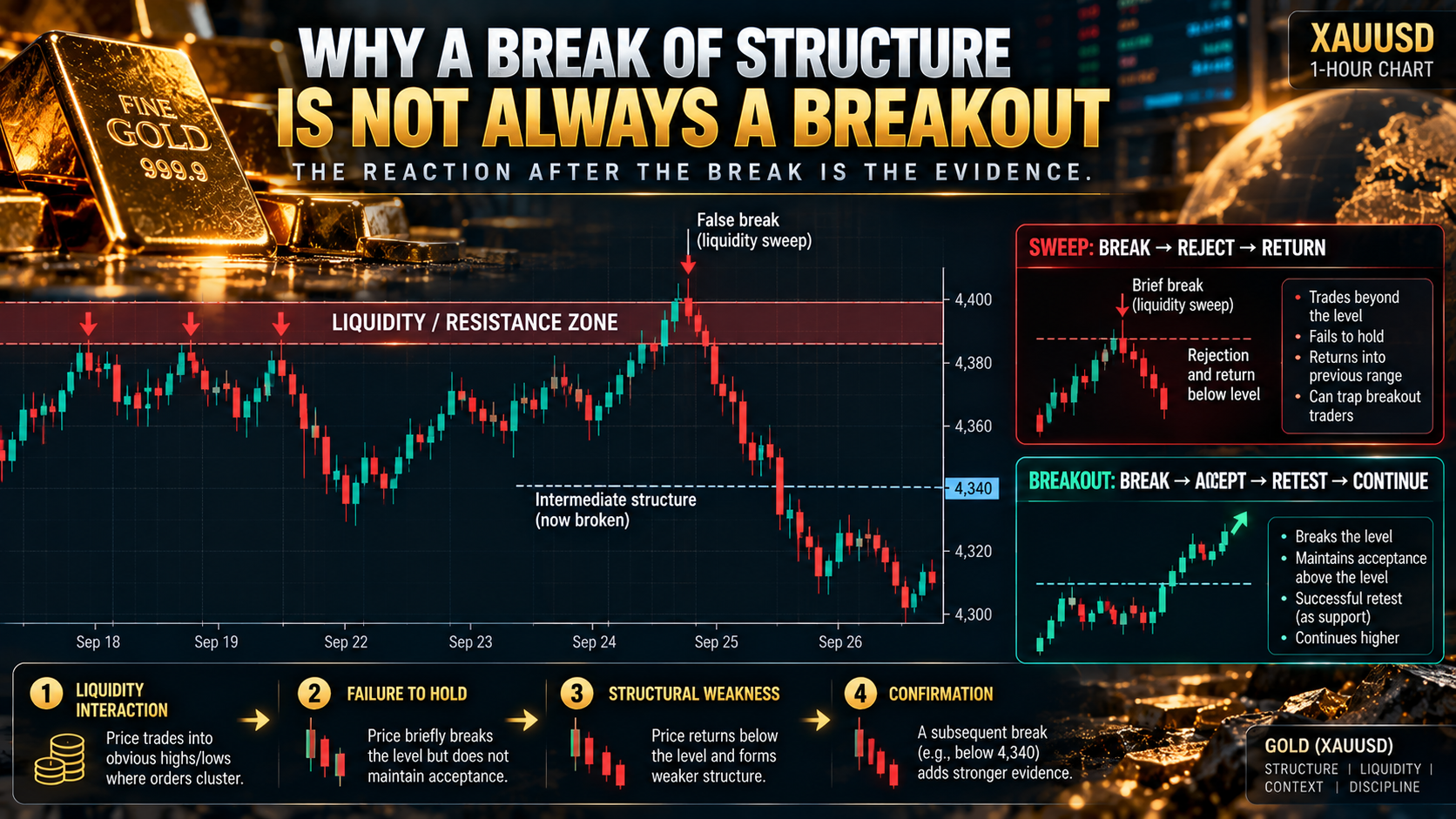
In the accompanying XAUUSD 1-hour chart, price repeatedly interacts with the upper liquidity and resistance area around the recent highs.
The important observation is not simply that price reached or briefly exceeded resistance. The more useful information comes from its inability to maintain acceptance above that region.
Price returns beneath the upper zone and later fails to sustain recovery through the intermediate structure.
That is where the breakout thesis begins to weaken.
A genuine breakout would normally require stronger evidence of acceptance.
That could include continued closes beyond resistance, successful retests of the former resistance as support, constructive higher lows, or additional displacement in the breakout direction.
Without those conditions, the trader may be looking at liquidity collection rather than sustainable expansion.
Failure to Hold Is Information
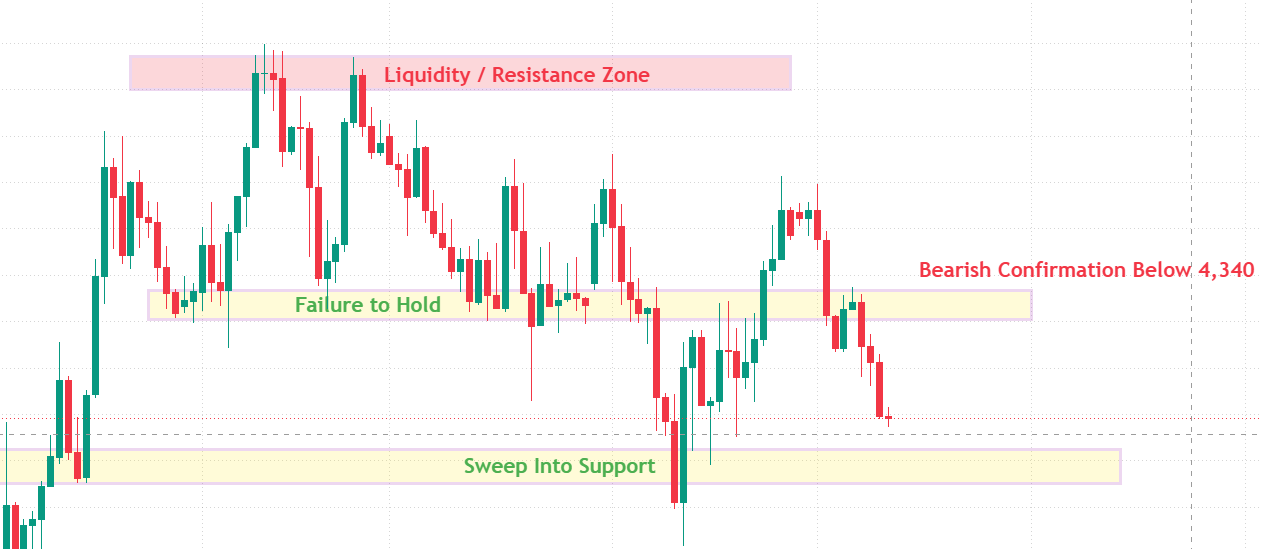
The phrase "failure to hold" is important.
Many traders focus heavily on the candle that breaks resistance while paying much less attention to the candles that follow.
But the reaction after the breakout may contain more useful information than the breakout itself.
If buyers are genuinely controlling the new price area, the market should eventually demonstrate that control.
If price repeatedly returns below the broken level, struggles to reclaim it, and begins forming weaker structure underneath it, the market is providing contradictory evidence.
This does not guarantee a reversal.
It simply means the initial breakout has not yet earned confirmation.
Confirmation Comes After the Event
The chart also illustrates why confirmation should be treated as a process rather than a single candle.
After the failure near the upper liquidity zone, price later loses the intermediate area around 4,340.
That break becomes more meaningful because it occurs after the market has already failed to maintain the higher region.
The sequence matters:
liquidity interaction → failure to hold → structural weakness → confirmation
This is stronger information than reacting to the original breakout in isolation.
The principle works in both directions.
A downside sweep beneath support is not automatically bullish either. Buyers still need to demonstrate that they can reclaim the level, hold above it, and produce enough structural improvement to support the reversal thesis.
Liquidity Sweeps Are Not Automatic Reversal Signals
Another mistake is assuming that every sweep must lead to a reversal.
A sweep only tells us that liquidity beyond a visible level has been accessed.
It does not tell us what the market must do next.
Sometimes price sweeps a high, briefly pulls back, and then continues higher.
Sometimes price sweeps a low and continues lower.
That is why the sweep itself should not become the trade signal.
The reaction to the sweep is what matters.
The trader should ask whether the market is rejecting the new territory, accepting it, or still producing mixed evidence.
Session Context Can Change the Meaning of the Move
Gold also behaves differently depending on when the breakout occurs.
London and New York typically bring deeper participation and stronger intraday liquidity than quieter periods.
A breakout occurring during low-participation conditions may therefore face a very different test when larger flows enter the market.
This does not mean that one session automatically produces valid moves while another produces false moves.
It means timing should be considered together with structure.
The same technical break can behave very differently depending on the liquidity environment surrounding it.
Higher-Timeframe Context Still Controls the Narrative
A lower-timeframe breakout should also be interpreted within the larger market structure.
An M5 or M15 breakout above a local high may look impressive while H1 price is still trading directly into major resistance.
Likewise, a short-term bearish break may occur while the larger structure remains constructive.
This is why lower timeframes are better used for timing and confirmation than for replacing higher-timeframe context.
The sequence should remain logical:
first identify the broader environment, then locate meaningful liquidity and structure, and finally use the lower timeframe to evaluate the reaction.
Why Waiting Can Be an Edge
The desire to predict the breakout before confirmation is understandable.
Earlier entries can offer attractive reward-to-risk characteristics.
But they also introduce greater uncertainty.
Waiting for acceptance or rejection sacrifices some entry precision in exchange for additional information.
That trade-off can be worthwhile.
A trader does not need to capture the exact turning point to participate in a well-structured move.
In many cases, avoiding the wrong breakout matters more than entering the right one at the earliest possible moment.
Risk Must Follow Structure
This framework also affects position sizing.
The trader should first determine where the thesis is invalidated.
Only after that invalidation point is defined should stop distance and position size be calculated.
Choosing a large position first and then forcing the stop closer to make the monetary risk acceptable reverses the proper sequence.
The market structure should determine where the idea is wrong.
Risk management should determine how much that wrong idea is allowed to cost.
The Practical Takeaway
When Gold approaches an obvious high or low, the key question is not:
"Did price break the level?"
The better questions are:
Did price remain beyond the level?
Did the market accept the new territory?
Did the retest hold?
Did structure continue in the breakout direction?
Or did price immediately return into the previous range?
A successful breakout tends to show expansion, acceptance and continuation.
A failed breakout tends to show liquidity access followed by rejection and structural weakness.
And sometimes neither outcome is sufficiently clear.
That third possibility matters.
There is no requirement to trade every breakout attempt.
For XAUUSD traders, patience around obvious liquidity can be more valuable than predicting the first move through the level.
The breakout is the event. The market's response to the breakout is the evidence.
Comments
Log in or sign up to join the conversation.