

What Is Execution Breakdown and Why It Happens in Growing Companies
The strategy session went well. Everyone agreed on the priorities, the owners, and the timeline. Three weeks later, half of what was decided has quietly not happened, not because anyone disagreed with it, but because it dissolved somewhere between the meeting room and the actual work. Nobody sabotaged it. Nobody forgot it entirely. It simply lost momentum in the gap between being decided and being done, the way most decisions in a growing company eventually do.
This is an execution breakdown, and it is one of the most misdiagnosed problems in founder-led businesses, because it looks like a talent problem, a discipline problem, or a focus problem, when it is almost always a structural one. Spotting it usually starts with a clear-eyed Founder Pressure Scan of where decisions are actually stalling, not another look at the strategy itself.
What I see most often in my work with founders is that they respond to execution breakdowns by pushing harder, sending more reminders, and holding people more visibly accountable, even when the actual cause is no upstream of any individual's effort. This tracks closely with why every decision drains founders faster than it should: a decision made once in a meeting has to survive contact with a business that has no reliable mechanism for carrying it through to completion, and in most growing companies, that mechanism was never built.
What Execution Breakdown Actually Is
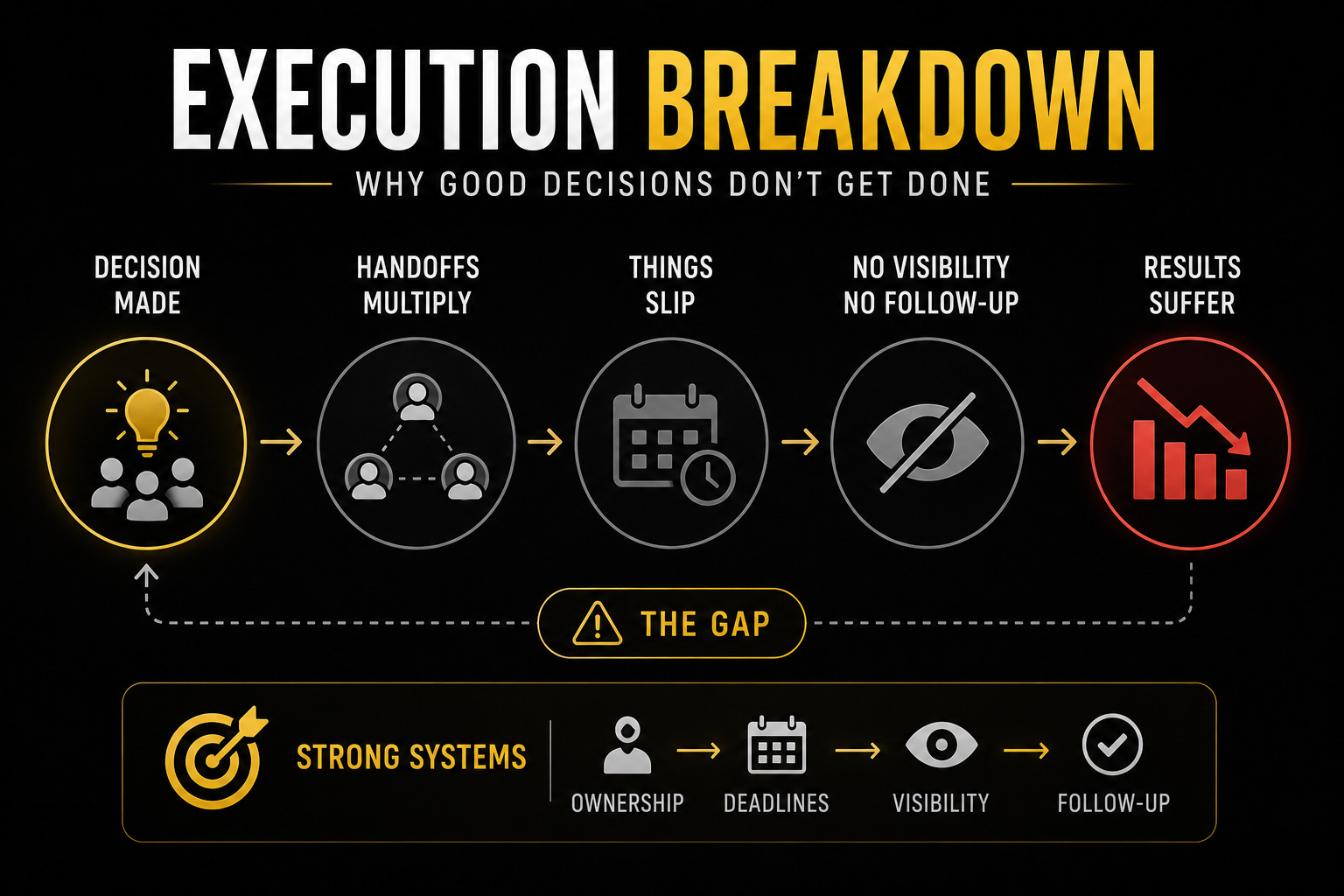
Execution breakdown is the gap between a decision being made and that decision being reliably carried through to completion. It is distinct from having a bad strategy. The strategy can be correct, the priorities clear, and the team capable, and the business can still fail to execute consistently, because the mechanism that should carry a decision from the meeting to the outcome has structural gaps.
A decision that is made but not executed was never really a decision. It was an intention that happened to be discussed out loud. Execution breakdown is the space where good intentions go to become nothing, quietly, without anyone intentionally deciding that outcome.
This distinction matters because founders often respond to execution breakdown by revisiting the strategy, assuming the plan itself was flawed. Frequently, the plan was sound. What failed was the invisible infrastructure between the decision and the delivery, ownership, follow-through, and a mechanism for catching things before they drift.
Why Execution Breakdown Happens Specifically in Growing Companies
Small companies rarely experience execution breakdown in a visible way because the distance between deciding something and doing it is short. The founder decides, and often the founder or someone sitting three feet away executes it directly. There is no room for a decision to get lost, because there is nowhere for it to go.
Growth adds that room. More people are involved in carrying a decision forward, more handoffs occur between the decision and the delivery, and more competing priorities exist to quietly displace something that was agreed to three weeks ago but never had a mechanism forcing it to stay visible. Execution breakdown is not a sign that a company is struggling. It is frequently a sign that a company has grown past the size where informal follow-through was ever a reliable system, without anyone building the formal one that should have replaced it.
How Execution Breakdown Builds as Companies Scale
In the early stage, follow-through happens naturally because the founder personally tracks everything and personally chases what starts to slip. This is not a system. It is proximity substituting for one, and it works precisely as long as the founder's personal attention can reach every open item in the business. Left unaddressed, this proximity is often the earliest form of what later hardens into a founder bottleneck the business can no longer route around.
That coverage erodes as the company scales, and it erodes in a pattern that closely tracks recognizing overload before it spreads through a growing leadership structure. Every new initiative competes with existing open items for the same limited tracking capacity. Every new hire adds someone whose follow-through depends on being personally reminded, because no other mechanism exists to hold them to it. Every decision made in a meeting without an explicit owner and deadline becomes a decision that depends entirely on someone remembering to revisit it, and memory is not a system.
By the time a founder notices a pattern of things quietly not happening, the underlying gap, the absence of a real execution mechanism, has usually existed for a long time, invisible because each individual instance looked like a one-off rather than a structural pattern.
The Cost of Execution Breakdown on the Founder
When there is no reliable mechanism carrying decisions through to completion, the founder becomes that mechanism by default. Every open item that starts to drift eventually surfaces back to the founder, because the founder is the only person whose attention has historically been reliable enough to catch it. This adds directly to the mental load titles never reveal, because tracking every open commitment across the business, quietly, in the background, is invisible labour that exists nowhere on any job description, including the founder's own.
This is also why founders often feel like they are the only ones who notice when something has stalled. It is rarely true that no one else noticed. It is usually true that no one else was structurally positioned or explicitly responsible for catching it before the founder did.
Why the Usual Fixes Don't Resolve Execution Breakdown
More Urgency Doesn't Build a Missing Mechanism
Pushing harder on a specific initiative can get that one thing done. It does not build a repeatable system that catches the next ten things before they drift, which means the same pattern reappears with the next decision, and the one after that.
Project Management Tools Track Tasks, Not Ownership
A tool can list what needs to happen. It cannot, on its own, ensure someone is genuinely accountable for the outcome rather than simply assigned to the task. Without real ownership behind it, a tracked task can sit untouched indefinitely, visible and still not moving.
Holding People More Accountable After the Fact Doesn't Prevent the Drift
Addressing execution failures after they've already happened can correct a specific instance. It does not build the upstream structure, clear ownership, or defined checkpoints that would have caught the drift before it became a missed deadline in the first place.
Execution does not improve because people are told to follow through better. It improves when the business has a structure that makes drift visible before it becomes a failure, regardless of how busy any individual gets.
What Actually Resolves Execution Breakdown
Closing the gap between decisions and delivery requires four structural components.
A named owner for every decision, not just a task: Every decision leaving a meeting needs a single accountable person attached to its outcome, distinct from whoever happens to be assigned the associated tasks.
A checkpoint cadence that catches drift early: Scheduled review points, set before a decision has time to quietly stall, surface slippage while it is still easy to correct rather than after it has already become a missed commitment.
Escalation that doesn't depend on someone remembering to raise it: A defined process for what happens when an owned decision starts to slip, so drift surfaces automatically rather than depending on someone's memory or willingness to flag it.
A closing mechanism, not just a starting one: Most businesses are well-practised at deciding things and poorly practised at confirming they were actually completed. A defined step that closes the loop on every decision prevents the quiet disappearance that defines execution breakdown.
This is the structural work Leaders Performance conducts through the RESET Blueprint methodology. Execution breakdown is rarely a talent or effort problem. It is the predictable result of a business that has grown past the size where informal follow-through worked, without building the formal mechanism that should have replaced it.
FAQs
What is execution breakdown?
Execution breakdown is the gap between a decision being made and that decision being reliably carried through to completion. It occurs even when strategy and talent are strong, because the structural mechanism connecting decisions to delivery, ownership, cadence, and follow-through was never deliberately built.
Why does execution breakdown happen more in growing companies than in small ones?
In small companies, the founder's direct proximity substitutes for a formal execution system, and it works because the distance between deciding and doing is short. As companies grow, that distance increases, and without a formal system replacing informal follow-through, decisions have more room to quietly drift.
Is execution breakdown a sign of a weak team?
Rarely. It is more often a sign that decisions leave meetings without clear ownership, defined checkpoints, or a mechanism to close the loop. Capable people can still fail to execute reliably inside a structure that gives drift no visible triggers.
How can a founder tell if their business has an execution breakdown?
Look at how many decisions from the last quarter were fully completed versus quietly abandoned or forgotten. A consistent pattern of good decisions that never fully materialised is the clearest signal of a structural execution gap rather than an isolated one-off.
Can execution breakdown be fixed without adding more meetings?
Yes, and in most cases it should be. The fix is rarely more time spent discussing progress. It is clearer ownership, a defined checkpoint cadence, and an explicit mechanism for closing the loop on decisions once they're actually completed.
If Good Decisions Keep Disappearing, the Mechanism Is Missing, Not the Effort
You are not surrounded by people who don't follow through. You are running a business that never built the structure to carry decisions from the meeting room to completion, so that job has quietly defaulted to your own memory and attention instead.
Take the Founder Pressure Scan at leadersperformance.ae
The Founder Pressure Scan maps exactly where execution is breaking down in your business, which decisions are quietly stalling without a clear owner, and Lionel Eersteling will walk you through what a reliable execution mechanism looks like for a company like yours.
Comments
Log in or sign up to join the conversation.