
Introduction: The Silent Backbone of Digital India
Every time you log into your banking app, complete a UPI transaction, or sign up for a new service in India, there's an invisible gatekeeper working behind the scenes — the OTP (One-Time Password). Over the last few years, WhatsApp OTP verification has emerged as the preferred channel for businesses because it's fast, feels trustworthy, and comes wrapped in a familiar, conversational interface millions of Indians already use daily.
But here's the catch: WhatsApp, no matter how popular, is not infallible. Internet outages, uninstalled apps, unregistered numbers, and network congestion can all silently break the OTP journey. This is exactly why SMS fallback for WhatsApp OTP has become less of a "nice-to-have" and more of a business-critical safety net for anyone operating in India's diverse, high-volume digital ecosystem.
In this guide, we'll break down why SMS fallback matters, how it technically works, what it costs, and how platforms are combining WhatsApp Business API with traditional SMS gateways to build a verification system that simply doesn't fail.
What Exactly Is SMS Fallback and How Does It Work?
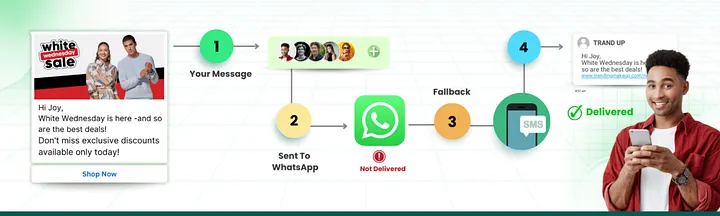
Think of SMS fallback as an insurance policy for your OTP delivery. Instead of putting all your eggs in one basket, the system automatically switches channels the moment the primary channel shows signs of failure.
Here's the typical flow:
The OTP request is first routed through WhatsApp, since it's cheaper on data and offers a rich, branded experience.
The system monitors delivery status in near real-time.
If WhatsApp fails to deliver — because the user is offline, hasn't installed WhatsApp, or the message gets stuck — the same OTP is instantly re-routed through SMS.
The end user receives their code without ever realizing two different channels were involved.
This dual-channel approach means businesses no longer have to choose between the affordability of WhatsApp and the universal reach of SMS — they get both, layered intelligently.
Why SMS Fallback Isn't Optional in the Indian Market
The DLT Compliance Maze
India's Distributed Ledger Technology (DLT) framework, mandated by TRAI, requires every business sending SMS to pre-register their sender ID and message templates. While this cuts down spam, it also introduces friction — template mismatches, registration delays, or scrubbing by telecom filters can quietly kill OTP delivery if not managed properly. A well-built fallback system accounts for this and keeps templates pre-approved and ready to fire the moment they're needed.
WhatsApp's Real-World Limitations
WhatsApp OTP delivery depends entirely on three things being true at once: the user has an active internet connection, WhatsApp is installed and functioning, and the number is correctly linked to a WhatsApp account. In India's Tier-2 and Tier-3 towns — home to a massive share of the country's mobile users — patchy 4G coverage, older smartphones, and storage-constrained devices make these assumptions shaky at best.
The Business Cost of Failed OTPs
It's easy to underestimate what a "small" failure rate actually means at scale. Even a 1-2% OTP failure rate translates into tens of thousands of frustrated users per million transactions — users who abandon signups, drop off checkout pages, or fail to complete a payment. For fintech, e-commerce, and banking platforms, that's real revenue walking out the door, not just a technical hiccup.
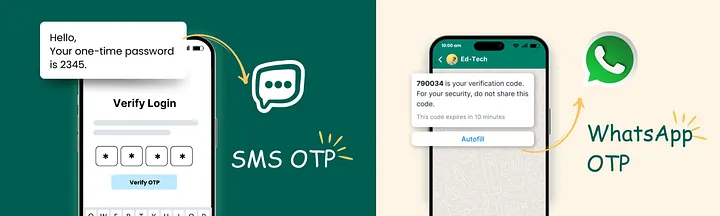
WhatsApp OTP vs SMS OTP: A Quick Comparison
Factor | WhatsApp OTP | SMS OTP |
Urban Delivery Rate | High, typically 90%+ | Slightly lower due to spam filters |
Rural/Semi-Urban Reach | Dependent on internet access | Works even on 2G networks |
Speed | Near-instant | A few seconds slower |
Cost per Message | Higher | Comparatively lower |
Regulatory Requirement | Business verification | DLT template registration |
Security | Encrypted, verified business profile | Vulnerable to SIM-swap fraud |
Neither channel alone is perfect — which is precisely the argument for combining them.
The Real Cost-Benefit of Going Hybrid
Businesses often hesitate to add SMS fallback because it looks like an added expense on paper. But when you zoom out, the math tells a different story. Yes, WhatsApp-first delivery with SMS fallback costs more per message than pure SMS. However, the jump in successful deliveries — often pushing overall reliability above 99% — directly protects revenue that would otherwise be lost to failed logins, abandoned transactions, and support tickets.
Add to that the improved user experience WhatsApp brings (rich formatting, branded sender names, faster load), and many businesses report conversion upticks in the double digits after switching to a hybrid model. The extra spend on fallback essentially pays for itself by rescuing transactions that would have silently failed.
Where WhatsApp Business API Fits Into the Picture
SMS fallback doesn't happen by accident — it needs the right infrastructure, and that starts with the WhatsApp Business API. Unlike the regular WhatsApp app, the Business API allows companies to send verified, templated, and automated messages at scale, including OTPs, order confirmations, and marketing broadcasts — all from a verified business identity with a green tick of trust.
This is where the line between transactional messaging and WhatsApp marketing starts to blur in a good way. The same API infrastructure that powers your OTP delivery can also power:
Promotional broadcasts and product announcements
Abandoned cart recovery messages
Customer support automation through chatbots
Order and delivery status updates
By consolidating OTP verification, customer engagement, and marketing on a single WhatsApp Business API integration, businesses cut down on vendor sprawl and get a unified view of customer communication — while still keeping SMS as the dependable backup channel for anything WhatsApp can't reach.
Best Practices for a Reliable SMS Fallback Setup
If you're planning to implement or upgrade your OTP fallback system, keep these practices in mind:
Keep the trigger window short. Don't make users wait too long — a delay of even 20-30 seconds before fallback kicks in can frustrate users. Aim for a near-instant switch.
Use identical OTP codes across channels. Sending a different code via SMS than the one sent via WhatsApp creates confusion and increases failed verification attempts.
Choose a direct-connect SMS gateway. Working with a provider that has direct telecom operator routes (instead of layered resellers) improves both speed and delivery consistency.
Monitor delivery analytics continuously. Real-time dashboards help you catch delivery drop-offs early and adjust routing before it impacts a large user base.
Localize your fallback messages. Sending OTP SMS in regional languages — Hindi, Tamil, Bengali, Telugu, and others — significantly improves comprehension and trust, especially outside metro cities.
Choosing the Right Fallback Partner
Not all OTP delivery providers are built the same. When evaluating a partner for WhatsApp OTP with SMS fallback, look for:
Single API integration for both WhatsApp and SMS, so your dev team isn't juggling multiple vendors.
Built-in DLT compliance, so template registration and sender ID approval don't become your headache.
Transparent SLAs, ideally guaranteeing delivery rates close to 99.9%.
Smart routing logic, ideally powered by AI, that picks the fastest and most cost-efficient path automatically.
This is exactly the space Anantya.ai operates in — offering businesses a unified WhatsApp Business API platform that combines OTP delivery, SMS fallback, and WhatsApp marketing automation under one roof. Instead of stitching together separate tools for verification and engagement, businesses get a single dashboard to manage both transactional and promotional messaging, with built-in fallback logic so OTPs reach users reliably regardless of network conditions.
What's Next: Beyond WhatsApp and SMS
The fallback ecosystem itself is evolving. A few trends worth watching:
RCS (Rich Communication Services) is emerging as a middle ground — it delivers directly into a phone's native messaging app but with branded, verified sender information, similar to WhatsApp's trust signals.
AI-driven failure prediction is reducing the traditional 10-15 second wait before triggering fallback. Smarter systems can now detect a likely WhatsApp failure within a second or two and switch channels almost instantly.
Omnichannel verification is also on the horizon — where OTP delivery doesn't stop at WhatsApp and SMS, but extends to voice calls and email as additional layers, ensuring users are never left stuck mid-transaction.
Conclusion
India's mobile-first economy runs on trust, and OTP verification is the quiet mechanism that keeps that trust intact. While WhatsApp OTP delivers a smoother, more branded user experience, it simply cannot guarantee delivery on its own — network gaps, app dependency, and device fragmentation see to that. SMS fallback closes this gap, ensuring that no user is ever left waiting for a code that never arrives.
For businesses building on WhatsApp Business API, pairing OTP verification with SMS fallback — and layering in WhatsApp marketing capabilities — isn't just a technical upgrade. It's a strategic move that protects revenue, builds customer trust, and future-proofs communication infrastructure in one of the world's most complex mobile markets.
Frequently Asked Questions
Q1: Why do businesses in India specifically need SMS fallback for OTP verification?
India's mix of patchy rural connectivity, high smartphone fragmentation, and DLT-regulated SMS routing means no single channel can guarantee 100% OTP delivery on its own. SMS fallback bridges these gaps automatically.
Q2: Does adding SMS fallback significantly increase messaging costs?
There is some added cost since a portion of OTPs route through SMS after a failed WhatsApp attempt. However, the increase is generally modest compared to the revenue saved from reduced failed transactions and abandoned signups.
Q3: What role does DLT play in SMS OTP delivery?
DLT (Distributed Ledger Technology) registration is mandatory in India for any business sending SMS. It requires pre-approved sender IDs and message templates, and non-compliance can lead to blocked or delayed messages.
Q4: Can SMS fallback be combined with other verification channels like voice or email?
Yes. Many modern platforms are moving toward omnichannel verification, where voice OTP calls or email codes act as additional fallback layers beyond just WhatsApp and SMS.
Q5: How does WhatsApp Business API relate to OTP delivery and marketing together?
The WhatsApp Business API isn't limited to OTPs — the same verified infrastructure can power promotional broadcasts, cart recovery messages, and customer support automation, allowing businesses to manage both verification and marketing through a single integration.
Comments
Log in or sign up to join the conversation.