
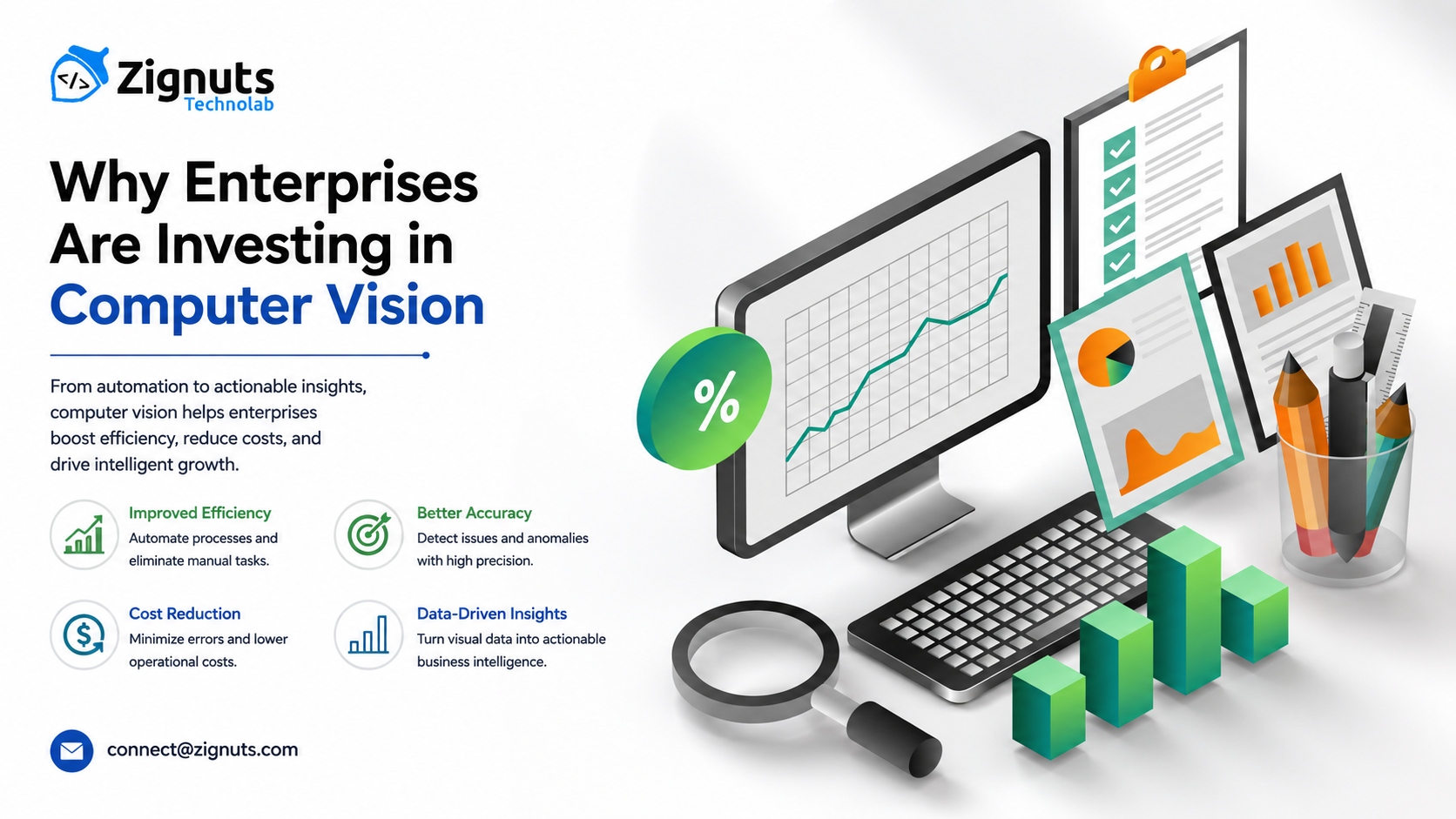
Enterprise leaders are under pressure to improve efficiency without sacrificing quality, safety, or customer experience. Yet many large organizations still operate with a significant visibility gap. Their enterprise systems can track transactions, inventory, and outcomes, but they often cannot interpret what is happening across factory floors, warehouses, retail locations, and other physical environments. Enterprise Computer Vision Solutions are gaining strategic attention because they can help organizations transform visual information into operational intelligence and connect physical activity with digital decision-making.
2027 Insight | Business Impact | What Leaders Should Do |
|---|---|---|
Vision AI becomes part of enterprise data ecosystems | Visual insights can support broader operational intelligence | Include visual data in enterprise data architecture planning |
Enterprise deployments prioritize integration | Standalone pilots will deliver less value than connected workflows | Focus investment on systems that integrate with core platforms |
Governance requirements become more formalized | Privacy and accountability risks increase with scale | Establish enterprise-wide policies and ownership |
Scalable AI operations become essential | More locations and use cases increase management complexity | Plan for monitoring, maintenance, and lifecycle management |
The enterprise opportunity is not simply about automating visual inspection. It is about gaining a more complete understanding of operations. Enterprise Computer Vision Solutions can help organizations analyze physical processes that were previously difficult to measure consistently, from manufacturing activity and warehouse movement to retail operations and asset conditions.
For executives, the investment case is increasingly connected to a larger strategic question: how can the organization make faster and better decisions when important business signals exist outside traditional databases? Visual intelligence can provide another layer of information, but only when it is connected to meaningful workflows, governance structures, and measurable business objectives.
Why Enterprises Are Looking Beyond Traditional Data
Most enterprise technology environments are built around structured information.
ERP platforms record transactions. CRM systems capture customer interactions. Supply chain software tracks movement and inventory.
These systems are essential, but they do not capture everything.
A dashboard may indicate that production output declined without explaining what happened on the production floor. A warehouse system may show delayed shipments without identifying physical congestion. Retail data may reveal lower sales without showing whether products were unavailable on shelves.
This is where visual intelligence becomes strategically relevant.
Computer vision can help analyze information contained in:
Video feeds
Product images
Facility cameras
Inspection photographs
Industrial imagery
Physical process recordings
The objective is not to replace existing enterprise systems.
It is to extend their visibility.
The Shift From Passive Monitoring to Active Intelligence
For decades, cameras have served primarily as recording tools.
They captured information that humans could review later.
That approach becomes increasingly difficult at enterprise scale.
A multinational organization may operate hundreds of facilities and thousands of cameras. Even when the footage contains useful information, manual review is expensive and slow.
Computer vision changes the role of visual infrastructure.
Instead of asking employees to watch everything, organizations can configure systems to identify defined events, conditions, and patterns.
For example, an enterprise may want to detect:
Product defects
Process interruptions
Inventory inconsistencies
Equipment conditions
Defined safety events
Operational bottlenecks
The goal is selective intelligence.
The organization should focus on signals that can influence a business decision.
How Enterprise Computer Vision Creates Business Value
Technology investment at enterprise scale requires more than an interesting use case.
Leaders need to understand how the capability affects financial and operational performance.
Improving Process Visibility
Large enterprises often struggle with fragmented visibility.
Headquarters may have access to reports, but reports can lag behind physical events.
Visual intelligence can provide additional operational context.
This can help teams understand not only what happened but where a process may be breaking down.
Supporting Quality Management
Quality problems can become expensive when detected late.
Computer vision can support inspection processes by identifying potential issues for human review.
The business value may include:
Earlier detection
More consistent inspection
Reduced rework
Improved traceability
The appropriate level of automation depends on the operational and regulatory environment.
Reducing Repetitive Monitoring
Enterprise operations can generate enormous volumes of visual information.
Automated analysis can reduce the need for employees to review routine footage and images.
Human attention can then focus on exceptions, complex cases, and decisions requiring judgment.
Improving Operational Response
Faster awareness can support faster action.
However, detection alone is insufficient.
A mature enterprise deployment should define what happens after the system identifies a relevant event.
Connecting Visual Intelligence to Enterprise Workflows
The greatest challenge is often not building the AI model.
It is operational integration.
Enterprise Challenge → Visual Data → Computer Vision Intelligence → Enterprise System Integration → Operational Action → Business Value
This left-to-right workflow highlights the importance of integration.
A vision system may identify a potential defect, but the business process must determine whether to:
Alert a quality team
Create an incident ticket
Trigger an inspection
Update an enterprise dashboard
Pause a defined process
The AI output becomes valuable when it enters an existing decision framework.
This is why enterprise architecture should be considered early.
Computer vision cannot be treated as a disconnected application if the goal is enterprise-wide operational impact.
Major Enterprise Use Cases
Manufacturing and Industrial Operations
Manufacturing is a natural environment for enterprise computer vision because production processes generate continuous visual information.
Potential applications include:
Automated inspection support
Assembly verification
Defect detection
Equipment observation
Packaging analysis
For large organizations, consistency across multiple facilities can be especially valuable.
However, deployment across different sites may introduce environmental differences that affect model performance.
Supply Chain and Logistics
Supply chains depend on the efficient movement of products and materials.
Visual intelligence can support visibility into:
Warehouse activity
Loading processes
Dock utilization
Package handling
Facility congestion
The strongest implementations connect visual insights with warehouse and supply chain systems.
This creates more useful context for operations teams.
Retail and Multi-Location Businesses
Large retailers often face a visibility challenge across hundreds or thousands of locations.
Visual intelligence can support operational analysis involving:
Shelf conditions
Queue patterns
Store process compliance
Product placement
The focus should remain on clearly defined business outcomes and responsible data use.
Infrastructure and Asset Management
Enterprises managing large physical assets can use visual analysis to support inspection and maintenance processes.
Images collected through cameras, drones, or other approved systems can potentially help teams prioritize assets requiring closer examination.
Human expertise remains important when interpreting complex or high-risk conditions.
Enterprise Value Requires More Than Technical Accuracy
A common mistake is evaluating computer vision primarily by model accuracy.
Accuracy is important, but it is not the only metric that matters.
An enterprise system must also demonstrate:
Operational reliability
Integration capability
Scalability
Security
Governance
User adoption
Financial value
Enterprise Decision Area | Key Question | Business Consideration |
|---|---|---|
Business Value | What operational problem has the highest cost? | Prioritize measurable outcomes |
Technology | Can the solution integrate with enterprise systems? | Avoid isolated AI deployments |
Data | Is visual data representative and governed? | Data quality affects reliability |
Security | How is sensitive visual information protected? | Define access and retention controls |
Scale | Can the solution operate across locations? | Plan for monitoring and lifecycle management |
Enterprise leaders should evaluate the complete operating model rather than focusing only on a technology demonstration.
Financial Benefits and ROI Considerations
Computer vision can create value through multiple channels.
Lower Cost of Quality Issues
Earlier identification of potential defects can reduce downstream waste and rework.
Improved Workforce Productivity
Employees can spend less time on repetitive observation and more time on problem-solving.
Better Asset Utilization
Visual insights can reveal inefficiencies in the use of facilities, equipment, and physical spaces.
Faster Operational Decisions
Teams can receive relevant signals closer to the time an event occurs.
Scalability
Automated analysis can support larger volumes of visual information as enterprise operations expand.
Executives should avoid using a single ROI metric for every use case.
A quality inspection project may focus on waste reduction, while a logistics project may focus on throughput or delay reduction.
The measurement framework should reflect the business objective.
What C-Suite Leaders Should Evaluate Before Investing
What is the business problem?
The use case should address a meaningful operational challenge.
Avoid implementing technology simply because competitors are experimenting with it.
What measurable outcome should improve?
Define success before deployment.
Possible metrics include:
Process cycle time
Inspection speed
Waste levels
Throughput
Response time
Operational downtime
What infrastructure is required?
Enterprise deployments may require consideration of:
Data storage
Network capacity
Edge processing
Cloud infrastructure
System integration
How will security be managed?
Visual data can be sensitive.
Organizations should establish strong controls around access, storage, encryption, and monitoring.
What governance model is needed?
Leaders should define accountability for:
Data ownership
Model monitoring
Performance evaluation
Privacy compliance
Human oversight
How will the organization manage change?
New technology can affect established workflows.
Operational teams should be involved early so that adoption challenges are identified before large-scale deployment.
A Practical Enterprise Implementation Plan
Step 1: Identify a High-Value Use Case
Select a business problem with measurable operational consequences.
Step 2: Define Success Metrics
Establish business and operational indicators before selecting a technical solution.
Step 3: Assess Data and Infrastructure
Evaluate visual data quality, connectivity, storage, and processing requirements.
Step 4: Build a Focused Pilot
Test the technology in one environment or workflow.
Step 5: Integrate With Enterprise Systems
Connect insights to relevant business applications and decision processes.
Step 6: Establish Governance
Define policies for privacy, security, model ownership, and human oversight.
Step 7: Measure Business Outcomes
Evaluate whether the initiative achieved its original objective.
Step 8: Scale Strategically
Expand across facilities or business units only after validating performance and operational value.
Risks and Challenges at Enterprise Scale
Large-scale deployments introduce additional complexity.
Integration Challenges
Enterprise systems often contain legacy platforms and fragmented data environments.
Integration planning can become a major component of the project.
Data Variability
A model trained in one facility may encounter different lighting, equipment, processes, or products elsewhere.
Testing across environments is essential.
Security and Privacy
More cameras and users increase the potential attack surface and governance requirements.
Vendor Dependency
Organizations should understand how dependent they may become on proprietary technologies.
Questions about data portability and long-term costs should be addressed early.
Model Monitoring
AI performance can change as business environments evolve.
Enterprises need processes for evaluating systems after deployment.
Organizational Silos
Technology, operations, security, and legal teams may have different priorities.
Successful implementation requires cross-functional ownership.
Preparing for the Future of Enterprise Visual Intelligence
By 2027, computer vision is likely to become more deeply connected with enterprise AI ecosystems.
Visual signals may increasingly be combined with:
IoT data
ERP information
Operational analytics
Automation platforms
Language-based AI interfaces
This could enable more context-aware decisions.
A visual system may detect an operational anomaly. Connected enterprise data could help explain its potential impact on inventory, production targets, maintenance schedules, or customer commitments.
The future opportunity is therefore broader than image analysis.
It is the creation of a more connected understanding of enterprise operations.
Organizations that prepare for this shift should focus on data architecture, integration, governance, and organizational capability rather than treating each AI project as an isolated experiment.
Conclusion
Enterprises are investing in computer vision because important operational information often exists outside the structured data captured by traditional business systems.
Visual intelligence can help organizations improve process visibility, support quality management, reduce repetitive monitoring, and accelerate operational responses.
However, successful enterprise adoption requires more than an accurate model.
Leaders must connect technology investments to measurable business problems, integrate insights into workflows, establish governance, and prepare infrastructure for scale.
Enterprise Computer Vision Solutions are most valuable when they become part of the organization's broader decision-making ecosystem.
The practical next step for executives is to identify one high-impact area where visual information could close a meaningful visibility gap. Test the business case, validate the operational impact, and build the governance and integration foundation needed before scaling.
FAQs
1. What are Enterprise Computer Vision Solutions?
They are computer vision systems designed to support large-scale business operations by analyzing images and video and connecting visual insights with enterprise workflows and systems.
2. Why are enterprises investing in computer vision?
Enterprises use computer vision to improve operational visibility, support quality processes, reduce repetitive monitoring, and gain insights from physical environments.
3. Can computer vision integrate with ERP and enterprise platforms?
Yes, computer vision outputs can be integrated with enterprise applications, depending on the architecture and use case.
4. What is the biggest challenge in enterprise computer vision?
Integration, data variability, governance, security, and scaling across multiple operational environments are common challenges.
5. How should enterprises measure computer vision ROI?
ROI should be connected to the original business objective, such as reduced waste, improved throughput, faster inspection, lower operational delays, or better asset utilization.
6. Is cloud infrastructure required for enterprise computer vision?
Not always. Architecture depends on processing requirements, latency needs, security policies, connectivity, and the operational environment.
7. How should enterprises begin implementing computer vision?
Start with a focused, high-value use case, define measurable success criteria, test through a controlled pilot, and establish governance before broader deployment.
Comments
Log in or sign up to join the conversation.