

Over the final trading week of May 2026, the S&P 500 (Index: SPX) rose 1.4% over its previous week's close to reach 7,580.06, a new record high for the index.
According to news headlines, it did so because of hopes of realizing a Middle East peace deal that might reopen the Hormuz Strait to oil shipping and because of strong earnings among technology companies whose products have become in high demand to build out the infrastructure to support Artificial Intelligence (AI) systems.
But we can't help noticing that these are variations of the same headlines that have accompanied the rise of the S&P 500 over much of the last two months. Can the prospect of a negotiated end to the Iran war geopolitical event still be powering stock prices higher? At what point are the expectations associated with a Middle East peace deal fully priced into the market? Especially when the proverbial can for actually reaching a deal to satisfactorily end the conflict keeps getting kicked down the road?
The real story is the outlook for both earnings and dividends has improved substantially throughout the past two months as the conflict's cease fire has held. These positive changes are the main drivers behind the rise in stock prices and they have benefited stock prices in two ways:
They reversed the negative momentum that had sent stock prices substantially lower from the end of February through the end of March 2026.
As affected firms have progressively reported the associated improvement in their outlooks, stock prices have continued rising, even though no deal has yet been reached.
That's a state of affairs that could change quickly and negatively if the cease fire breaks down, but short of the announcement of a deal that definitively ends the conflict, there's little room left for stock prices to rise more on these headlines with 2026-Q2's earnings season mostly having come and gone.
Meanwhile, the progress of AI technologies and the massive investments being made to advance them continues to be the market moving story of the year. There's a strong argument to be made the development is a modern day analog of the 19th century's boom in railroads. The booming earnings of companies whose products have become essential to the rapid, widespread adoption of AI technologies have been key in powering stock prices higher.
Speaking of which, the latest update of the alternative futures chart shows we have come to the end of the redzone forecast range we added in late February. The S&P 500's trajectory has shifted in the last few days away from the trajectory associated with investors focusing mainly on 2026-Q2 in setting stock prices to the more distant future quarter of 2026-Q4.
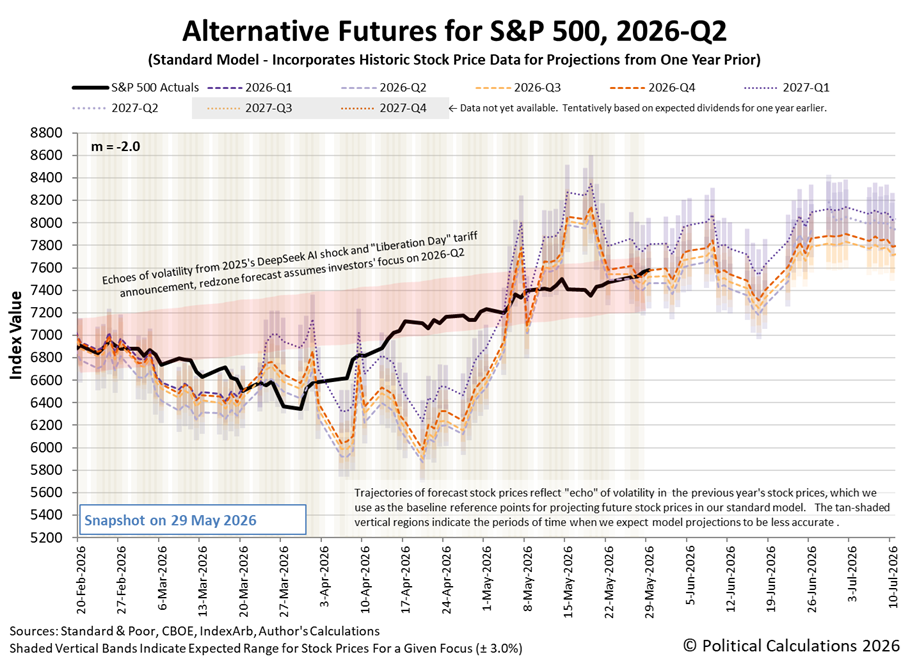
Although this is a relatively small change, the shift in how far forward in time investors are focusing their attention represents a Lévy flight event.
That timing is interesting because it coincides with a growing expectation of when the Fed might act to next change U.S. interest rates. The CME Group's FedWatch Tool pushed back the expected timing of a quarter point increase in the Federal Funds Rate to 9 December (2026-Q4), six weeks later than it had projected on Friday, 22 May 2026. Beyond that hike, the FedWatch tool no longer anticipates the Fed will hold the Federal Funds Rate at a target rate of 3.75-4.00% through all of 2027.
But there's a bigger question that now needs to be asked. Since the S&P 500 bottomed on 30 March 2026, has the index risen too far too fast? We'll take that question on in the very near future.
Meanwhile, how long investor expectations might hold depends upon the random onset of new information. Here are the market moving headlines that affected investor outlooks for stock prices in the Memorial Day holiday-shortened trading week.
Tuesday, 26 May 2026
Signs and portents for the U.S. economy:
Oil prices bounce around over Memorial Day holiday weekend with geopolitics:
Bigger trouble, stimulus developing in China:
BOJ minions excited to see inflation data to support plan to hike Japan's interest rates:
ECB minions getting ready to ditch their perfect monetary policy for the Eurozone, say private credit is no big deal:
S&P 500, Nasdaq hit record closing highs on AI optimism, Micron joins $1 trillion club
Wednesday, 27 May 2026
Signs and portents for the U.S. economy:
Fed minions want to see lower demand, worry about inflation:
Fed's Logan: world may need to cut use of oil and natural gas
Fed's Kashkari calls for focus on inflation risk, mum on timing of next rate move
Fed's Cook says she is prepared to raise rates if inflation doesn't ease
Fed's Jefferson says monetary policy is 'well positioned' amid inflation risks
Fed's Goolsbee says oil shock could exacerbate inflationary impulse of AI hype
Bigger trouble, stimulus developing in China:
BOJ minions making less money because of their higher interest rates, worry energy shock may not be temporary, may need action to bailout Japan's currency again:
Bigger trouble developing in Eurozone:
Wall Street indexes post closing record highs, AI rally pauses
Thursday, 28 May 2026
Signs and portents for the U.S. economy:
Fed minions say they have monetary policy right where they want it, don't think AK will reduce inflation:
Bigger trouble, stimulus developing in China:
BOJ minions getting Japan ready for their plan to hike interest rates:
ECB minions say Eurozone inflation will be persistent:
S&P 500 and Nasdaq hit record closing highs as US and Iran agree to extend ceasefire
Friday, 29 May 2026
Signs and portents for the U.S. economy:
Fed minions starting to eye rate hike as next move:
BOJ minions busy with yen bailout, see inflation come in lower than they want to justify next rate hike:
ECB minions getting excited for Eurozone interest rate hikes:
The Atlanta Fed's GDPNow toolestimate of real GDP growth for the U.S. economy in the current quarter of 2026-Q2 decreased to +3.8%, falling back from the +4.3% it projected a week earlier.
Comments
Log in or sign up to join the conversation.