
Most commissioning problems occur at component interfaces—even when each part looks correct on its own.
For: door OEMs, locksmiths, contractors, consultants and building owners | Technical review: TOPTEK Access
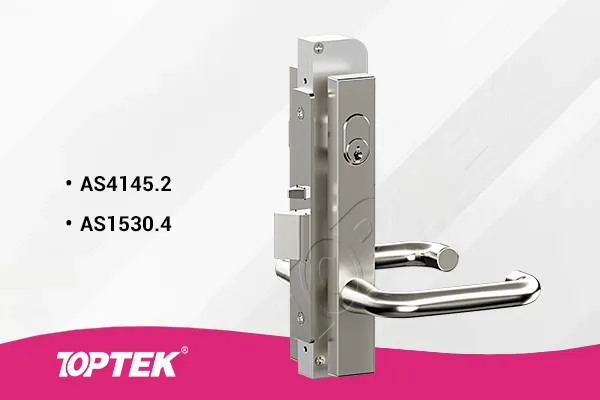
Approve the opening as a system: lock case, cylinder, trim, strike, door and frame.
TL;DR A compatible opening needs the correct cylinder profile and cam/tailpiece, sufficient cylinder length, aligned strike geometry, an accurate lock pocket and coordinated trim fixing. Test the exact component set in a representative door before production or site rollout. |
The quick answer
Compatibility failures are often subtle. The cylinder enters the case but its cam does not complete the intended movement. The strike accepts the latch but fails to depress the auxiliary deadlatch. The lock operates on the bench but binds after through-bolts are tightened. None of these issues can be solved by quoting the standard name alone.
The approval unit should be a complete opening sample. Use the project cylinder, trim and strike in the real door and frame construction, then test every function from both sides.
Cylinder compatibility is mechanical, dimensional and operational
Confirm the cylinder profile, length, cam or tailpiece geometry, rotation, fixing method and key-removal behavior. A cylinder that is too short may sit below the trim; one that projects excessively can be vulnerable or visually unacceptable. A mismatched cam may not fully lock, unlock or retract the required mechanism.
Keying requirements add another layer: keyed alike, master keyed, construction keyed or restricted systems need the correct cylinder format and supply process. Electrified projects should also define mechanical override behavior during a power or controller fault.
Interface rule “Fits the hole” is not proof of compatibility. The cylinder must complete the full operating sequence without overtravel, lost motion or interference. |
The strike controls latch and deadlatch behavior
Strike lip, box depth, opening size, fixing position and frame material affect closing force and engagement. If the strike is too high or low, the latch rubs. If the opening is too shallow, the bolt bottoms out. If the auxiliary deadlatch enters the opening instead of being held depressed, the lock’s anti-shimming behavior may be defeated.
Check the opening under real door load, with seals, closer and final gaps. Mark the latch path rather than setting the strike only from a nominal vertical dimension.
Door preparation can distort a correct lock
A pocket that is tight, angled or full of debris can press on the case. Off-axis spindle, cylinder and fixing holes can introduce side load. Uneven escutcheon screws can compress the assembly, while a missing reinforcement can allow movement over time.
Use a controlled template with common datums and tolerances. For replacement work, measure the existing opening directly; nominal backset and centres do not guarantee that faceplate, fixing and strike details match.
Commission the function, not just the latch
Operate the outside and inside levers, key, turn, deadbolt, holdback or privacy control in every scheduled state. Confirm free egress where required. For solenoid or motorized variants, cycle power, simulate a controller command and verify the mechanical key override.
Record the accepted sample configuration: lock model and revision, backset, cylinder, trim, strike, door thickness, handing and any electrical details. That record becomes the reference for procurement, assembly and field troubleshooting.
Opening interface review
Interface | Approval question | Common symptom |
|---|---|---|
Cylinder to lock | Correct profile, length, cam/tailpiece and rotation? | Key turns but does not complete lock operation |
Trim to lock | Spindle/fixings aligned and screw length controlled? | Lever binds only after trim is tightened |
Lock to door | Pocket square, supported and clear? | Case feels stiff or faceplate will not sit flush |
Latch to strike | Correct lip, opening, depth and deadlatch position? | Door bounces, drags or can be shimmed |
Door to frame | Gaps and alignment stable under closer load? | Works open, fails when closed |
Electrical interface | Voltage, current, wiring and logic approved? | Intermittent or reversed access behavior |
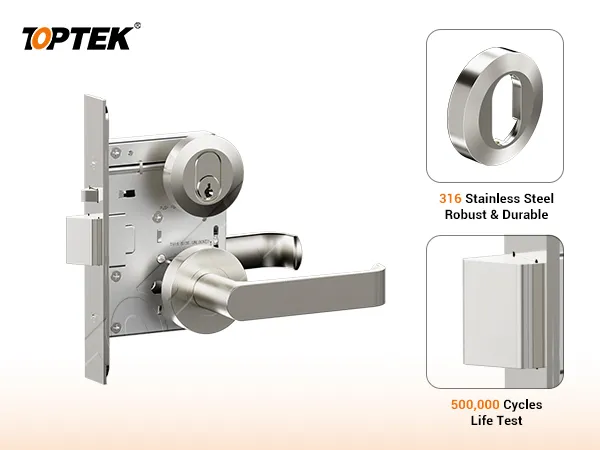
Round-rose example: compact trim still depends on accurate spindle, cylinder and fixing-hole coordination.
Representative-opening test checklist
▪ Record exact lock, cylinder, trim and strike model/revision identifiers.
▪ Verify backset, centres, door thickness, handing and faceplate orientation.
▪ Test cylinder engagement, rotation, key removal and every scheduled key action.
▪ Tighten trim to the specified condition and check for binding or bolt interference.
▪ Confirm latch, auxiliary deadlatch and deadbolt engagement at the strike.
▪ Cycle the door with final seals, closer and expected operating gaps.
▪ For electrified variants, test power-loss state, command state and mechanical override.
▪ Photograph and sign off the accepted sample before mass preparation.
What a capable manufacturing partner should provide
TOPTEK’s AS 4145 mortice-lock platform includes escutcheon and round-rose arrangements around the TKAU6400 family. The exact cylinder, function and strike should be included in the technical submittal rather than left to site interpretation.
For OEM work, TOPTEK’s engineering and production capabilities can support a golden-sample process that connects approved interfaces to drawings, inspection records and repeat orders.
Frequently asked questions
Can any Australian oval cylinder operate the lock?
Do not assume so. Confirm profile, length, cam/tailpiece, fixing and operating sequence against the exact lock drawing.
Why must the auxiliary deadlatch be checked?
Its position relative to the strike affects anti-shimming behavior. It normally needs to be held in the designed state when the door is closed.
Is a bench sample enough?
No. Use a representative door and frame because pocket accuracy, trim compression, gaps, seals and strike alignment affect operation.
Coordination takeaway Package the lock, cylinder, trim, strike and door template as one submittal. TOPTEK can review the component set and support a representative-opening sample before production release. |
Comments
Log in or sign up to join the conversation.