
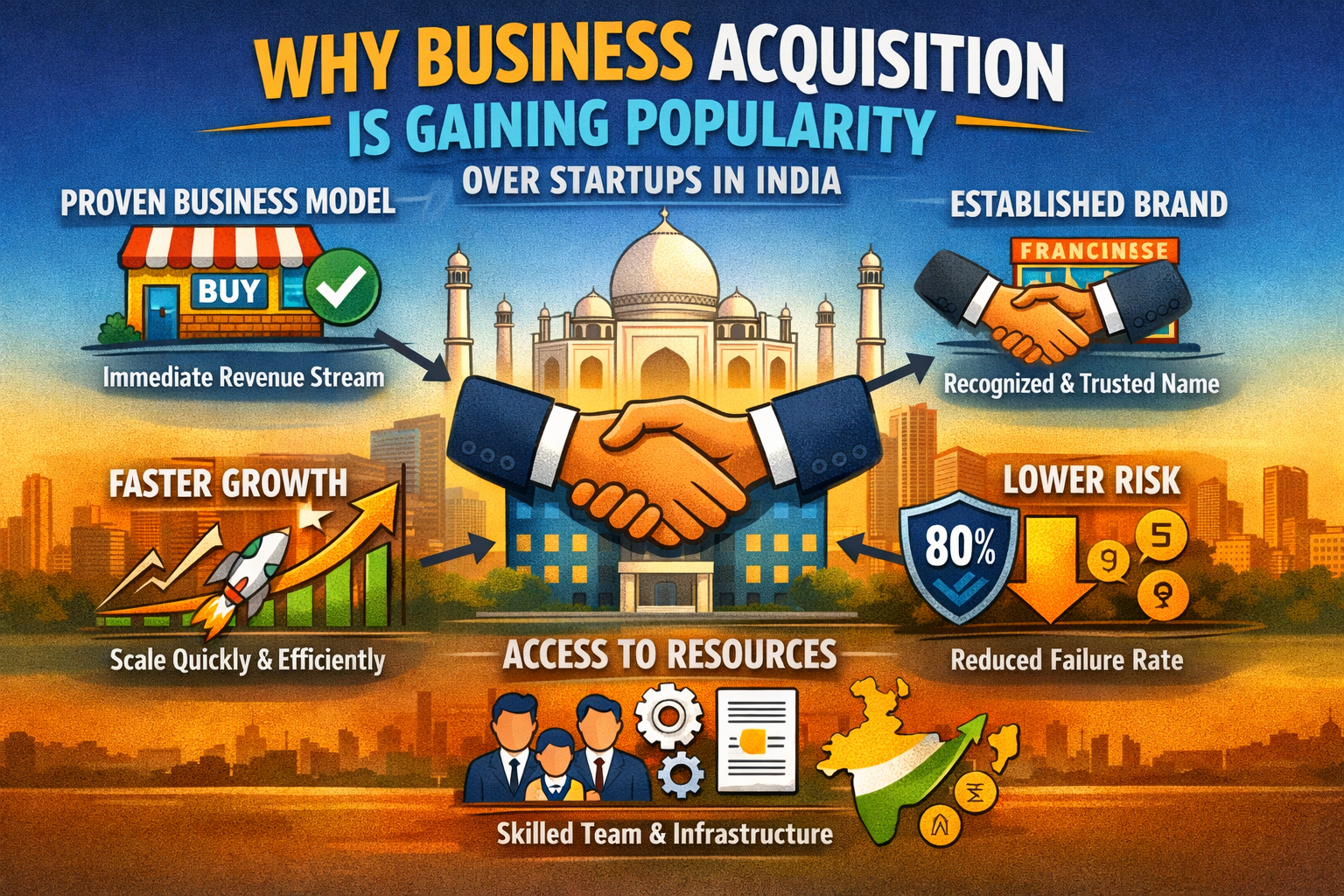
The entrepreneurial culture of India has long been associated with the culture of startups - new ideas, innovative disruptive models, and ambitious founders striving to create something out of nothing. Yet, a quiet shift is underway. Many business investors and entrepreneurs are currently considering acquiring an existing business as an alternative to starting a new one. This is one strategy; that is, buying out existing companies instead of establishing new ones, which is fast gaining momentum in the fast-changing economy in India.
So, what’s driving this trend? We will de-box why the option of business acquisition is becoming the favorite among Indian entrepreneurs by 2026 and beyond.
1. Reduced Risk and Established Business Models.
Starting a business usually implies going into the unknown. Despite the good idea and good funding, there is still a high chance of failure, approximately 90 percent of start-ups fail within five years. Conversely, business acquisition provides a businessperson an opportunity to acquire a business that has already established a customer base, systems of operation, and revenue base.
When buying an already operating business, entrepreneurs do not go through the experiment of product-market fit and operations establishment. The goodwill and brand reputation that exist also reduce the uncertainty, and thus acquisitions are a safer bet than the unpredictable way of a startup.
2. Short-term Cash and Access to Markets.
Acquired businesses are able to begin generating revenue immediately as opposed to startups, which may take years to break even. In the case of business acquisition, the acquiring party gets the current contracts, regular clients, and market share, which are translated to cash flow.
In addition, the new owner will not have to start all over with creating a distribution network, supplier relations, and marketing channels since these are already in place. This advantage of ready infrastructure is among the strongest reasons why entrepreneurs are choosing the route of acquisitions in the competitive market of India.
3. Increased Growth and Scalability.
The normal time frame for a startup to build a brand and scale is years. Conversely, the purchase of an existing business enables business owners to grow at a higher rate due to strategic growth or operational growth.
As an example, a technology entrepreneur can purchase a mid-sized IT services company, which would immediately provide a client base, labor force, and business structure. Equally, a local manufacturer could be able to take over smaller rivals to increase its geographical coverage.
Concisely, business acquisition will boost growth since it will make use of the current business momentum rather than beginning from scratch.
4. Availability of Quality talent and developed teams.
Talent acquisition and retention are among the most difficult problems in startups. Employees with talent seek to work in a setting that is well-organized and offers predictable pay, which the start-up company may not offer at the initial stage of its growth.
Once an entrepreneur decides to acquire businesses, he/she will have access to trained personnel and professional management. This continuity facilitates the smooth transition cycle, stability in operations, and increases the pace at which new strategies can be implemented.
To most founders, it is time-saving and easy to raise an excellent workforce by acquiring a business compared to spending substantial resources on recruitment.
5. Easier Access to Financing
New start-up businesses are usually reluctant to be financed by banks and investors due to their untested business models. Lenders, on the other hand, feel more at ease investing in acquisitions of profitable and existing businesses that have a good track record.
Indian financial institutions and other players in private equity have warmed up towards providing funds to business acquisition deals, particularly businesses in manufacturing, logistics, healthcare, and IT services.
Such businesses are creditworthy due to predictable cash flows and past financial reports, which create a smooth way of accessing capital.
6. Opportunities for expansion and diversification.
Acquisitions are also a viable method of business diversification, expansion, or penetration into new markets by existing business owners. Instead of trying out a completely different entrepreneurial venture, entrepreneurs have the chance to buy an already existing enterprise in a complementary sector.
The strategy will also take less time to enter new markets and will work as a measure to reduce risk by diversification. An example is where a retail entrepreneur can invest in an e-commerce firm in order to combine both offline and online platforms to increase competition.
7. Favorable regulatory and digital environment.
The ecosystem, which has been formed by government policies like Startup India, Make in India, and the Micro, Small, and Medium Enterprises Development Act, 2006 framework, has enabled entrepreneurship at every level, including acquisitions.
Simultaneously, India Biz For Sale, SMERGERS, and Biz Buy Sell have simplified and opened up the process of finding and acquiring businesses, as well as making it more transparent.
These sites link buyers and sellers, provide valuation support, and due diligence, and so business acquisition is a feasible and easily available alternative to the entrepreneur in India.
8. Reduced Time to Market
The creation of a new startup becomes a time-consuming process, starting with the initial idea and ending with the creation of the product, its testing, and launching into the market. Conversely, an acquisition allows business people to skip such initial phases.
The business acquisition, whether it is a local restaurant, an IT services company, or a manufacturing plant, lets entrepreneurs get into the market right away and concentrate on growth and innovation rather than issues with setup.
This time advantage may be the difference between the front-runners and the back-runners in the race in fast-moving industries.
9. Increasing International Investor Piquing.
The economic stability, increasing number of consumers, and adoption of digital in India are drawing foreign investors. Most people choose acquisition as opposed to startups, as they are sure of an immediate entry into the market with reduced operational risk.
The demand and valuations are on the rise in the technological sector, healthcare, education, and logistics as global funds and corporate investors are aggressively seeking business acquisition opportunities in the mid-market segment in India.
Conclusion
The startup romanticism age is transforming into the age of smart entrepreneurship - an entrepreneurship that emphasizes sustainability, profitability, and scalability. The Indian market has become increasingly competitive, and business acquisition is a quicker, safer, and more lucrative way of achieving success in the Indian market.
Since the entrepreneurial ecosystem in India is becoming more mature, the practice of purchasing existing businesses is no longer viewed as a shortcut; it is a decision supported by reasoning, facts, and prospective growth in the long run. To a large number of would-be entrepreneurs, business acquisition may be simply the more intelligent approach to realizing the dream business.
Comments
Log in or sign up to join the conversation.