
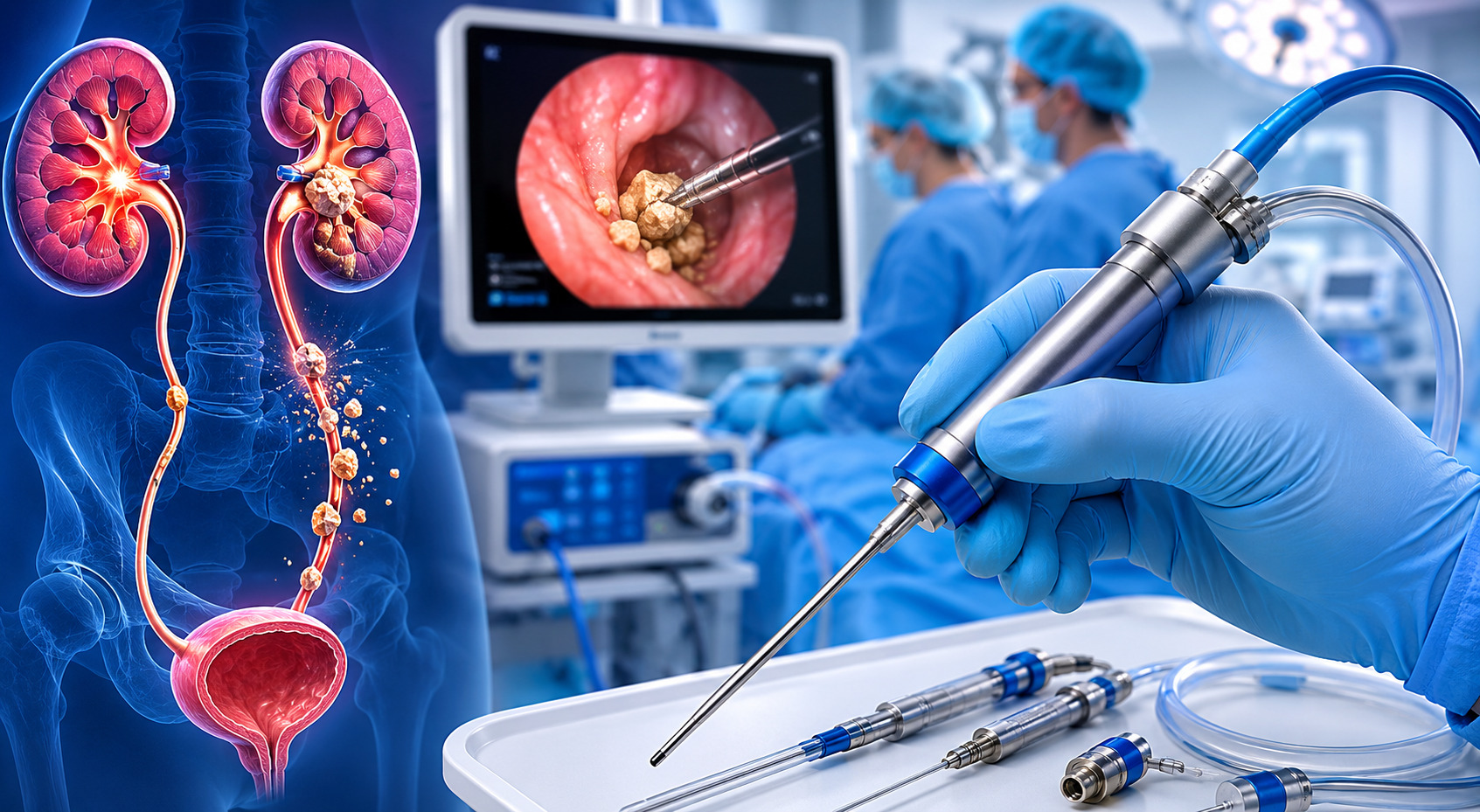
Kidney stones remain one of the most common urological conditions, often requiring advanced treatment when stones are too large or hard to pass naturally. Among the technologies used for stone management, the pneumatic lithotripter has earned a strong reputation for its ability to break stones efficiently during minimally invasive procedures.
As treatment techniques continue to evolve, healthcare professionals look for solutions that deliver consistent performance, procedural control, and reliable clinical outcomes. Effective stone fragmentation is essential for reducing procedure time and supporting successful stone clearance.
This is where the pneumatic lithotripter stands out. Widely used in ureteroscopic stone removal and other endourological procedures, it combines mechanical precision, durability, and dependable kidney stone fragmentation capabilities, making it a preferred choice in modern urology practice.
How Pneumatic Lithotripters Work
Pneumatic lithotripters consist of a small handpiece, a metal probe, and a console that supplies compressed gas. When activated, a piston inside the handpiece fires a metal bullet or projectile down the probe at about 12 shots per second (12 Hz). Each impact sends a shockwave through the probe into the stone. The rigid working channel of the scope ensures efficient energy transfer, any bending of the probe would dissipate power.
In a lithotripter, the metal projectile is the “moving ball,” the probe is the chain, and the stone is the target. Because the probe and stone have different mechanical properties, the impact causes the stone to fracture rather than bounce off. Importantly, pneumatic lithotripters do not generate heat, so there’s minimal thermal effect on surrounding tissues.
Modern devices often come in different probe sizes (e.g. 0.8 mm, 2.5 mm, 3.8 mm) to fit various endoscopes. Some systems are even portable, using CO₂ cartridges instead of wall air. This means you can operate them in suites without special gas lines. The key takeaway is: pneumatic lithotripters use straightforward mechanical power, which translates into reliable stone-crushing performance in many scenarios.
Key Advantages of Pneumatic Lithotripsy
Clinicians favor pneumatic lithotripters for several reasons. The following bullet points highlight why these devices are so widely used:
Powerful Fragmentation of Hard Stones – Pneumatic probes excel at breaking hard calculus compositions because the mechanical impact shatters brittle stones effectively. If you’re dealing with a rock-hard renal calculus, pneumatic energy can pulverize it into removable chunks.
No Thermal Injury – Unlike lasers or ultrasonic probes that generate heat, the pneumatic method is purely mechanical. It has no thermal effect on tissue, so there’s less risk of heat damage to the ureter or kidney lining. This safety profile makes it forgiving when accidentally touching the wall, as opposed to a hot laser fiber.
High Stone-Free Rates – Clinical outcomes with pneumatic lithotripsy are excellent. In practice, stone-free rates (SFR) typically range from about 70% up to over 90% in a single procedure, depending on stone location. These numbers are comparable to laser lithotripsy in many scenarios, meaning pneumatic lithotripsy can clear stones just as effectively in expert hands.
Cost-Effectiveness and Sustainability – Pneumatic systems are typically less expensive than laser platforms and have lower maintenance costs. There’s no pricey laser console or fragile fibers to replace. In low-resource settings or busy public hospitals, this affordability means more patients can be treated without breaking the budget. In short, you get robust stone-breaking power with a lower price tag.
Simplicity and Durability – These devices are mechanically simple. With fewer complex electronic parts than lasers, they’re rugged and often easier to service. Urologists appreciate that pneumatic lithotripters don’t require specialised training beyond normal endoscopy skills, you just hold the probe against the stone and fire. Some systems even offer single-use probes to eliminate sterilization concerns. The straightforward nature of the tool builds confidence in the OR.
In summary, pneumatic lithotripsy combines reliability and raw power. It’s like bringing a sledgehammer to a demolition job: not always the most delicate tool, but incredibly effective at smashing stubborn material. These bullet points cover the main reasons clinicians keep it in their arsenal.
Clinical Applications and Outcomes
Pneumatic lithotripters are versatile, but they excel in certain clinical situations. They are most commonly used during rigid or semi-rigid ureteroscopy and during (mini-)percutaneous nephrolithotomy. In rigid ureteroscopy, especially for mid or distal ureteric stones, a pneumatic probe can rapidly clear large obstructing stones.
Here are some key clinical points:
Ureteric Stones: Pneumatic lithotripsy is especially effective for lower and mid-ureter stones. In these cases, it can quickly break the stone into fragments that are easily extracted or passed.
Renal Stones (PCNL): In percutaneous procedures, pneumatic probes can knock down renal calculi in a percutaneous nephroscope. While Holmium lasers are popular in flexible PCNL or RIRS, pneumatic lithotripters still play a role in mini-PCNL systems.
Cost-Sensitive Settings: In many hospitals worldwide, especially in developing countries or smaller centers, high-end laser machines may not be available. Pneumatic lithotripters fill this gap.
Overall, clinical outcomes support the use of pneumatic energy. When used properly, it achieves very high success rates for stone clearance. Surgeons just need to account for the fact that fragments are larger and might migrate. However, these risks can be managed.
Practical Considerations and Device Options
Beyond raw performance, practical factors drive the popularity of pneumatic systems:
Simple Setup: Pneumatic lithotripters connect to standard medical gas outlets. They don’t need specialized cooling or laser safety measures. This simplicity means quicker setup and turnover between cases.
Probe Reuse vs Single-Use: Some systems offer reusable metal probes while others are disposable. Facilities can be chosen based on cost and convenience. Reusable probes make per-case costs very low, boosting economic appeal.
Portability: As mentioned, there are portable “StoneBreaker” devices that run on CO₂ cartridges. These are handy for smaller clinics or even field settings. No bulky console needed.
Low Maintenance: With few electronics, maintenance is mostly replacing O-rings or checking air lines. Compare that to the regular upkeep a laser generator needs. The durable nature of pneumatic handpieces means less downtime and expense.
Conclusion
Pneumatic lithotripters continue to play an important role in modern stone management due to their reliable performance, effective stone fragmentation capabilities, and ease of use. From ureteroscopic stone removal to kidney stone fragmentation procedures, these systems provide a practical solution for breaking hard urinary stones while supporting efficient clinical outcomes.
Their combination of durability, cost-effectiveness, and proven results has made pneumatic lithotripsy a widely trusted approach in urology. As healthcare facilities continue to seek dependable technologies for endoscopic stone fragmentation, pneumatic lithotripsy systems remain a valuable choice for delivering safe, precise, and effective stone treatment across a wide range of clinical settings.
Comments
Log in or sign up to join the conversation.