
How autonomous software is changing telecom operations, customer support, and digital connectivity.
For decades, mobile networks have evolved through better infrastructure—faster radios, smarter routing, cloud-native cores, and the introduction of technologies like 5G and eSIM. While these innovations dramatically improved connectivity, one thing remained surprisingly manual: the way mobile services are managed.
Provisioning plans, handling billing disputes, activating SIMs, managing roaming, and responding to customer requests often require multiple systems and significant human intervention.
Today, that is beginning to change.
The rise of AI agents—software capable of understanding requests, making decisions, and executing tasks autonomously—is transforming telecom from a service operated by humans into one increasingly operated by intelligent software.
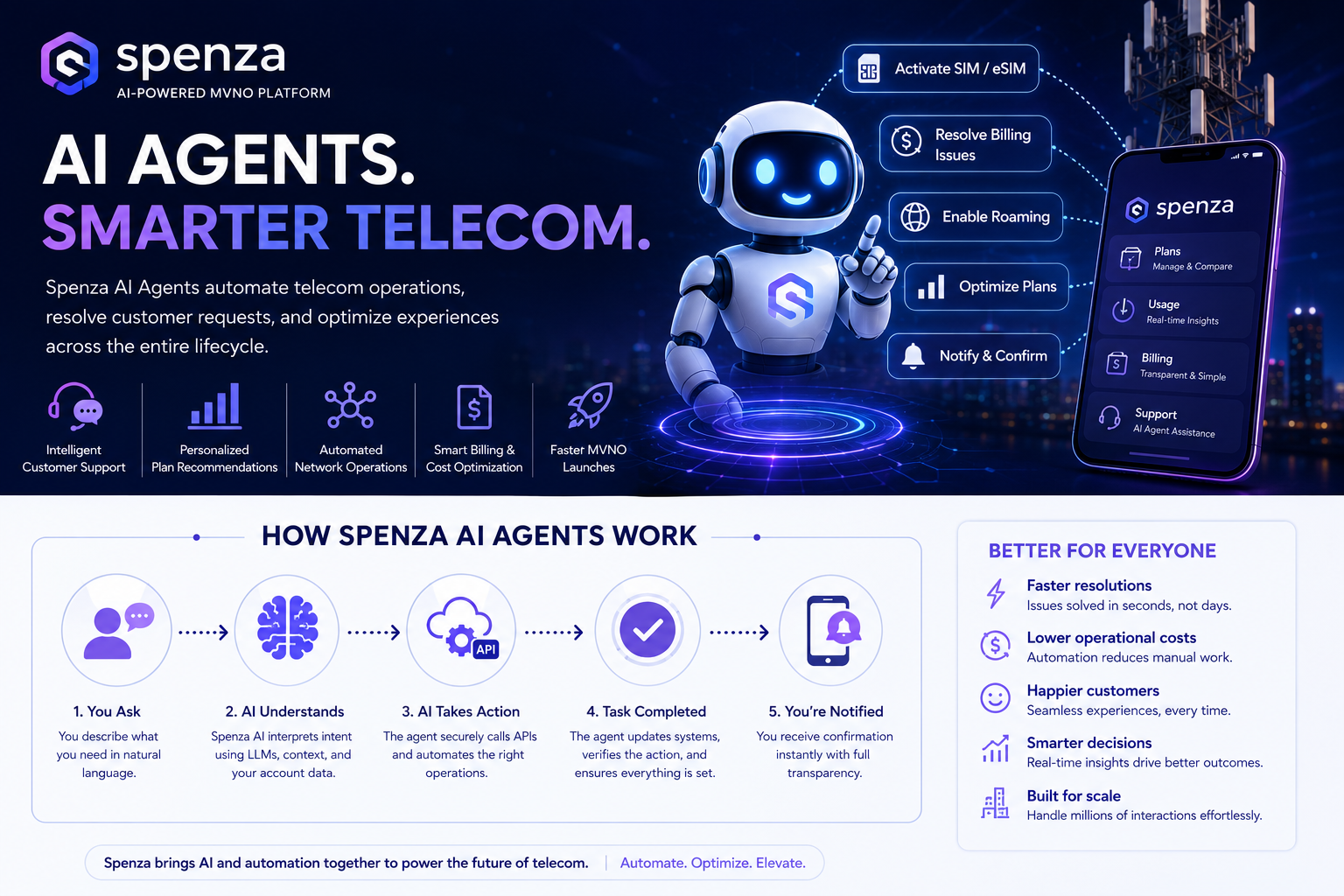
Rather than simply answering customer questions, AI agents can perform actions: activate plans, troubleshoot connectivity issues, optimize costs, recommend packages, and even coordinate with multiple backend systems without human involvement.
This shift may become as significant for telecom as cloud computing was for enterprise software.
From Chatbots to Autonomous AI Agents
Traditional chatbots follow predefined conversation flows.
Ask them something unexpected, and they usually respond with:
"Sorry, I didn't understand your request."
AI agents are fundamentally different.
Instead of relying solely on scripted responses, they combine:
Large Language Models (LLMs)
Context awareness
Tool usage (APIs)
Decision-making capabilities
Memory across interactions
This enables them to execute real tasks instead of merely providing information.
For example, instead of saying:
"You can activate roaming in your account."
an AI agent can actually:
verify eligibility,
enable roaming,
confirm pricing,
notify the customer,
and update billing records automatically.
The conversation becomes the interface—not just to information, but to the telecom infrastructure itself.
Why Telecom Is an Ideal Environment for AI Agents
Telecommunications already generates enormous amounts of structured operational data.
Examples include:
subscriber information
SIM lifecycle events
billing records
network usage
plan catalogs
APIs
support tickets
payment history
Because these systems are already digital, AI agents can interact with them through APIs and automation layers.
Instead of replacing telecom infrastructure, AI agents orchestrate it.
Imagine asking:
"Find me a cheaper plan with at least 100GB of data."
Instead of directing you to a comparison page, an AI agent could:
analyze your previous usage,
compare available plans,
identify the most cost-effective option,
switch your subscription,
notify billing,
send confirmation.
The entire workflow could finish in seconds.
Five Areas Where AI Agents Are Transforming Telecom
1. Customer Support That Solves Problems
Support teams spend a large portion of their time handling repetitive requests:
SIM activation
password resets
billing questions
usage inquiries
roaming configuration
AI agents can resolve many of these without escalation.
Customers receive faster responses, while support teams focus on complex cases requiring human judgment.
2. Intelligent Plan Recommendations
Traditional recommendation engines rely mostly on demographics or historical purchases.
AI agents can incorporate real-time behavior, including:
monthly usage
travel frequency
device type
roaming history
business versus personal usage
The result is a recommendation tailored to the customer's actual needs rather than generic marketing rules.
3. Automated Network Operations
Modern telecom networks generate millions of operational events daily.
AI agents can continuously monitor these events and:
identify anomalies,
correlate alarms,
recommend corrective actions,
initiate automated remediation workflows,
notify engineers only when human intervention is required.
This reduces operational overhead while improving network reliability.
4. Smarter Billing and Cost Management
Billing systems are among the most complex components of telecom operations.
Customers often struggle to understand:
unexpected charges,
roaming fees,
promotional pricing,
invoice adjustments.
AI agents can explain billing in plain language while simultaneously accessing backend systems to verify charges and resolve common issues.
For enterprises managing hundreds or thousands of mobile subscriptions, AI can also recommend cost-saving opportunities by identifying unused or underutilized plans.
5. Faster MVNO Launches
Mobile Virtual Network Operators (MVNOs) often face significant operational complexity despite not owning physical network infrastructure.
Launching a new MVNO traditionally involves integrating multiple systems for:
subscriber management
billing
customer support
provisioning
partner management
reporting
AI-driven automation helps reduce manual processes across these functions, allowing operators to focus more on customer experience and business growth rather than repetitive operational tasks.
Why APIs Matter More Than Ever
The effectiveness of AI agents depends heavily on access to well-designed APIs.
Telecom providers increasingly expose services such as:
SIM activation
eSIM provisioning
account management
billing
messaging
authentication
usage analytics
An AI agent becomes dramatically more capable when it can securely invoke these APIs to complete tasks on behalf of users.
This is one reason why API-first architectures are becoming increasingly important across modern telecom platforms.
Security Cannot Be an Afterthought
Granting AI systems the ability to execute real actions introduces new security considerations.
Organizations implementing AI agents should prioritize:
role-based access control,
API authentication,
audit logging,
human approval for sensitive operations,
data encryption,
regulatory compliance.
Rather than replacing existing security practices, AI should operate within established governance frameworks.
What This Means for Customers
For end users, the technology should become almost invisible.
Instead of learning complex mobile apps or navigating lengthy support menus, customers simply describe what they want.
Examples include:
"Move my family to the best-value plan."
"Activate an eSIM for my new phone."
"Explain why my bill increased."
"Pause this SIM until next month."
"Turn on roaming for my trip to Japan."
The AI agent translates natural language into secure telecom operations.
Looking Ahead
The telecom industry has spent years modernizing its infrastructure through virtualization, cloud-native networking, and programmable APIs. AI agents represent the next logical step—bringing intelligence to how those systems are operated.
As these technologies mature, mobile services may increasingly be managed through conversations rather than complex dashboards or support queues. The underlying networks will remain essential, but the experience of interacting with them will become faster, more intuitive, and more autonomous.
For technology companies building modern telecom platforms, the challenge is no longer just exposing APIs or digitizing workflows. It is enabling those capabilities to work together intelligently, securely, and at scale. AI agents offer a compelling path toward that future.
References
GSMA. The Mobile Economy.
TM Forum. Autonomous Networks Framework.
McKinsey & Company. The Future of AI in Telecommunications.
NVIDIA. Generative AI for Telecommunications.
Deloitte Insights. Artificial Intelligence in Telecom Operations.
Author Bio
Om Satyam is an SEO and technology content specialist focused on AI, telecommunications, cloud platforms, and enterprise software. He researches emerging trends in MVNOs, eSIM technology, telecom APIs, and AI-driven automation, translating complex technical concepts into practical insights for technology professionals.
Comments
Log in or sign up to join the conversation.