

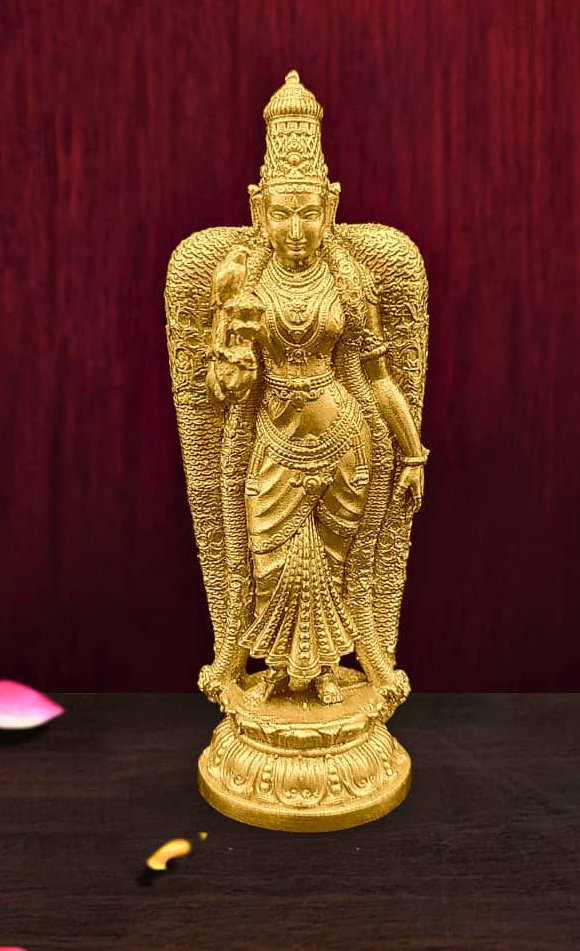
Meenakshi Amman Idol captures one of the most extraordinary goddesses in Hindu tradition — a fierce warrior princess who became a ruling queen, and whose divine marriage still draws millions of devotees to Madurai every year. Meenakshi is unlike most consort goddesses: at her own temple, she is worshipped first, with her husband Shiva honored beside her rather than above her.
Her story combines valor, prophecy and devotion in a way few other Hindu legends do, making her idol a favorite for those who wish to invite feminine strength, grace and protection into their homes. Handcrafted brass idols of Meenakshi Amman are especially cherished for pooja rooms, and Idol Brass brings this centuries-old Madurai tradition to devotees seeking an authentic piece for daily worship.
Who Is Meenakshi Amman?
Meenakshi Amman is a form of Goddess Parvati worshipped as the presiding deity of the Meenakshi Sundareswarar Temple in Madurai, Tamil Nadu. What sets her apart from almost every other Shakti form is that she is not merely a consort figure placed beside Shiva — in Madurai, she is the ruling monarch of the city, and Shiva, worshipped here as Sundareswarar, is honored as her royal consort.
Meenakshi and Sundareswarar – The Divine Couple
Sundareswarar, meaning "the handsome lord," is the form Shiva takes when he descends to marry Meenakshi. Their union is unusual in Hindu iconography: rather than the ash-smeared ascetic wanderer seen elsewhere, Sundareswarar appears here as a bejeweled, silk-clad royal husband — a reflection of Meenakshi's own status as queen of Madurai.
Meenakshi Among the Forms of Shakti
Like Kamakshi of Kanchipuram or Karumariamman worshipped across Tamil Nadu, Meenakshi belongs to the wider family of Amman goddesses central to South Indian devotion. But where many Amman forms are worshipped chiefly for their fierce, protective energy, Meenakshi is unique in combining that same warrior strength with royal sovereignty, beauty and marital grace — a rare balance of power and tenderness in a single form.
The Symbolism of Meenakshi
What "Meenakshi" Means
The name comes from the Tamil and Sanskrit words "meena" (fish) and "akshi" (eyes) — "the fish-eyed one," a poetic classical reference to eyes of exceptional, captivating beauty. It is a name that celebrates both her physical grace and the piercing clarity of her divine gaze.
The Warrior-Queen Who Ruled Before She Married
Long before her marriage, Meenakshi ruled as a sovereign in her own right, leading successful military campaigns and expanding her kingdom. This detail matters: Meenakshi is not a goddess defined by her marriage alone. She is worshipped first and foremost as a powerful, independent ruler — a symbol of feminine authority that predates and ultimately equals her union with Shiva.
The Legend of Meenakshi's Birth and Marriage
Born from the Sacred Fire
The Pandya king Malayadwaja and his queen Kanchanamala longed for a child and performed a Vedic yagna to ask the gods for a son. From the sacred fire emerged not a son, but a three-year-old girl — with three breasts. A divine voice reassured the astonished king that the child was an incarnation of Parvati herself, and that her third breast would vanish the moment she met her destined husband.
The Warrior Princess and Her Conquests
Raised as heir to the Pandya throne, Meenakshi grew into a formidable warrior queen after her father's passing. She led her armies across the land, conquering kingdom after kingdom, undefeated by any opponent she faced — establishing herself as ruler in her own right long before any thought of marriage.
The Meeting at Kailash and the Vanishing Third Breast
Meenakshi's conquest eventually brought her to Mount Kailash, Shiva's own abode. Facing her army, the gods turned to Shiva for help. But the moment Meenakshi stood before him, her third breast disappeared exactly as prophesied — and in that instant, she recognized him as her destined husband rather than her adversary.
The Divine Marriage at Madurai
Shiva agreed to marry her, and the queen returned to Madurai, where their wedding was celebrated with heavenly grandeur. This marriage — between a warrior queen and the god who alone could match her — became the founding legend of the city's most important temple, and is re-enacted every year as one of Tamil Nadu's grandest festivals.
Meenakshi Sundareswarar Temple – The Sacred Shrine in Madurai
The Meenakshi Amman Temple stands on the southern bank of the Vaigai River in Madurai, a city whose worship of this goddess-and-consort pair is said to stretch back over two millennia, with the temple's earliest construction traditionally linked to the Pandya king Kulasekara. The temple seen by visitors today, however, largely took shape under the Nayak dynasty in the 16th and 17th centuries, particularly under Thirumalai Nayak.
The complex is famous for its 14 gopurams, richly carved gateway towers, the tallest of which rises to roughly 170 feet and is covered with over a thousand sculpted figures of gods, goddesses and mythical beings. Inside, the Ayirakkal Mandapam, or Hall of a Thousand Pillars, showcases extraordinary stone carving across hundreds of intricately sculpted columns. The temple's Porthamarai Kulam, or Golden Lotus Tank, holds particular literary significance — Tamil scholarly works were traditionally said to be tested by being placed on its waters.
The temple's most important annual celebration, Meenakshi Thirukalyanam, takes place during the Chithirai festival each April, re-enacting the divine wedding of Meenakshi and Sundareswarar with grand processions that draw enormous crowds from across South India.
Spiritual Significance of Meenakshi Amman
Feminine Sovereignty – Meenakshi ruled as queen before she married, making her a powerful symbol of independent feminine strength and leadership.
Protection and Courage – Her warrior conquests reflect the protective, fearless energy devotees invoke when facing life's challenges.
Divine Union and Marital Harmony – Her marriage to Sundareswarar is widely regarded as an ideal of devoted, balanced partnership.
Beauty and Grace – Her very name celebrates captivating beauty, making her a deity associated with grace, charm and inner radiance.
Why Is Meenakshi Amman Different from Other Goddess Forms
Most Amman temples in Tamil Nadu place the goddess as the fierce guardian consort of a Shiva shrine. Meenakshi inverts this arrangement entirely — she is the principal deity of her city, worshipped before her husband, with her own royal lineage, conquests and independent rule preceding her marriage. Where many warrior goddesses are approached primarily through fear and awe, Meenakshi is worshipped with a blend of reverence, affection and celebration, embodied every year in one of Hinduism's most joyous wedding festivals.
Conclusion
Meenakshi Amman remains one of the most compelling goddesses in Hindu tradition — a warrior, a queen and a bride whose story reshapes the usual balance between god and goddess. Her temple in Madurai continues to celebrate her not as a subordinate consort but as a sovereign in her own right, beloved for her courage, beauty and devotion alike. A brass Meenakshi Amman idol offers devotees a lasting connection to this powerful, graceful goddess and the city that still calls her queen.
Comments
Log in or sign up to join the conversation.