
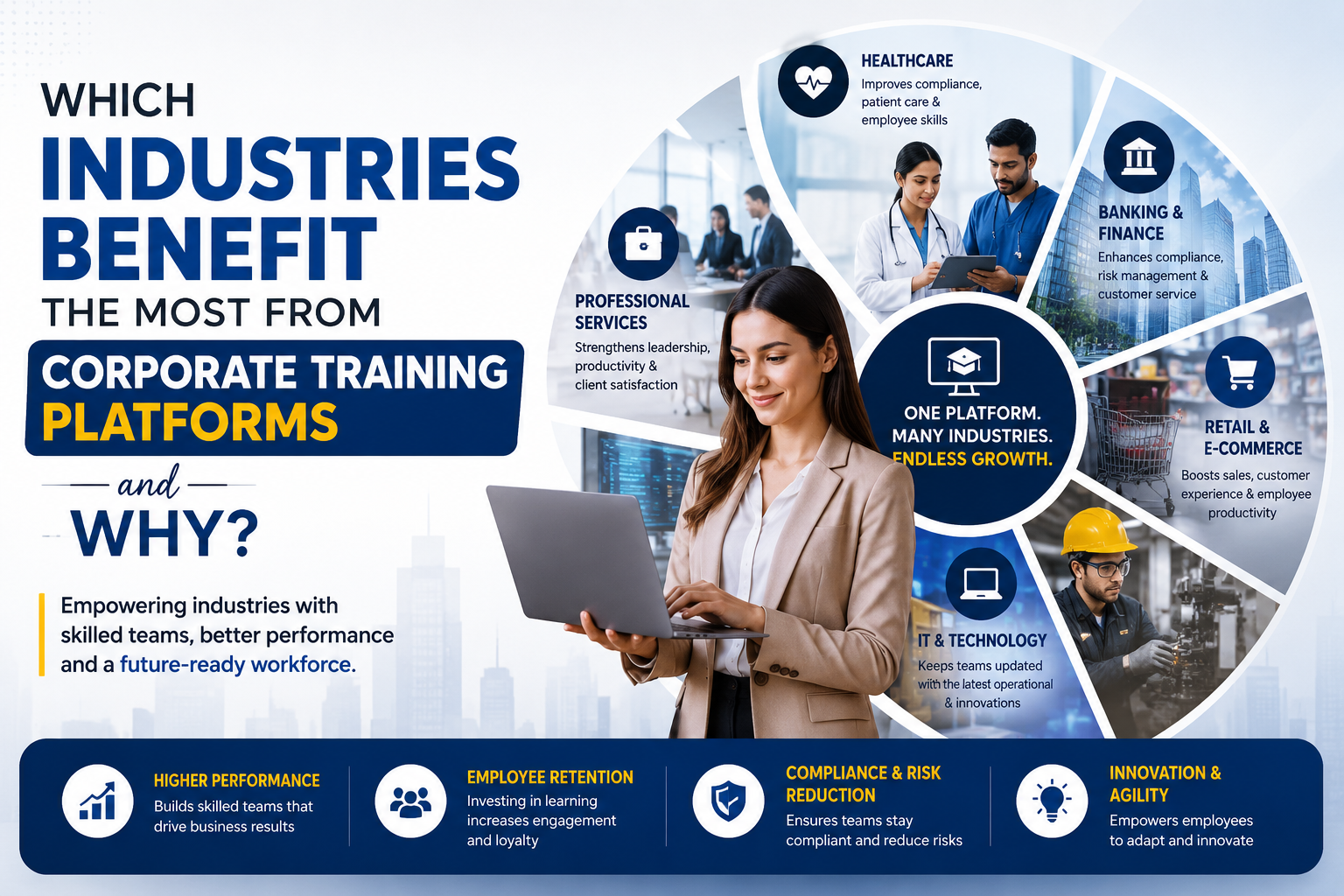
Every industry deals with skill gaps. The real difference is what happens when those gaps go unaddressed. In retail, it shows up in customer experience and lost sales. In healthcare, it affects the quality of care patients receive. In manufacturing, it hits productivity and creates safety risks. In banking and pharma, the consequences tend to be compliance failures and operational breakdowns. The industries that get the most out of corporate training platforms are the ones where workforce preparedness has a direct bearing on how well the business performs.
This is why corporate training platforms have evolved well beyond course libraries. Today's platforms function as learning systems built around one goal: making sure your workforce has the capabilities your business needs, before the absence of those capabilities costs you.
Industries That Benefit the Most from Corporate Training Platforms
1. Retail
Retail has always dealt with high turnover, seasonal hiring surges, and the challenge of getting new employees floor-ready within days. There isn't much runway for extended onboarding. AI-powered adaptive learning platforms help retailers compress that ramp-up time without cutting corners on product knowledge or customer engagement training, both of which directly affect store performance.
2. Healthcare
Healthcare professionals work in an environment that doesn't stay still. Clinical protocols get updated, new technologies come in, care standards shift. Keeping the workforce aligned with all of that requires more than annual compliance training. AI-powered training supports continuous skill development, helps staff stay current with evolving practices, and contributes to both compliance outcomes and patient care quality.
3. Pharmaceutical Industry
Pharma is one of the more demanding environments for workforce training. Employees need to stay on top of regulatory changes, updated SOPs, product knowledge, and scientific developments, all while maintaining strict GxP compliance. Falling behind on any of these isn't just an operational issue; it creates audit exposure.
Digitally validated platforms like Enthral.ai are built specifically for regulated industries. They offer audit-ready learning workflows, role-based access controls, automated compliance management, and real-time visibility into where the workforce stands on readiness, not just who completed a module.
4. Manufacturing
The shop floor today looks fundamentally different than it did a decade ago. Automation, robotics, and smart production systems have replaced many manual processes, and the workforce needs to keep pace continuously, not just at the point of hiring. Shift-based schedules, multilingual workforces, and geographically spread facilities make traditional classroom training impractical, while the stakes of unpreparedness are immediate: downtime, defects, or safety incidents.
AI-powered learning platforms address this by delivering role-specific, mobile-first training suited to shop floor conditions: short modules, vernacular language support, and assessments tied to actual job tasks. The result is a workforce that makes fewer errors, adheres more consistently to safety standards, and adapts faster when processes change.
5. Banking and Financial Services
Banks and financial institutions are navigating a lot simultaneously: regulatory shifts, digital transformation, cybersecurity threats, and customer expectations that keep moving. Corporate training platforms help these organizations stay compliant, build the skills needed for modern financial services, and ensure frontline staff can handle increasingly complex customer interactions.
How Enthral.ai Delivers Workforce Training and Skill Development Across Industries
Enthral.ai is built for organizations that want learning to drive real workforce capability, not just check a compliance box.
The platform brings together learning management, learning experience, skills intelligence, and Agentic AI in one place. That combination allows organizations to move away from static training programs and toward learning journeys that adapt as workforce needs change.
Through its AI-powered adaptive learning capabilities, Enthral.ai helps organizations:
Deliver learning experiences tailored to individual roles and skill requirements.
Map workforce capabilities against what the business actually needs.
Identify skill gaps before they show up as performance problems.
Automate learning recommendations and development pathways.
Drive engagement through experiences designed around the learner.
Scale workforce development across distributed, large teams.
For industries like retail, healthcare, pharma, manufacturing, and banking, the measure of a training platform isn't how many courses it hosts; it's how well it prepares people to do their jobs. Modern platforms are increasingly expected to do exactly that.
Conclusion
The industries that benefit most from corporate training platforms are the ones where employee capability has a direct line to business outcomes: productivity, compliance, customer experience, operational performance. As workforce demands keep shifting, organizations are moving away from traditional training models and toward learning ecosystems that can anticipate gaps, personalize development, and sustain learning at scale.
Comments
Log in or sign up to join the conversation.