

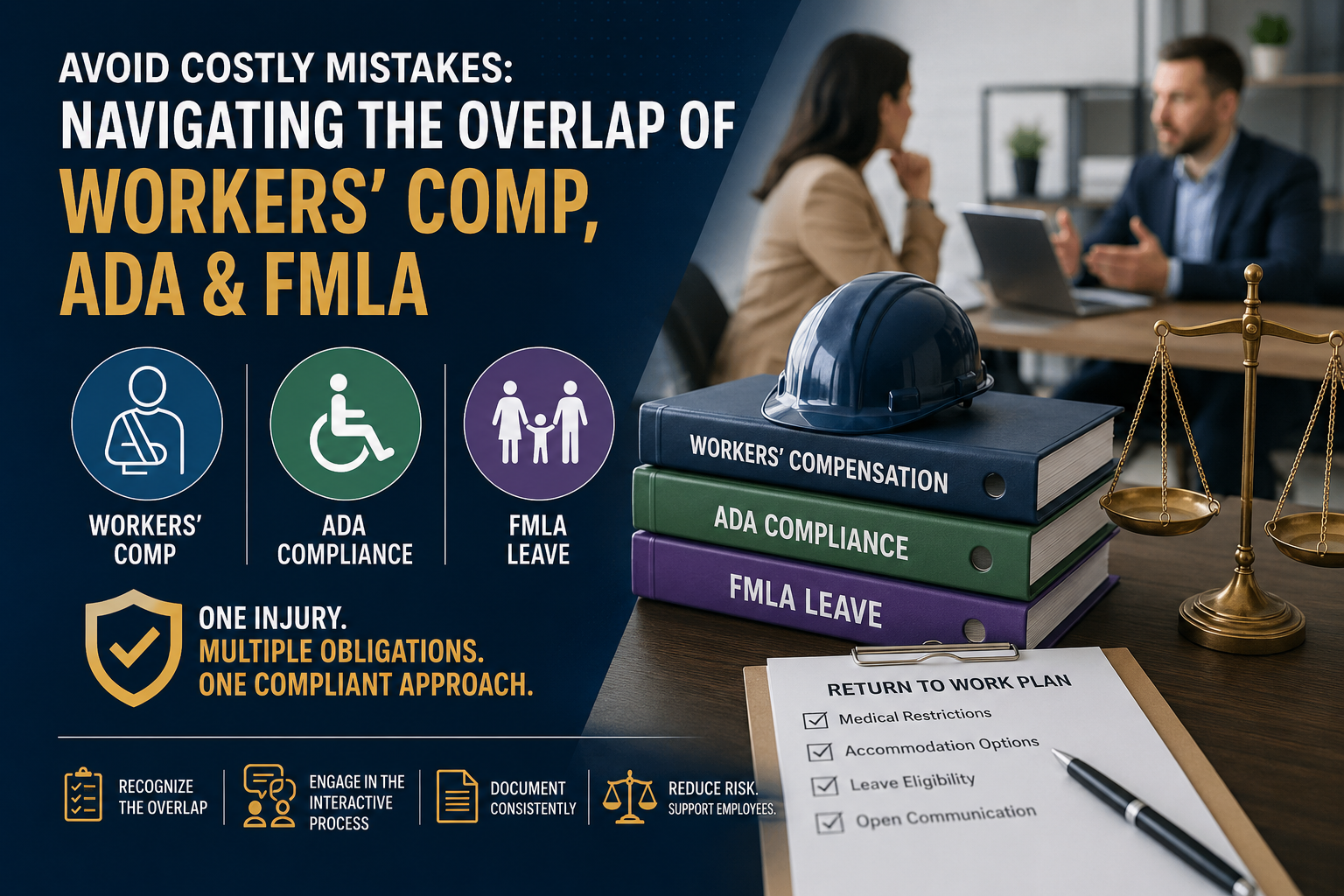
An employee gets hurt on the job, opens a workers' compensation claim, and returns to work with a doctor's note listing restrictions. For many employers, that's where the trouble starts. Workers' Compensation is treated as a stand-alone process, separate from disability law, and that assumption is exactly what creates legal exposure. In reality, a single injury can trigger workers' compensation obligations, Americans with Disabilities Act (ADA) duties, and sometimes Family and Medical Leave Act (FMLA) protections all at once. Employers who don't recognize that overlap tend to make the same predictable mistakes.
Mistake #1: Assuming a Workers' Comp Claim Isn't an ADA Issue
Workers' compensation and the ADA come from different legal frameworks with different purposes, but they frequently apply to the same employee at the same time. A workplace injury can qualify as a disability under the ADA if it substantially limits a major life activity, even temporarily. When that happens, the employer's obligations don't end with filing the comp claim; they extend into engaging in the ADA's interactive process to determine whether reasonable accommodations can get the employee back to work. Skipping that step because "it's a workers' comp matter" is one of the most common and costly errors HR teams make.
Mistake #2: Treating Light-Duty Assignments as Automatic Accommodations
Many employers assume that offering light-duty work satisfies their ADA obligations. It doesn't always. Light-duty programs are typically designed for workers' compensation purposes and may come with time limits, pay differentials, or eligibility rules that don't align with what the ADA requires. An employee may be entitled to a different accommodation altogether, such as modified scheduling, equipment changes, or a transfer to a vacant position. Employers should evaluate accommodation requests independently rather than defaulting to whatever light-duty policy already exists.
Mistake #3: Setting Rigid Return-to-Work Deadlines
A "100% healed" policy, requiring an employee to return with zero restrictions before coming back to work, is a frequent source of ADA violations. Regulators have repeatedly challenged blanket return-to-work rules because they fail to account for individualized assessment, which the ADA requires. Even well-intentioned leave policies tied to a fixed number of weeks can run afoul of the law if they don't allow for a case-by-case review of whether additional leave itself might be a reasonable accommodation.
Mistake #4: Failing to Loop in FMLA Where It Applies
Workplace injuries covered by workers' compensation can simultaneously qualify as a serious health condition under the FMLA. When that overlap exists, an eligible employee may be entitled to job-protected leave running alongside their comp benefits. Employers who fail to designate the leave properly, or who assume workers' compensation coverage automatically satisfies FMLA notice requirements, risk interference and retaliation claims. Coordinating these three laws requires cross-checking eligibility under each one rather than assuming that satisfying one authority covers the rest.
Mistake #5: Documenting Inconsistently Across Departments
Workers' compensation is often handled by risk management or a third-party administrator, while ADA accommodation requests go through HR. When these functions don't communicate, documentation becomes inconsistent, and inconsistent records are a liability in litigation. A restriction noted in a comp file but never shared with HR can mean an accommodation request effectively goes unanswered. Centralizing communication, or at minimum ensuring both teams review the same medical documentation, closes this gap.
Building a Coordinated Compliance Approach
The safest path forward is treating every workplace injury as a potential trigger for all three laws rather than assuming Workers' Compensation operates in isolation. That means training supervisors to recognize when a comp claim may also raise ADA or FMLA questions, engaging in the interactive process promptly, evaluating accommodations on their own merits rather than defaulting to standard light-duty offers, and keeping documentation centralized and consistent. Multi-state employers face an added layer of complexity, since state workers' compensation rules and local leave laws can impose requirements beyond the federal minimum.
Getting this overlap right isn't just about avoiding fines. It's about supporting injured employees through a return to work that's both legally sound and genuinely workable for the business.
FAQs
Q1.Does a workers' compensation injury automatically qualify as an ADA disability?
Not automatically, but it can. If the injury substantially limits a major life activity, even on a temporary basis, the ADA's protections may apply alongside workers' comp benefits.
Q2.Can an employer require an employee to be fully healed before returning to work?
No. Blanket "100% healed" policies conflict with the ADA's requirement that accommodations be evaluated individually rather than through a fixed, one-size-fits-all standard.
Q3.Is offering light-duty work the same as providing an ADA accommodation?
Not necessarily. Light-duty programs are usually built for workers' comp purposes and may not meet what the ADA requires, so accommodation requests should be assessed separately.
Q4.Can FMLA leave run at the same time as a workers' compensation claim?
Yes. If the injury also qualifies as a serious health condition under the FMLA, eligible employees can take job-protected leave concurrently with their workers' comp benefits.
Comments
Log in or sign up to join the conversation.