


One of the easiest ways to get AI investing wrong is to think it’s all about artificial intelligence.
It isn’t.
The biggest winners of the past three years haven’t simply built smarter AI models. They’ve repeatedly solved the physical problems that kept those models from becoming more powerful.
First it was processors. Then memory. Then the networking needed to connect thousands of AI chips together.
Now, we’re hitting another physical limit.
And I believe it hints at where the next fortunes in AI will be made.
The Bottleneck Effect
Every major technological revolution eventually runs into the same problem.
Success.
The more useful a technology becomes, the more pressure it puts on the systems supporting it. Eventually, that pressure creates bottlenecks.
That’s exactly what has happened throughout this AI boom.
When ChatGPT introduced millions of people to generative AI in late 2022, the industry’s first challenge was obvious.
It needed far more computing power than anyone had anticipated.
Graphics processing units, or GPUs, quickly became the industry’s workhorses because they could perform the massive number of calculations needed to train and run AI models.
Suddenly, the companies making those GPUs suddenly found themselves at the center of the AI revolution.
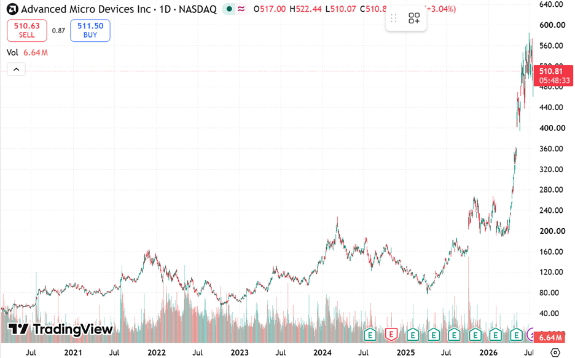
Seeing that demand for AI computing was only beginning, I recommended Advanced Micro Devices (AMD) (Nasdaq: AMD) to my readers. And as demand for AI chips accelerated, AMD became one of the biggest beneficiaries of the industry’s first major bottleneck.
But once that first bottleneck was solved, it exposed the next one.
Those powerful chips needed an enormous amount of data delivered at incredible speeds. But traditional memory couldn’t keep up.
That created a huge demand for high-bandwidth memory, or HBM.
Unlike traditional memory, HBM sits much closer to the processor, allowing it to move data much faster.
That made it one of the most important parts inside every advanced AI server.
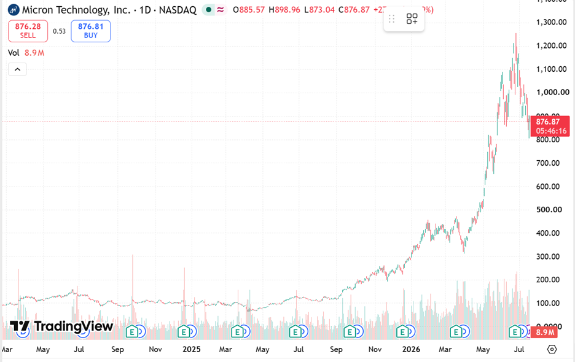
I recommended Micron Technology (MU) (Nasdaq: MU) to Strategic Fortunes readers in early 2024, arguing that memory had become “the heart of AI servers.” Within months, Micron announced that its HBM production was effectively sold out through 2025 as demand from AI customers overwhelmed supply.
And as I wrote about here, Micron’s stock price exploded.
But even that wasn’t the end of the story.
As AI factories grew larger, they began connecting thousands of processors together. Suddenly, moving information between those chips became just as important as the chips themselves.
That created another bottleneck.
Light can carry enormous amounts of data faster and more efficiently than traditional copper cables. That’s why companies specializing in optical networking suddenly found themselves at the center of the AI buildout.
It’s also why I recommended Coherent (COHR) (NYSE: COHR) to my readers in 2024, citing the growing importance of optical technology inside AI data centers.
As demand accelerated, Coherent became one of the key suppliers benefiting from the next bottleneck for AI.
In other words, the AI boom hasn’t been a single investment story.
Each time the industry solved one physical constraint, another emerged. And the companies that removed those bottlenecks usually became the next big winners.
Now it’s happening again.
Over the past year, we’ve talked quite a bit about AI’s growing appetite for electricity.
We’ve looked at data centers struggling to secure enough power from local utilities. We’ve discussed how permitting delays are slowing new construction. And we’ve even examined why transformers and high-voltage transmission equipment are suddenly becoming strategic assets.
Those aren’t isolated problems. They’re all symptoms of the same underlying challenge.
The next generation of AI systems simply requires far more electricity than the last.
Today’s most advanced AI server racks already consume roughly 120 kilowatts of power. Nvidia (NVDA)’s newest designs push that figure closer to 135 kilowatts.
But that’s nothing compared to what’s coming next.
The company has publicly discussed future AI racks capable of consuming as much as one megawatt of electricity. To put that into perspective, that’s roughly enough power to supply hundreds of average American homes.
Supplying enough electricity to make that possible will be an extraordinary engineering challenge.
The problem is that today’s AI servers weren’t designed for machines this powerful.
Most move electricity around the rack using what’s known as a 54-volt architecture. That worked well when processors used far less power.
But bigger AI systems need much more electricity. And pushing all that power through the old system creates new problems.
It generates more heat. It requires much thicker copper conductors. And every time the electricity is converted from one voltage to another, some of it is wasted.
Nvidia’s engineers recently explained the problem this way:
If future one-megawatt AI racks continued using today’s 54-volt architecture, the copper busbars carrying electricity through the cabinet could weigh roughly 440 pounds by themselves.
Imagine building a supercomputer where hundreds of pounds of copper occupy space that could otherwise hold processors.
Clearly, the industry will have to find a better way.
And somewhere a small group of companies is already working to solve this bottleneck.
Here’s My Take
Investors who’ve paid close attention to the AI boom have learned a valuable lesson.
The biggest winners haven’t just been the companies building AI models. They’ve often been the companies that solved the bottlenecks preventing AI from moving forward.
That’s why I’m increasingly asking myself where the “fourth AI fortune” might come from.
If the pattern we’ve seen over the past three years continues, the companies solving AI’s growing power challenge could become the next big winners in AI.
So that’s where I’ll be focusing my attention in the weeks and months ahead.



Comments
Log in or sign up to join the conversation.