

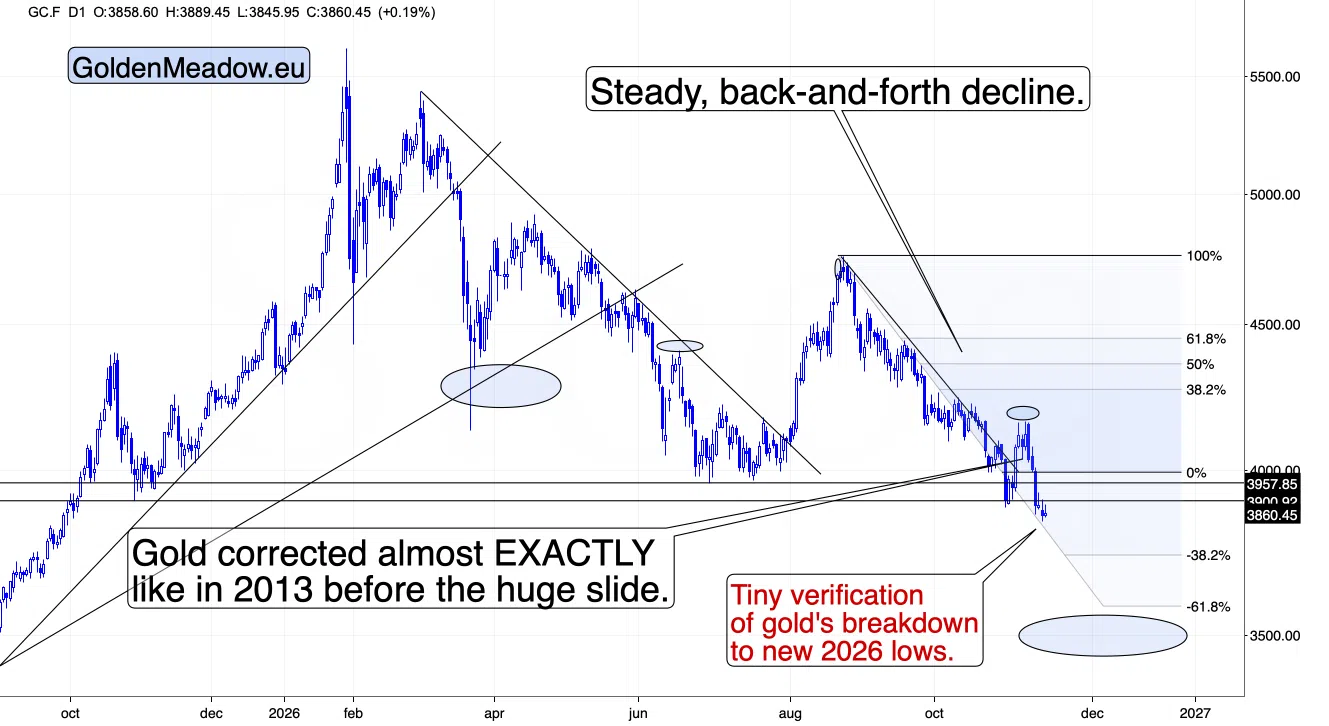
At the moment of writing these words, December gold futures trade near $3,883, after closing at $3,853.00 on Monday.
This is their lowest close since September 19, 2025. December silver futures trade near $47.55, after a 4.6 percent slide to $46.859 on Monday, their lowest close since September 24, 2025. Stocks fell for the third day in a row, and the junior mining stocks fell almost twice as much as the S&P 500.
This is the sequence that I described two months ago.
When the Stock Market's Leadership Breaks
On September 15, when gold futures traded near $4,350 and the S&P 500 closed at 7,619.98 the day before, I wrote: "When the stock market's leadership breaks, the decline does not stay in the leadership. Industrial commodities get sold as growth assets, silver gets sold as an industrial metal, gold gets sold as collateral, and mining stocks get sold as equities first and as gold proxies second, which is why the GDX in 2008 fell further than either gold or the S&P 500."
Since then, the S&P 500 has declined by 2.7 percent, gold by 11.5 percent, the GDXJ by 21.1 percent, and silver by 26.9 percent. In the 2008 financial crisis, the miners fell further than gold and the S&P 500, and this time, the GDXJ has declined almost eight times as much as the S&P 500.
Monday's slide was led by the tech stocks. The Nasdaq 100 fell 2.67 percent, and the S&P 500 fell 1.92 percent, its third decline in a row. Both indices broke below their rising support lines, moved back up to them, and turned lower again. This is how a breakdown gets verified, and Monday's slide is the move lower that tends to follow such a verification.
The miners reacted right away.
The Miners Fall Twice as Much as Stocks
The GDXJ fell 3.71 percent on Monday, to $95.35, and it plunged back below its declining support line.
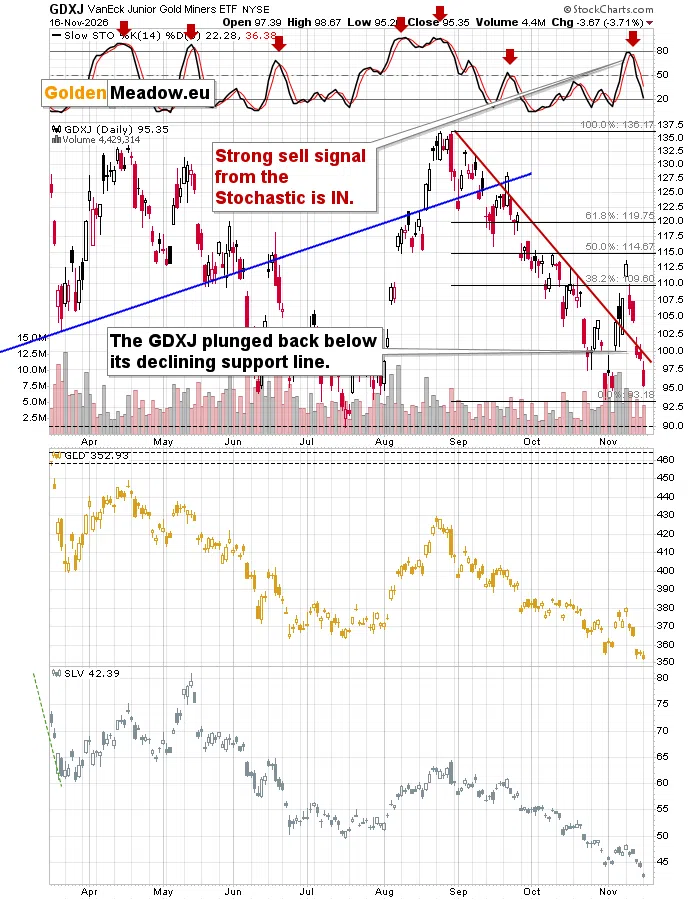
This is how the link between the S&P 500 and gold works in a decline: when stocks slide, the mining stocks are sold as stocks first, and they fall more than the metals. This morning, the GDXJ is rebounding along with gold, and it's up about 2 percent, even though the S&P 500 is down about 1.5 percent. The sell signal from the Stochastic indicator is strong, though, so I don't think that the miners' slide is over.
One stock fell even harder than the miners.
FCX: Congratulations to Those Who Shorted It
On September 2, I wrote: "This convinces me that getting back on the short side of the FCX trade when it was above $75 was indeed a good idea." On Monday, FCX plunged 6.84 percent, to $55.19, its lowest close since March 30 and more than 26 percent below $75. On October 29, I told my subscribers that FCX's lagging created another good shorting opportunity. FCX closed at $66.14 that day, and it's now 16.6 percent lower. Congratulations to all of you who took advantage of this decline.
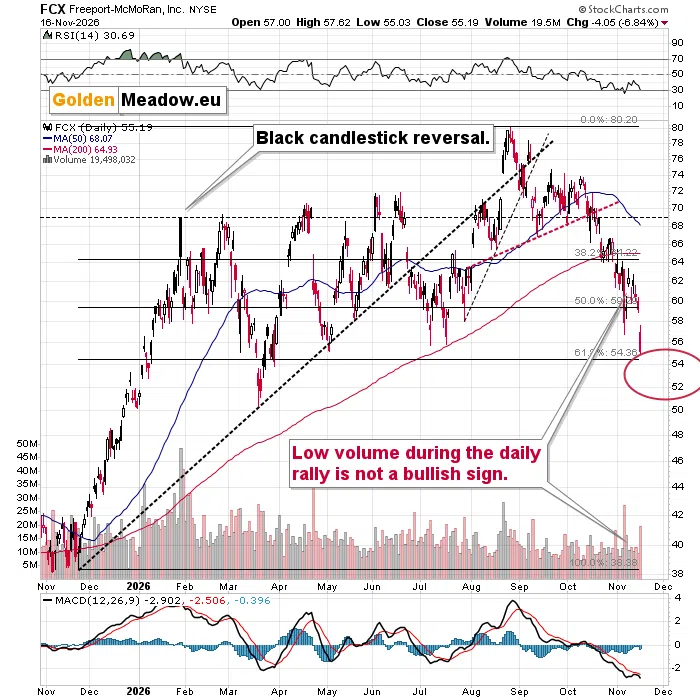
Copper points in the same direction. December copper futures closed at $6.0075 on Monday, their lowest close since May 4, and this morning, they moved down to $5.9460, their lowest level since April 9. Please note that while copper is far from its 2026 lows, FCX is almost at them.
The precious metals are following the same path.
Gold and Silver Confirm Their Breakdowns
Gold had at least three reasons to rally on Monday, and it ignored all of them. The Empire State manufacturing index fell to 7.8 in November, far below the 18 that economists had expected; the 2-year Treasury yield dropped 5 basis points; and Iran's Revolutionary Guards said that more tankers caught fire near the Strait of Hormuz. Gold futures fell $33.30 anyway. When gold fails to rally on news that should help it, it's bearish information.
This morning, gold moved up to $3,894.00, and it's near $3,883 now. In my view, this tiny upswing is another verification of the breakdown to new 2026 lows.
Silver is falling faster. On October 8, when silver futures traded near $60, I wrote: "Silver's underperformance is the sector-wide decline showing up first where it shows up most, and the move below $50 remains the medium-term outlook." Silver closed below $50 for the first time on October 30, and on Monday, it closed at $46.859. Since October 8, silver has declined by about 22 percent.
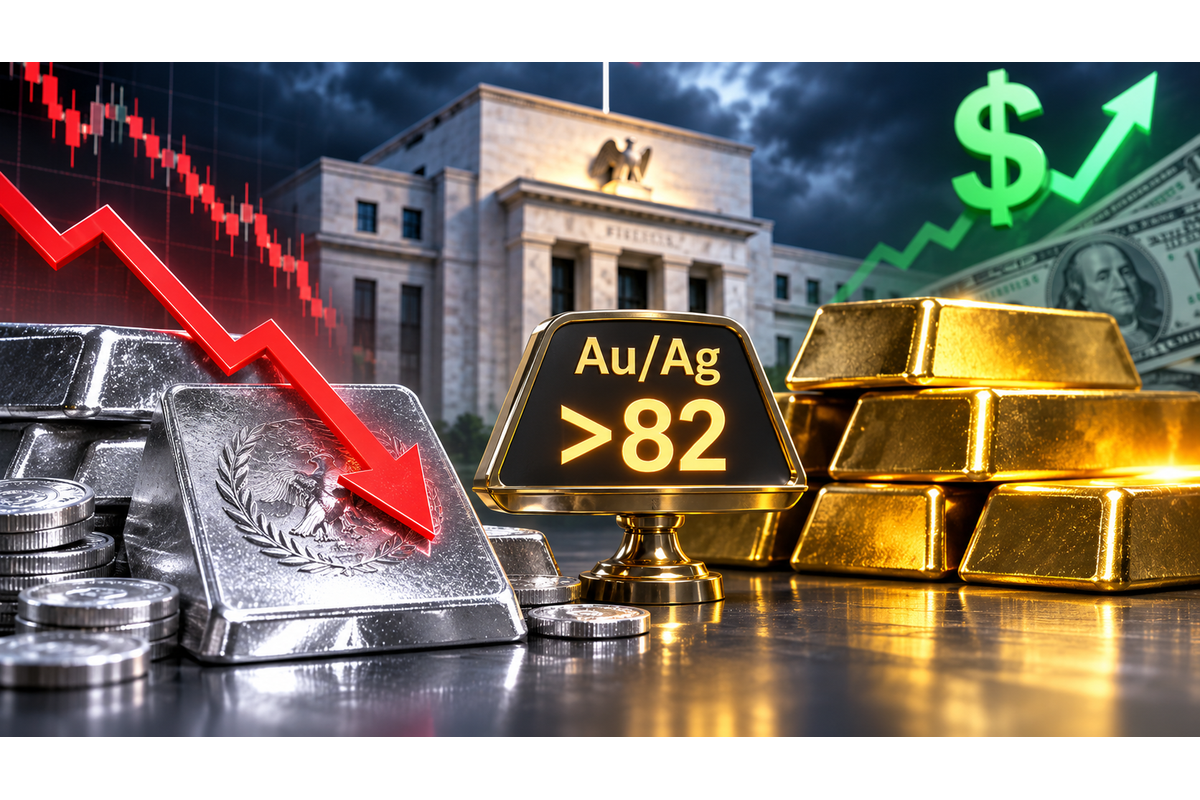
The gold-to-silver ratio rose to 82.2 at Monday's close, its highest close since November 2025. In declines, silver falls faster than gold, and the ratio rises.
The price of money keeps pushing in the same direction. The USD Index closed at its highest level since April 2025 on Monday, and the fed funds futures fully price in another step in the Fed's tightening cycle: a 25-basis-point hike on December 9.
Where This Leaves Us
Stocks verified their breakdowns and moved lower, and gold and silver are confirming theirs. The miners and FCX are falling harder than the metals, as in the sequence that I described in September.
It looks like another wave down in the precious metals sector is about to start. In my view, gold is likely to decline toward about $3,500, the target that I described in my November 2026 forecast. In today's Gold Trading Alert, I also covered the VIX, the USD Index, crude oil's failed attempt to break lower, and why oil fell while tankers burned.
When the stock market's leadership breaks, the precious metals don't stay out of it.

Comments
Log in or sign up to join the conversation.