

Market Analysis
The wheat market’s focus will likely be split between the upcoming quarterly stocks and the US producers’ prospective planting survey since both USDA reports will be released on March 31. The upcoming March 1 stocks report is important to see if wheat’s current demand trends for exports, feed and food are remaining on their targets as this food grain enters its final quarter of its crop year. After last fall’s modest decline in US winter wheat plantings (355,000 acres) vs. 2018’s 1.4 million drop, the trade will watching to see what the N. Plains producers do with their durum and hard red spring seedings.
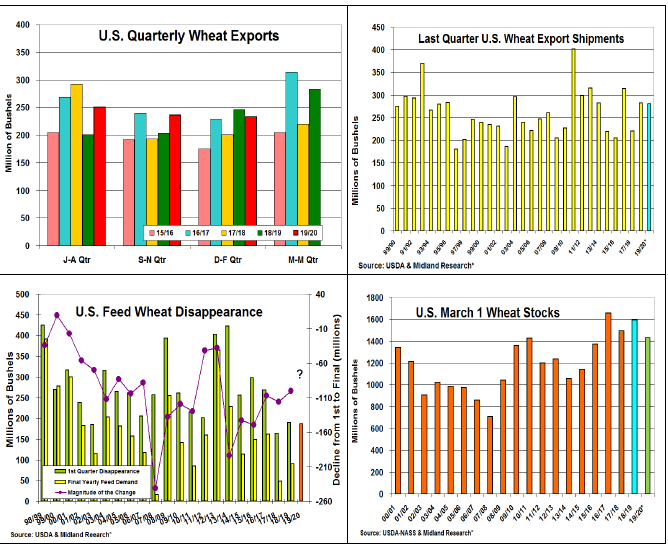
Despite the South Plains having improved moisture vs. last year’s winter period, US export sales remain 30 million bu. ahead of 2018/19 pace. Looking at shipments, US wheat’s Dec-Feb exports project a 233 million bu. quarterly pace, similar to the first two quarters of this crop year. This trend prompted the USDA to up its outlook by 25 million bu to 1.0 billion last month. However, this means the US wheat’s final quarterly exports will need to be 281 million bu, the same as last year to hit the USDA goal. The current strong US Dollar & the Black Sea crops (currently mixed) will determine if the USDA’s overseas outlook is attainable.
To measure US wheat feeding, the USDA needs to survey commercial and producers inventories on a quarterly basis (similar to corn) to determine wheat’s feed demand. Normally, wheat’s highest unexplained disappearance occurs on its September 1 report when exports are in transit & some spring wheat bushels remain in the fields. This level normally falls through the balance of year. Given soft red wheat’s 20-45% price premium to corn since December, US wheat feeding may decline more than the current 37 million bu. the USDA is forecasting, This could result in higher March stocks & a smaller yearly demand (150 million bu). With food use remaining stable, wheat’s March stocks are likely 1.43 billion bu., down 163 million vs. 2019.
What’s Ahead: The trade’s focus will switch to the N. Plains & the Black Sea Region’s growing conditions, after March 31. Reduced ND rains are needed after a very late fall & heavy snows could delay seeding. Recently, Ukraine dropped its outlook while Russia expects a larger 2020 wheat crop. Utilize the current rally to clear final 25% of old-crop Chi/KC supplies & begin 10-15% of your July output at $5.40 & $4.75.



Comments
Log in or sign up to join the conversation.