


Photo Credit: htmvalerio
Banks and the financials in general have been the worst performing sector since the 2008 financial crisis. Between near zero interest rates from endless rounds of quantitative easing and a general lack of trust regarding the industry, Wall Street has suffered. More names than not have struggled to bounce back and deliver strong quarterly earnings. Wells Fargo and JPMorgan Chase have been the lone bright spots of the industry, with both companies reporting better than expected first quarter results. However, the overall expectations remains reasonably low, as the banks continue to struggle with volatile markets, trouble in China and low interest rates. The Fed’s announcement yesterday to leave interest rates unchanged spells more trouble for Wall Street’s titans heading into the second half of the year.
(Click on image to enlarge)
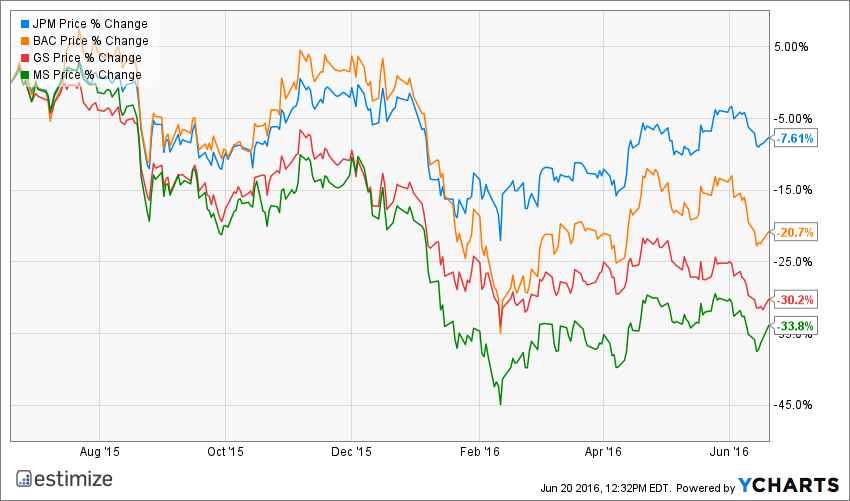
JPMorgan Chase (JPM) Financials – Diversified Financial Services
JPMorgan is the biggest of the retail banks in terms of assets under management. Its large assets base and robust balance sheet has left the company vulnerable in the event of another crisis. The company came under intense scrutiny in April after failing to pass the living will standards which are set so that the government will never have to bail out banks again. JPMorgan was one of 5 big banks that would not have access to enough capital in the event of a new crisis. Regardless, JPM has exceeded earnings expectations in 4 of the last 5 quarters and is typically viewed as one of the better performing financial institutions. Last quarter, the company featured increases in consumer banking and asset management sectors. Net interest income increased as well, despite rates staying close to zero during the period. However, significant declines were seen in commercial and investment banking sectors. Overall net income and revenue were down on a yearly basis with a high likelihood of continuing through the remainder of fiscal 2016. The Estimize community is just as pessimistic on Chase’s growth prospects in Q2. The consensus data is looking for earnings per share of $1.42 on $23.76 billion, an 8% decline on the bottom line and 3% on the top.
Bank of America (BAC) Financials – Diversified Financial Services
Retail banking has been a tale of two banks with JP Morgan prevailing and names like Bank of America still struggling to reestablish themselves. Bank of America has fallen victim to many aspects that have plagued the industry as a whole; volatile markets, low interest rates and economic uncertainty. The stock has been in a tailspin, falling 20% in the past 12 months. In the last 2 quarters BAC missed its revenue expectation by $500 million and $700 million, respectively. This trend should continue to be troubling as BofA is expecting weakness in its trading and investment banking revenues. Projected year over year declines in these segments are predicted to outpace the losses of its peers. Meanwhile, Bank of America’s volatile net interest income, increased expenses, larger capital deployment and a deteriorating energy sector will hamper earnings this quarter. Estimates for the second quarter have come down in recent months as the bank continues to exhibit weakness. The Estimize consensus is calling for earnings per share of 38 cents on $20.88 billion in revenue, a 14% decline on the bottom line and 6% on the top. Just today, Bank of America announced they would cut 8,000 retail banking jobs in an effort to save money and reinvest in high growth technology.
The Goldman Sachs Group (GS) Financials – Capital Markets
Goldman Sachs was in the news this week for reports that the bank monitors its employees emails that might represent inside trading. Since the 2008 Financial Crisis, investment banks and Goldman Sachs in particular have had to enforce more stringent compliance rules as they continue to accumulate lawsuits. One of the biggest expenses the bank has seen in recent years has been from settling cases and litigation fees. Earlier this year Goldman reached a deal to pay $5.1 billion to settle claims of faulty mortgages which resulted in dismal first quarter results. The quarter reported revenue that decreased 40% and earnings that fell a resounding 55%. Volatile markets, weak investment banking trends and slower M&A activity have also played a role in the bank’s troubles. Second quarter earnings are shaping up to be just as bad. The Estimize community is looking for earnings per share of $3.27 on $7.84 billion in revenue, a 29% decline on the bottom and 12% the top. Estimates have come down since its last reports reflecting analyst negative sentiment towards the industry.
Morgan Stanley (MS) Financials – Capital Markets
If you didn’t think things could get worse, you were wrong. Morgan Stanley has been floundering, recently watching shares drops 38% in the past 12 months. Despite a better than expected first quarter results, the bank saw earnings drop 35% and revenue fall 21%. Sliding commodity prices, worries about the Chinese economy and uncertainty about interest rates are only a few of the handful of problems scaring investors and traders. The first quarter featured losses in its fixed income & commodities, equity sales and trading, and investment revenues. Advisory revenues were the lone bright spot, increasing from $471 million to $591 million. Morgan Stanley has started to implement new cost cutting initiatives that are expected to save the company $1 billion of the next few years. This won’t be enough to save quarterly earnings that are seeing adverse revision activity. The Estimize community is looking for earnings per share of 63 cents on $8.49 billion in revenue, a 19% decline on the bottom line and 9% on the top.

Comments
Log in or sign up to join the conversation.