

Some of my friends are upset that Donald Trump is president. Others are alarmed about the possibility of war with North Korea. Microsoft is mad that NSA hacking tools were stolen (?) and used to launch a global ransomware attack that clobbered Europe and Asia. Fifteen hours a day, conservative talk radio worries about Israel. Black Americans are angry about policing. White Americans are horrified by crime. European bureaucrats are demanding tens of billions from Britain to fund EU pensions as a price of exiting the EU. American college students won't tolerate "hate speech" on campus, and they're agitating for free education and health care. U.S. doctors are quitting the profession in droves, and health insurers are withdrawing from state after state, losing money. Republicans can't seem to pass new legislation of any kind, despite holding a majority in both houses of Congress, with a Republican White House. The geniuses at Google want gender equality in entertainment, more screen time for women. Russia worries about bellicose American posturing, and we condemn Russia for a long list of wrongs. Meanwhile, China, Japan, and Saudi Arabia are bankrupt, skating on thin ice papered over with debt. Another Wall Street crash is inevitable, merely a question of when.
All of these concerns and conflicting interests are, uh, fine.
What's wrong with the world, in my view, is something slightly different. People have lost sight of how recently we became well-fed and prosperous, blithely unconscious of liquid energy production. At the moment, oil is cheap because we're using less, but oil supplies are flowing from rusting rigs in the Gulf of Mexico through a crumbling infrastructure of pipelines built 50+ years ago. Shale has never made a dime of "full cycle" net profit, except wet gas production in the Marcellus that provides cheap fuel for heating and cooling in the Northeast -- New York, Boston, Philadelphia, Baltimore, Washington -- served by relatively new pipelines and newly built gas-fired power plants. But that has nothing to do with crude oil or refined products like gasoline, diesel, and jet fuel, liquid energy for transport.
Oil matters first, most, and always because it powers 95% of U.S. transportation. Farm to market. Bunker fuel for ships. Passenger cars. Jet aircraft. Heavy equipment for construction and mining. Asphalt for roads. Lubricants that every machine, every pump, everything with wheels has to have, including our commercial fleet of 350,000 big rigs and 25,000 diesel rail locomotives. Oil is our industrial lifeblood. No oil, no food or water or plastics. Hate plastic, do you? Without it there's no sterile surgery, no medical labs, no packaging, no consumer products like bleach, cell phones, Chapstick, bottled water. You and your loved ones need oil, every day all day and night to survive, because you're unfit to like cavemen or nomads, subsisting hand-to-mouth on roots and berries and wild game.
Sorry, electric cars and solar panels are expensive toys, less than 2% of the energy picture, if you include wind farms, biomass, gas-powered buses, delivery vans, and hybrids. Tesla could not exist without lavish Federal and California subsidies -- your tax dollars at work for the unearned benefit of "ecologically minded" upscale oil consumers. No oil, no food in grocery stores, no tractors or harvesters, no meat, milk, cheese, wheat, sugar, or pots and pans. Living without oil is not a good option, however much you want to "save the planet." People are eager to live better and healthier, not worse and sickly and poor. If you have a job, it's because oil powers it. If you need a cop or an ambulance, they operate on oil. Electrical wire insulation and plumbing parts are made from oil. Global trade runs on oil. Without imports, your cost of living would skyrocket. WalMart and Apple would shut down, unable to perform the miracle of sourcing products from China, Korea, Thailand, Malaysia.
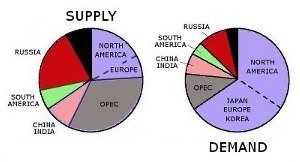
It's pretty simple, really. No oil, no carpeting or vinyl under your feet, no roof over your head, no car, no cheap fresh food. And I solemnly affirm that oil is NOT an inexhaustible resource. Most of it is in Russia and the Middle East, a few puddles in war-torn, corrupt Africa.
Two world wars, 1914-18 and 1939-45, were fought over oil. Germany had no oil. Britain had no oil. Japan had no oil. They fought over oil in Romania, Persia, and the Dutch East Indies. America prevailed because we were the world's #1 oil producer at the time. We built planes and ships by the tens of thousands, transported millions of soldiers and supplied them with food and fuel and weapons that no one else on earth could hope to match, because we were rich with oil (past tense). By 2003, we were reduced to seizing Iraqi oil (temporarily), a plan that failed because Americans did not grok what was happening or why. Wars are fought for oil, not "nation building" or purple ink on somebody's finger.
When you consider that most of the remaining oil is in Russia and Arabia, our foreign policy becomes a lot less confusing. Strip out the noise and bluster about human rights. We want to stay on cordial terms with oil producers, because world peace and prosperity depends on the oil trade. Freedom of the seas means supertanker oil exports to Japan, Germany, China, and (yep) the United States. Britain will join the list soon, because North Sea wells have declined in production, after 50 years of heroically exploiting it to the last drop of oil.
It is an uncomfortable fact of science that oil exists because organic matter and carbonates were buried by millions of years of erosion and sand and silt. No dinosaurs involved, none. Geologists and drillers became good at finding oil in saturated rock worldwide. What they found also was pretty scary, that the "elephants" (huge oil resources) were few and known, no happy surprises left anywhere on Earth. What we've been doing in the 21st century is to scrape the bottom of the barrel, expensive fracking, tar sands, little discoveries in ultradeep water or international joint ventures with crooks in Kazakhstan and Siberia.
At the moment, you can't feel it, because the U.S. economy is stagnant, no growth on Main Street, and reduced demand for oil has held the price down. Worldwide oil production is sufficient to limp along comfortably at present -- with a hidden penalty. It's hollowing out Saudi Arabia's finances, and it shut down unprofitable Canadian and U.S. production. Not good news. We're in an "energy trap." If demand picks up, the price of oil will rise and stunt growth. If there's a recession like 2008 again, oil companies will go bankrupt, or consolidate and lay off staff. Oil exploration and production is not a wildly profitable business, despite the folk lore about pioneer wildcatters and Gilded Age oil barons. To fear and hate 21st century oil companies like 19th century "robber barons" is more than stupid, it's willful disregard for factual data, clinging to a conspiracy theory that expired long before you were born. All oil companies in the United States are competitive, publicly traded corporations, trying to make a profit on declining wells and rising costs.
Some people think Big Oil is a safe investment and buy shares of Exxon, Chevron, Shell for pension funds and retirement portfolios. Little dividends are paid every quarter. But there's no astronomical triple-digit growth like Apple, Amazon, Google. Paradoxically, Big Oil is more high tech than most of the tech giants in Silicon Valley. Take my word for it as an insider industry analyst. They use more computing power to search for, develop, and produce oil than any other private or public activity, including military forces and intelligence gathering agencies. The F-35 is a marvelous new aircraft with high tech controls, a very costly development program. Drop in the bucket compared to oil company supercomputers and the capital investment required in a single new deepwater installation.
It might help a little to lighten up various Executive Orders and regulatory hurdles that block offshore exploration in California -- but, really, it doesn't matter at this point. Our problems are much bigger than that, specifically pipeline infrastructure. Keystone XL does not fix it. There are hundreds of thousands of miles of oil and gas pipelines in America that are nearing (or long past) the end of their dependable service life, slowly being eaten by corrosion. If our bridges need maintenance, imagine what iron pipe buried underground or in salt water looks like.
I wish it were that simple, print a trillion dollars of public money to replace our pipelines and refurbish refineries -- but it's not worth it. Fairly soon there will be less oil to pump through existing infrastructure and deliver to your neighborhood gas station by tank truck. When crude oil went to $100 a barrel, it hammered demand. We drove fewer miles and did without expensive meat and fish, bought fewer cars, shopped for bargains. Oil fell sharply, then crashed again, struggled for equilibrium in the New Normal of economic stagnation. North Dakota is kaput at $50 a barrel -- and storage at Cushing is full.
That's the good news. We can fill up our cars at $2 a gallon unleaded in the Midwest, always more expensive in California because they have higher taxes and higher transport costs. It doesn't matter what the price of gasoline is today. The problem is a darker future when U.S. firms produce less oil. The remaining reserves in North America are difficult to find and expensive to produce. Most of the world's oil reserves are Russian. Forget spendthrift Saudis and Venezuela in the grip of civil war, twin disasters that cannot be remedied, not even by force of arms. Ditto Iran and Iraq, mired in prayers five times a day and endemic graft. And Africa is far worse.
It's conceivable that the U.S. could work with Russia, but we have to rethink our diplomatic strategy, stop talking about Putin like he's an evil monster. Rapprochement will not be easy. Not that long ago Exxon, BP, and Shell got shafted in joint ventures with Russian partners. It's good that Rex Tillerson was nominated and confirmed as Secretary of State. The Exxon CEO knows as well as anyone how important it is to develop new joint venture projects. The press had palpitations when President Trump met with Russian officials at the White House recently, but that's what a working relationship will require, open handed diplomacy and cooperation.
Alternatively, we could invade and conquer Mexico, fire everyone at Pemex and auction off vast ultradeep blocks in the Gulf -- but I don't think anyone has enough money to gamble on the Perdido Fold Belt, complicated geology far from the existing pipeline network. That's the problem in deepwater Brazil, too. Tight oil under three miles of water plus two miles of salt and a rugged seafloor that precludes pipelaying. It doesn't matter what Brazilian politicians think they're doing with structured finance and Chinese loans. Santos pre-salt is uneconomic tight oil.
I want to end on a positive note. But that would be lying.
U.S. crude oil production is in long-term decline. There was a little boost from Prudhoe in Alaska and another boost from the Bakken and Eagle Ford shale plays, but those were blips compared to growing demand for oil since World War II. America is destined to be a net importer forever, to sustain what we've become, a pampered society that drives cars and flies commercial jets and eats well because farms are mechanized and food is trucked to cities and suburbs.
What ordinary people can do about this problem is "reduce, reuse, recycle." Our future will be less dependent on transport. It's always good to spend less and save more for a rainy day -- in this case, a rainy day with no car in the driveway, crowded buses, and fewer selections available at Kroger and Whole Foods. I know that sounds dire, horrible gloom and doom. Americans are resourceful, someone will figure it out, we'll never go without, right? Okay, fine. Working it out is going to be a question of working with Russians.
It's time to end the Cold War. That means mothballing NATO and our Fifth Fleet. Our future prosperity does not require defense of Israel or Saudi Arabia or Iraq. It requires a partnership with Russia, strategically and industrially. If we refuse, the Chinese will eat our lunch.

Comments
Log in or sign up to join the conversation.