

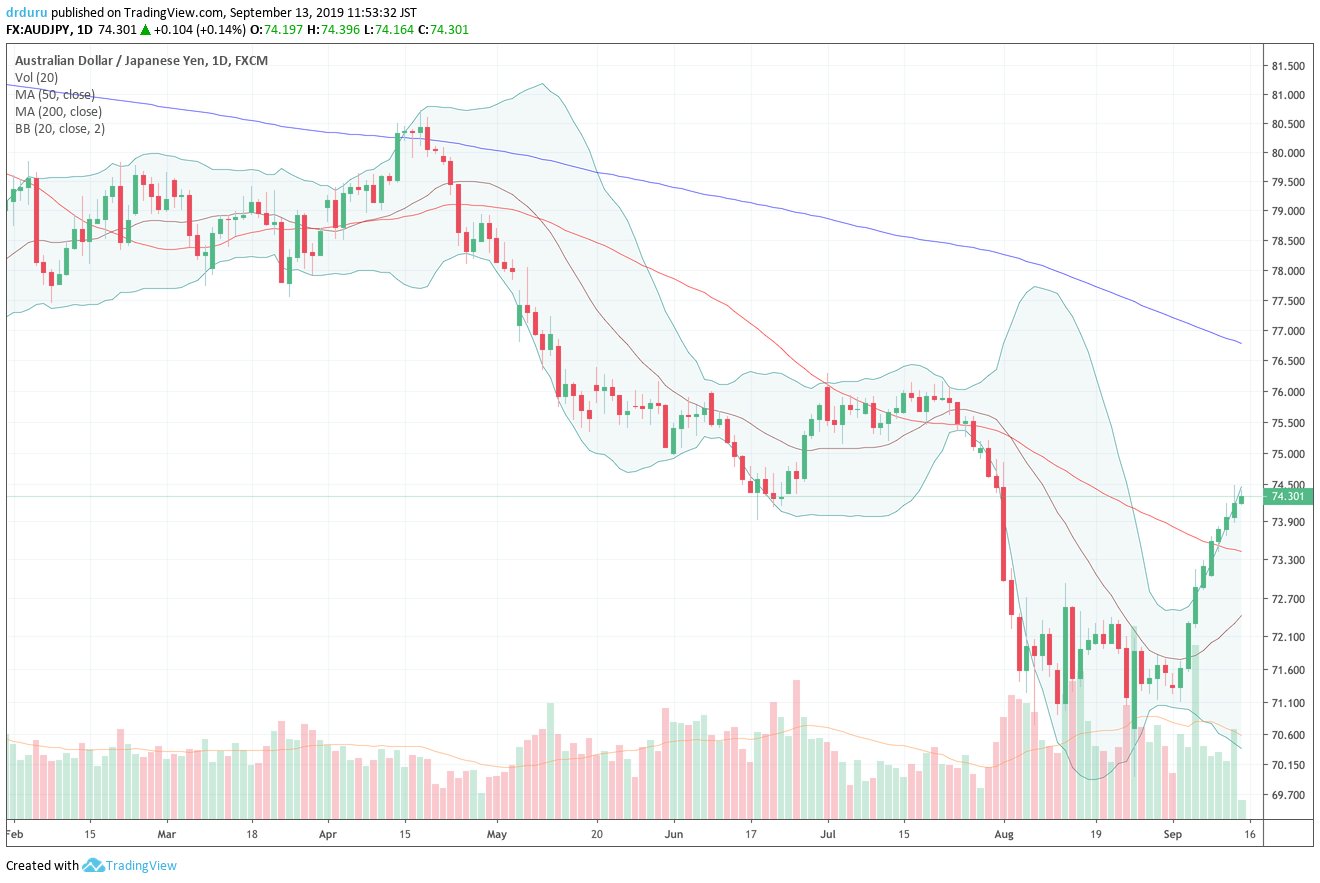
It seems like an eternity, but it was just over two weeks ago I showed plenty of market evidence that the US versus China Trade War was weighing more and more heavily on financial markets. After the S&P 500 (SPY) made an obvious breakout last week, the weight immediately lifted. However, the currency market still provides the clearest signal that Trade War fears are abating. The Australian dollar (FXA) versus the Japanese yen (FXY), or AUD/JPY, speaks a global language of risk appetites. This currency pair is working on a 9-day winning streak and has essentially reversed all its losses from August. Recall that AUD/JPY was just trading at levels last seen in the immediate wake of the financial crisis in April, 2009.
Source: TradingView.com
Both China and the U.S. have been floating tantalizing hints that "this time is different" when it comes to the prospect for another round of "constructive" talks. The latest hint is quite telling in that it opens up the prospect of signing a deal that accomplishes little of the headline demands but opens the possibility of a bullish detente. From Reuters:
“I’d rather get the whole deal done,” Trump told reporters at the White House. “I see a lot of analysts are saying an interim deal, meaning we’ll do pieces of it, the easy ones first. But there’s no easy or hard. There’s a deal or there’s not a deal. But it’s something we would consider, I guess.”
First of all, it is notable to see President Trump acknowledge that he is listening to and considering the merits of "analysts." Secondly, this response does not require a positive interpretation, but the market's presumed positive response reveals that the path of least resistance is upward.
While I am willing to ride this momentum higher in short-term, ultimately, I agree with the conclusion of the Reuters piece:
William Reinsch, a former senior U.S. Commerce Department official, said the goodwill gestures should help, but big hurdles remained.
“Both sides are trying to find a way out of the box,” he said. “Short term, that’s good. But I don’t think anything’s changed on the fundamentals, and once they get back to the table, they’ll discover that.”
So after the stock market flips into overbought trading conditions and new marginal all-time highs, I will be on alert for the next signs of topping in the stock market.
(For a review of the greater trading significance of AUD/JPY, see "Why the Australian Dollar and Japanese Yen Matter for Stock Traders.")
Be careful out there!
Full disclosure: short AUD/JPY (as a hedge against bullishness)


Comments
Log in or sign up to join the conversation.