

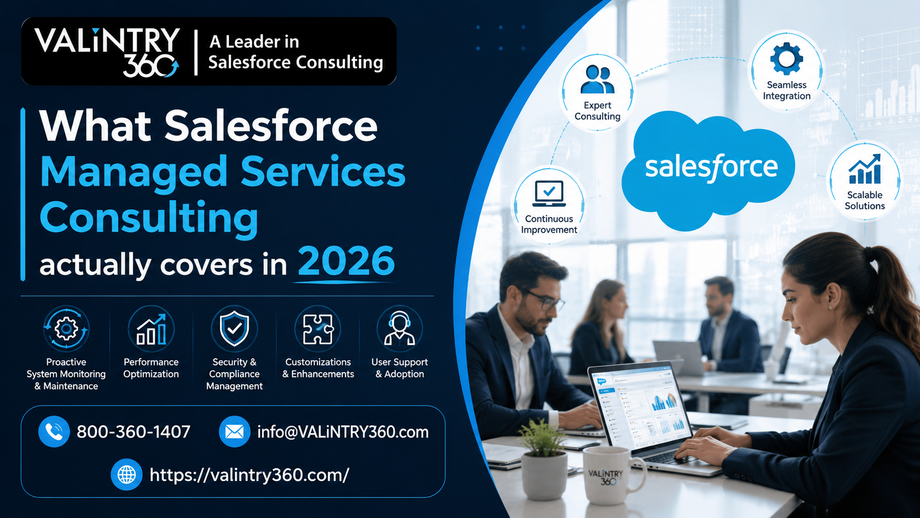
Most businesses buy Salesforce, configure it once, and then let it drift. Features go unused, data gets messy, and updates arrive faster than anyone can test them. That gap is exactly what Salesforce Managed Services Consulting is built to close. It's an ongoing partnership that keeps your CRM tuned, secure, and aligned with how your business actually runs, not a one-time project that ends at go-live.
VALiNTRY360 works with companies who've outgrown basic admin support but aren't ready to hire a full internal Salesforce team. Here's what this kind of Salesforce support really includes in 2026, and why it's become a standard part of running Salesforce well.
Strategy and planning come first
Good Salesforce managed services work doesn't start with a ticket queue. It starts with a clear look at your business goals, your current Salesforce setup, and the gaps between them. A consulting partner should assess your existing processes, map a roadmap tied to real objectives, and set priorities before touching a single workflow.
This planning stage matters because it prevents the most common failure mode in CRM projects: solving problems nobody asked about while the real bottlenecks stay untouched. VALiNTRY360 treats this step as foundational, not optional. Skipping it is how businesses end up with a Salesforce org that's technically functional but never quite fits how people work.
Development, customization, and integration services
Once the roadmap is set, the real build work begins. This covers custom app development, workflow automation, and UI changes that make the platform easier for your team to use day to day. It also covers Salesforce integration services: connecting your CRM to ERP systems, marketing tools, and analytics platforms so data moves in real time instead of living in separate silos.
Integration is where a lot of managed services work quietly pays for itself. Disconnected systems create duplicate records, manual data entry, and decisions made on stale numbers. A consulting partner builds these connections with APIs and middleware, so information flows correctly the first time and stays that way as your systems change.
Administration and day-to-day support
This is the piece most people picture when they hear "managed services": ongoing Salesforce administration support. That means user setup, access control, role configuration, routine health checks, and a help desk when something breaks. It's the unglamorous work that keeps a CRM running smoothly, and it's the reason teams stop losing hours to small technical issues every week.
Salesforce release management also lives here. Salesforce ships 3 major updates a year, and each one can shift how existing features behave. A managed services partner tests these updates in a sandbox before they touch your live environment, so your team never gets blindsided by a change nobody planned for.
Security, compliance, and data quality
Data security and compliance sit at the center of Salesforce Managed Services Consulting, especially for regulated industries like healthcare, finance, and insurance. This work includes scheduled security reviews, multi-factor authentication, encryption standards, and ongoing compliance oversight for frameworks like GDPR and HIPAA.
Data quality gets the same level of attention. Duplicate records, inconsistent fields, and outdated entries quietly erode CRM performance until reports stop matching reality. Strong data governance, routine cleansing, and validation rules keep records accurate enough to trust when a decision actually depends on them.
Continuous optimization, not a one-time fix
The biggest shift in how businesses think about Salesforce is this: optimization isn't a project you finish. It's a habit. This kind of ongoing Salesforce support builds that habit through regular performance reviews, early issue detection, and steady rollout of new Salesforce capabilities as they become available.
This continuous approach solves a problem that trips up a lot of companies: over-customization. Heavy, one-off customization slows performance and makes every future update harder. A managed services partner recommends practical, result-focused configurations instead, which keeps the platform flexible and easier to maintain long after launch.
Why this matters for ROI
Here's the part that gets missed in a lot of Salesforce conversations: the platform itself doesn't create ROI. How it's run does. Companies that treat Salesforce as "set it and forget it" tend to see usage drop, workarounds pile up, and the system slowly stop reflecting how the business actually operates.
A strong managed services partnership flips that pattern. Certified experts handle the technical work, so internal teams can focus on strategy instead of troubleshooting. Analytics turn into real decisions instead of dashboards nobody checks. And support scales up or down as your business changes, so you're never paying for more than you need or scrambling for help you don't have.
Why businesses choose VALiNTRY360
VALiNTRY360 approaches Salesforce Managed Services Consulting as a long-term partnership, not a support contract you renew out of habit. The team combines certified Salesforce expertise with structured project methods and clear, ongoing communication, so priorities stay aligned even as your business grows or shifts direction.
That combination shows up in the details: sandbox-tested releases, documented data governance, and a roadmap that gets revisited instead of shelved after the first quarter. For companies in banking, healthcare, retail, insurance, and beyond, VALiNTRY360 built its Salesforce consulting model around the idea that a CRM should get better with time, not just stay operational.
What to ask before you sign a contract
Before choosing a partner, ask a few direct questions. How do they handle release management and sandbox testing? What does their Salesforce health check actually measure? How is the service-level agreement structured, and does support scale as your user count grows? A partner who answers clearly, with specifics instead of general reassurance, is usually the one worth hiring.
The bottom line
Salesforce Managed Services Consulting covers a lot more ground than routine maintenance. It's strategy, development, integration, administration, security, and continuous improvement, all working together so your Salesforce investment keeps paying off instead of quietly losing value. If your CRM feels like it's coasting rather than growing with your business, that's the clearest sign it's time to bring in a partner who treats it that way. VALiNTRY360 is ready to help you get there.
For more information, visit VALiNTRY360 or contact us at 800-360-1407 or send mail [email protected] to get more quote.
Comments
Log in or sign up to join the conversation.