

Every POSP platform claims to be the easiest way to sell insurance from your phone. But once you're actually issuing policies, chasing commissions, and handling customer queries, the differences between the best POSP app and a barely functional one become obvious fast. Choosing the right one affects how much you earn, how many products you can offer, and how smoothly your day-to-day work runs.
Why the App You Choose Matters More Than It Seems
A Point of Sales Person (PoSP) is an IRDAI-certified intermediary who can sell simplified, pre-underwritten insurance products from multiple insurers through one unified platform, unlike a traditional tied agent who is restricted to a single insurer per category. That flexibility is the entire value of being a POSP — but you only get it if the app you're using actually delivers on it. A weak app limits you to a handful of insurers, delays your commission payouts, or leaves you without support when a customer has a claim question. A strong app is what turns the POSP model's promise of flexibility into real, usable earning potential.
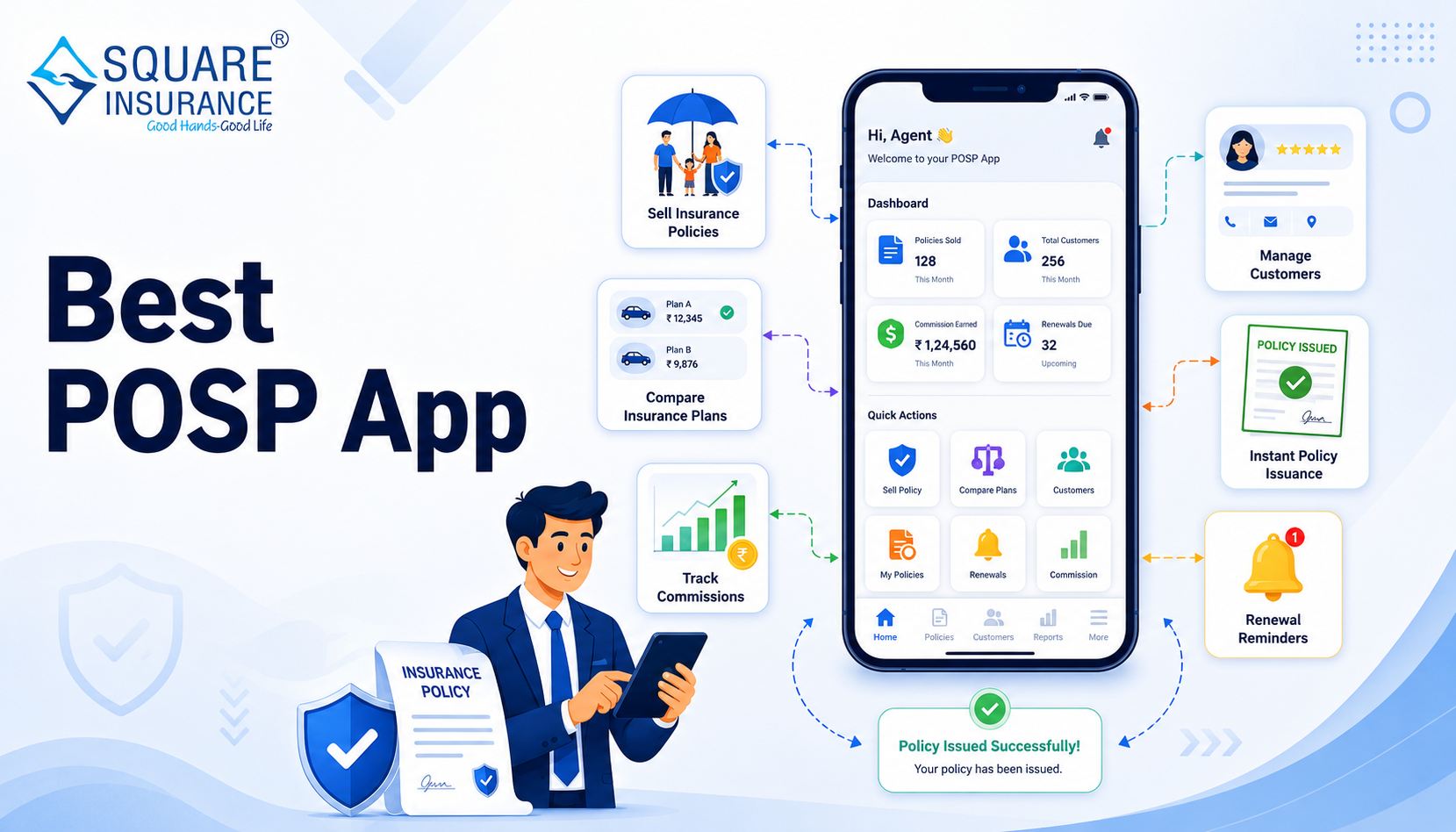
Core Features That Define the Best POSP Apps
1. IRDAI-Compliant Registration and Licensing Support
A genuine POSP app should register you as an IRDAI-recognised Point of Sales Person, not just as a lead-generation affiliate. This means it should guide you through eligibility checks, Aadhaar-based digital onboarding, e-KYC, and the mandatory training hours required before you're certified to sell.
2. Access to Multiple Insurers on One Dashboard
The core advantage of the POSP model is being able to compare and sell policies from several insurers instead of being tied to one. Look for apps that offer a genuinely wide panel across motor, health, life, and travel insurance, not just two or three tie-ups dressed up as a "multi-insurer" platform.
3. Instant, Paperless Policy Issuance
Recent regulatory updates have pushed the industry toward fully digital, Aadhaar-based onboarding and instant e-KYC. The best apps reflect this by letting you generate quotes, collect customer details, and issue a policy entirely on the phone, without physical paperwork or lengthy back-and-forth.
4. Transparent, Real-Time Commission Tracking
You should be able to see exactly what you've earned, what's pending, and when it will be paid, inside the app itself. Apps that hide commission structures, delay payouts without explanation, or make you chase support for basic earnings data are a red flag, regardless of how polished the interface looks.
5. Structured Product Training
Since POSPs sell pre-underwritten, simplified products across categories they may not have deep expertise in, ongoing product training matters. The best apps offer structured modules covering policy features, exclusions, and selling guidelines, not just a one-time certification video.
6. Post-Sale and Claims Support
Selling the policy is only half the job. Customers will come back with renewal questions, claim intimation needs, or documentation issues. An app that offers digital post-policy support, renewal reminders, and a clear claims-assistance workflow protects your relationship with the customer and your long-term commission from renewals.
7. Performance and Client Management Tools
As your client base grows, spreadsheets stop being practical. Better POSP apps include a dashboard for tracking client policies, renewal dates, and your own sales performance, which becomes essential once you're managing more than a few dozen customers.
Comparing What "Best" Should Mean for Different Agents
New POSPs just starting out - Strong in-app training, low/no onboarding cost, simple UI, responsive support
Motor insurance–focused agents - Wide insurer panel for car/two-wheeler/commercial vehicle, quick quote comparison
Health insurance–focused agents - Access to major health insurers, waiting-period and exclusion clarity in-app
Agents scaling a client base - Commission dashboards, renewal reminders, client management tools
Rural/Tier-2 and Tier-3 agents - Offline quote capability, regional language support, phygital (in-person + digital) backup
Questions to Ask Before You Commit to an App
Is the platform's IRDAI registration and the app's compliance status clearly stated?
How many insurers can you actually quote and issue policies from — not just advertise?
How and when are commissions paid, and can you see this breakdown yourself?
What happens if a customer needs claim assistance — does the app support this, or are you on your own?
Is there a real onboarding/training cost, and is it disclosed upfront?
Can you cross-sell life and non-life products, or does the app restrict you to one category?
Mistakes Agents Make When Choosing a POSP App
Signing up based only on commission percentage without checking payout reliability or delays
Assuming a large insurer list means a wide active panel — some apps show insurers you can't actually issue policies for yet
Ignoring post-sale support quality until a customer's claim gets stuck and there's no help available
Skipping the fine print on training costs that are sometimes bundled in as hidden onboarding fees
Choosing an app purely for its interface while overlooking whether it's actually IRDAI-compliant
Final Word
There's no single universally "best" POSP app — the right one depends on which products you want to sell, how much support you need as you grow, and how transparent the platform is about commissions and compliance. What consistently separates strong apps from weak ones is IRDAI-compliant onboarding, a genuinely wide and active insurer panel, real-time commission visibility, and dependable post-sale support. Evaluate any app against those four pillars before you commit your time to it.
Frequently Asked Questions
Q1. What is a POSP app used for?
A POSP app lets an IRDAI-certified Point of Sales Person compare, quote, and issue insurance policies from multiple insurers, track commissions, and manage clients, all from a single mobile platform.
Q2. Is it free to join a POSP app?
Many POSP platforms offer zero-investment onboarding, but some bundle training or certification costs into the process. Always confirm whether there's any fee before registering.
Q3. Can a POSP sell both life and general insurance through one app?
Recent regulatory reforms have encouraged composite access, allowing a single POSP to cross-sell across life and non-life products without needing separate enterprise licenses, provided the app and insurer tie-ups support this.
Q4. How is POSP commission different from a traditional agent's commission?
POSP commissions are typically capped and structured similarly to agent commissions but can vary by product and insurer. The app should show you the exact rate before you sell a policy, not just an average estimate.
Q5. Do I need technical skills to use a POSP app?
No. Most POSP apps are designed for first-time users with no technical background, requiring only basic smartphone familiarity to generate quotes and issue policies.
Conclusion
The best POSP app isn't the one with the flashiest homepage — it's the one that gets your IRDAI compliance right, gives you a genuinely wide and active insurer panel, pays you transparently, and backs you up when a customer needs post-sale support. Agents who evaluate apps against these fundamentals, rather than commission percentages alone, tend to build steadier, more sustainable insurance businesses.
Comments
Log in or sign up to join the conversation.