
When exploring the vast world of Linux, choosing the right distribution (or "distro") can feel overwhelming. You have user-friendly giants like Ubuntu, rock-stable enterprise clones like AlmaLinux, and highly customizable rolling releases like Arch.
Amidst these choices, Fedora Workstation holds a unique and respected position. Often considered the gold standard for developers, tech enthusiasts, and purists, Fedora strikes a delicate balance between cutting-edge innovation and polished reliability.
So, what exactly sets Fedora Workstation apart from other operating systems? Let's dive into the core features that make it unique.
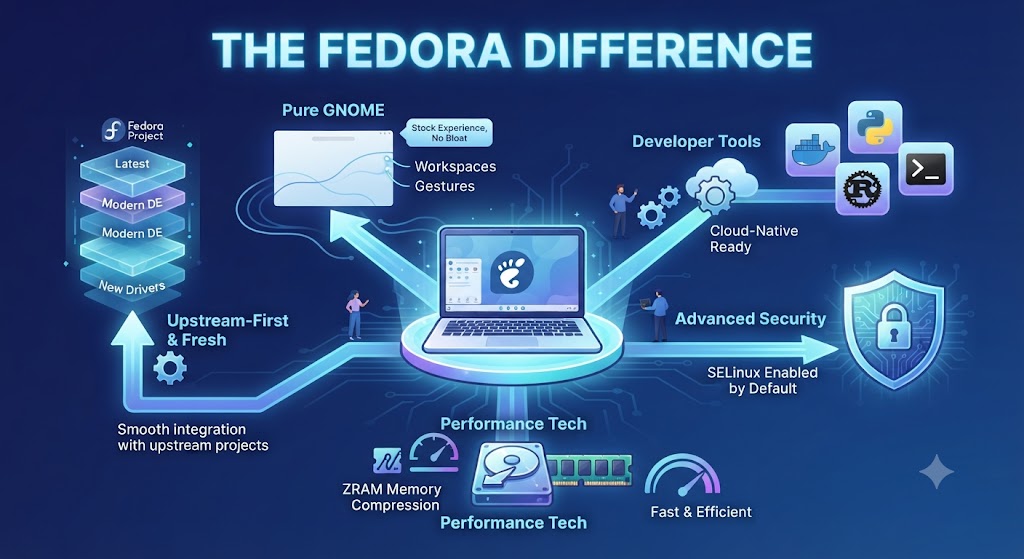
1. The Sweet Spot of Innovation: Cutting-Edge Yet Stable
Many Linux distributions fall into one of two camps: they are either ultra-conservative (relying on software that is years old for the sake of stability) or bleeding-edge (running the absolute latest code, which can occasionally break things).
Fedora pioneers a different philosophy:
Fresh Software Stack: Fedora releases a new version roughly every six months, ensuring you always get the latest Linux kernels, desktop environments, and graphic drivers shortly after release.
The Upstream First Philosophy: Heavily sponsored by Red Hat, Fedora works directly with upstream open-source projects (like the GNOME desktop and the Linux kernel) rather than modifying code heavily. This means you experience software the way creators intended it—clean, fast, and bug-free.
2. A Pure, Unmodified GNOME Desktop Experience
While distros like Ubuntu or Linux Mint customize their desktops with heavy themes, proprietary docks, and custom plugins, Fedora Workstation takes a different approach.
It ships with a stock, unmodified GNOME desktop environment.
If you appreciate a minimalist, workflow-driven, and modern user interface (often compared to macOS for its seamless handling of workspaces and gestures), Fedora provides the cleanest implementation of it available. There is no bloatware or forced third-party app stores getting in your way.
3. Out-of-the-Box Container and Developer Tools
If you are a software developer, DevOps engineer, or system administrator, Fedora Workstation is practically built for you straight out of the box.
First-Class Container Support: Unlike distros where you have to manually configure complex developer tools, Fedora features native, rootless containerization tools like Podman, Buildah, and Skopeo pre-integrated.
Up-to-Date Toolchains: Compilers, libraries, and programming languages (like Python, Go, Rust, and Java) are kept updated to their modern iterations, making it a seamless environment for building modern cloud-native apps.
4. Advanced Security with SELinux Enabled by Default
Security is often an afterthought that users have to configure manually, but Fedora takes a proactive stance from the second you boot it up.
It comes with SELinux (Security-Enhanced Linux) enforced by default.
SELinux provides a robust, mandatory access control security architecture. Even if a service or application is compromised, SELinux restricts what parts of the system the malicious process can touch, offering enterprise-grade security on a desktop operating system.
5. Smart Performance Innovations Under the Hood
Fedora doesn’t just rely on standard Linux conventions; it actively adopts modern performance standards to improve user experience:
ZRAM Instead of Swap Partitions: Fedora uses ZRAM by default, which compresses memory dynamically to create a fast, RAM-based swap space. This prevents system freezing and disk thrashing when you run out of memory, keeping your laptop snappy even under heavy loads.
Btrfs Filesystem: It utilizes the modern Btrfs filesystem out of the box, allowing for transparent compression (saving disk space) and snapshot capabilities.
The Verdict: Who is Fedora Workstation For?
Fedora Workstation stands out because it refuses to compromise. It gives you the latest open-source advancements without sacrificing security, and it provides a developer-focused playground wrapped in a gorgeous, distraction-free desktop interface.
If you want a Linux operating system that feels modern, respects your privacy, stays updated with cutting-edge tech, and "just works," Fedora Workstation is in a league of its own.
Have you ever tried running a pure GNOME distribution like Fedora, or are you currently using another Linux flavor for your daily work?
Comments
Log in or sign up to join the conversation.