
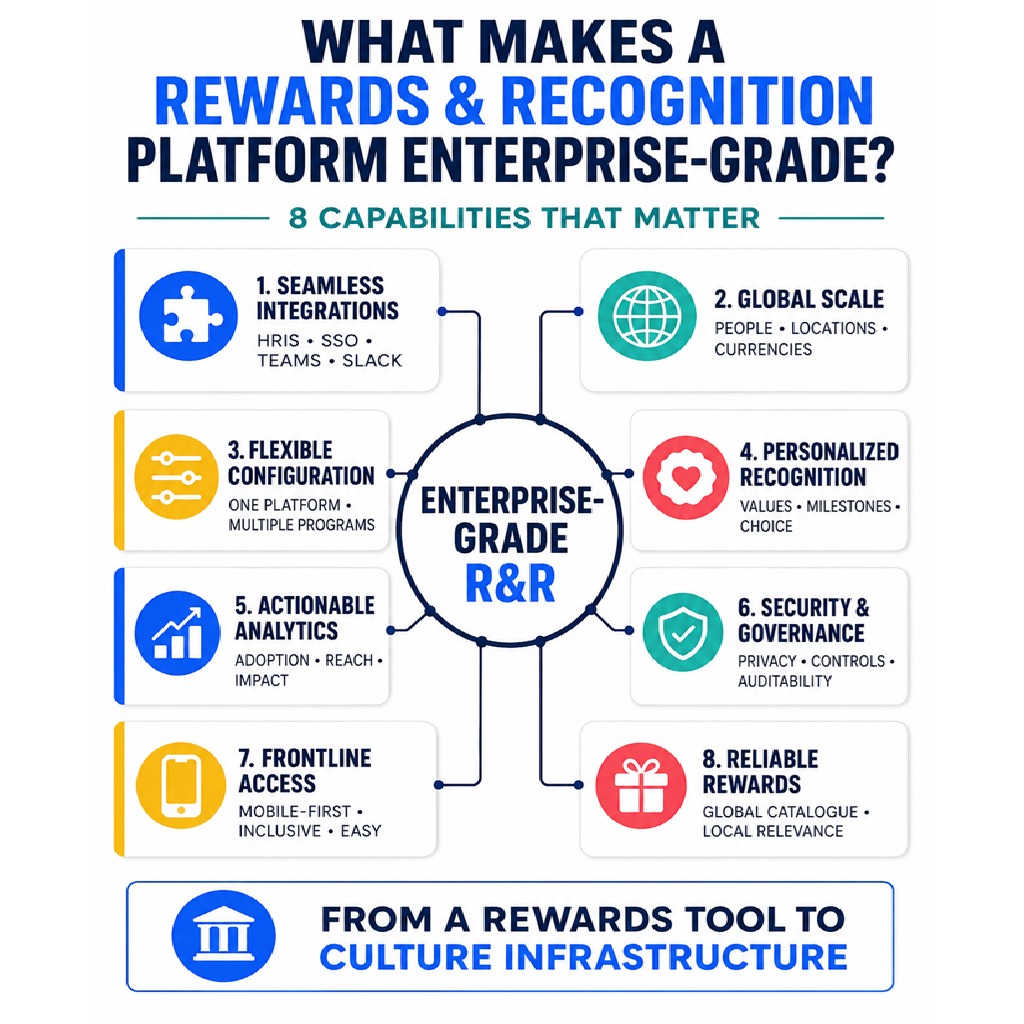
Executive Summary: An enterprise-grade rewards and recognition platform is secure, scalable, configurable, globally deployable, and deeply integrated with the organization’s HR and collaboration ecosystem. It supports different employee groups, business units, languages, currencies, reward preferences, approval workflows, and reporting needs while maintaining centralized governance and a consistent employee experience.
As organizations grow, delivering employee recognition consistently becomes harder. Employees may work from headquarters, factories, stores, client locations, hospitals, field sites, or home offices. They may operate across cities, countries, time zones, languages, and very different technology environments.
A basic rewards tool may work for a small, centrally located workforce. At enterprise scale, however, a platform has to do much more than distribute digital badges or gift cards. It must fit into the organization’s technical architecture, support global and frontline employees, enforce complex program rules, protect sensitive data, and give leaders reliable information about participation, fairness, culture, and spending.
The real test is not whether a platform can launch a recognition program. It is whether the platform can sustain a relevant, inclusive, measurable, and well-governed recognition ecosystem as the organization becomes more complex.
What Does ‘Enterprise-Grade’ Mean in Employee Recognition?
Enterprise-grade doesn't simply mean a platform can hold a large number of employee records. It means the technology, operating model, controls, and employee experience can scale together.
A mature platform should be able to:
1. Embed recognition into the tools employees and HR teams already use.
2. Serve multiple business units, worker groups, locations, languages, and currencies.
3. Configure different programs without losing central standards and oversight.
4. Personalize recognition and rewards without creating administrative chaos.
5. Protect personal, organizational, and transaction data through enterprise controls.
6. Turn recognition activity into insights that leaders can use to improve the program and culture.
1. It Integrates with the Enterprise Technology Ecosystem
Employees are more likely to participate when recognition is part of their routine. Requiring them to open a separate application, remember another password, search for employee details, and recreate information already held elsewhere adds friction. At scale, that friction becomes low adoption and heavy administration.
a) HRIS and Payroll Integration
HRIS integration keeps employee data, reporting relationships, departments, locations, joining dates, and eligibility rules current. New hires can be added automatically, transfers can update program access, and departing employees can be removed without maintaining duplicate records.
Payroll and finance connections can support taxable reward reporting, reimbursements, budget reconciliation, and financial controls. The value is not only convenience. It also improves data quality and creates a clearer audit trail across HR, finance, and recognition systems.
b) Microsoft Teams, Slack, and Other Collaboration Tools
Recognition should be available where work already happens. Collaboration integrations allow employees to appreciate a colleague, submit a nomination, view recognition activity, and engage with recognition posts without leaving the work channel.
This is especially important for hybrid and remote teams. A contribution made in a project channel can be recognized while the context is fresh, giving the achievement timely visibility across the team.
c) Single Sign-On (SSO) and Identity Management
Single Sign-On allows employees to use existing corporate credentials. It reduces password friction and connects access to the organization’s identity lifecycle. When an employee changes roles or leaves, recognition access can change through the same identity controls used for other enterprise applications.
d) Performance and Learning Systems
Recognition becomes more meaningful when it connects with performance and development. Completing a certification, demonstrating a core value, sharing knowledge, finishing a demanding project, or developing a new capability can become part of a broader employee experience rather than an isolated award event.
Quick Check: Ask the vendor which systems are supported through standard connectors, APIs, file transfers, webhooks, or embedded applications. Then confirm which integrations are already proven in production and which would require custom development.
2. It Can Scale Across People, Programs, and Geographies
Scalability is not limited to system uptime or the number of user accounts. It includes the platform’s ability to manage higher transaction volumes, more administrative roles, multiple programs, diverse workforce segments, and regional operating requirements without becoming slow, fragmented, or difficult to govern.
a) Large and Diverse Employee Populations
An enterprise platform should support employees, managers, nominators, approvers, jury members, HR administrators, finance teams, business leaders, and auditors. Each role may require different permissions, views, alerts, and data access. Role-based experiences should simplify work without exposing information unnecessarily.
b) Global and Multi-Location Deployment
Global organizations need to balance consistency with local relevance. Central teams may define common values, governance, brand standards, and reporting, while regional teams may need local award categories, budgets, communications, reward options, and approval structures.
A strong platform supports one enterprise framework without forcing every country, plant, office, or business unit into an identical program.
c) Languages, Currencies, and Local Reward Availability
Employees should be able to understand program rules, nomination journeys, notifications, and reward values in a familiar language and local context. Multi-language support is particularly important for global and frontline workforces, where English may not be the primary working language.
Multi-currency capabilities should display clear local values, support regional budgets and reporting, and account for currency conversion and reward availability. Employees should not have to calculate a reward's value or discover after redemption that it cannot be used in their country.
3. It Supports Configuration Without Fragmentation
Different parts of an enterprise recognize different kinds of contribution. Sales may celebrate customer wins. Manufacturing may prioritize safety, quality, and operational excellence. Technology teams may emphasize innovation and knowledge-sharing. Customer service teams may recognize empathy, responsiveness, and problem resolution.
Enterprise recognition software should allow administrators to configure eligibility rules, award categories, approvers, jury panels, nomination windows, budgets, escalation paths, messages, certificates, and reward options without building a separate solution for every business unit.
The goal is controlled flexibility: local teams can adapt the experience, while central HR retains governance, data consistency, and an organization-wide view.
4. It Makes Recognition Personal and Relevant
Generic appreciation has limited cultural value. ‘Good job’ may feel pleasant, but it does not explain what the employee did, why it mattered, or which behavior others should repeat.
Gallup reports that when recognition hits the mark, employees are four times as likely to be engaged and five times as likely to feel connected to their organization’s culture. Relevance is therefore not cosmetic. It is central to the outcome recognition is meant to create.
a) Purpose-Built Recognition Programs
Organizations should be able to create distinct programs for moments such as:
1. Project completion and customer impact.
2. Innovation, problem-solving, and knowledge-sharing.
3. Safety, quality, and operational excellence.
4. Leadership, collaboration, and values-based behavior.
5. Learning, certification, skill development, and career milestones.
6. Service anniversaries, promotions, birthdays, and major personal or professional milestones.
b) Values-Based Recognition
Recognition should connect a specific contribution with an organizational value. A message should explain, for example, how an employee displayed teamwork by helping a colleague resolve a difficult problem, or demonstrated customer focus by protecting a critical client outcome.
c) Reward Choice and Employee Preferences
No single reward works for everyone. Employees may prefer shopping or dining vouchers, learning opportunities, experiences, merchandise, donations, or other locally relevant options. A broad marketplace gives employees choice while allowing the organization to retain budget controls.
Recognition preferences matter too. Some employees value public appreciation, while others prefer a private message. Gallup and Workhuman found that only 10% of employees had been asked how they prefer to be recognized, revealing a significant personalization gap.
d) Multiple Recognition Channels
A mature platform should support complementary forms of appreciation:
1. Peer-to-peer recognition for everyday help and teamwork.
2. Manager recognition for performance, behavior, and results.
3. Spot recognition for achievements that deserve immediate appreciation.
4. Team recognition for shared outcomes and collaborative work.
5. Formal awards for contributions with wider organizational impact.
This mix matters because value is not created only through the reporting hierarchy. Peer recognition can reveal contributions managers miss, while team awards prevent shared success from being reduced to one visible individual.
5. It Provides Decision-Ready Analytics
Recognition should be managed with the same discipline as other people initiatives. Spending data alone cannot tell leaders whether the program is inclusive, whether managers participate, whether recognition is aligned with values, or whether certain groups remain invisible.
An enterprise platform should report on:
1. Participation and adoption by employee group, role, location, and business unit.
2. Recognition frequency, reach, and reciprocity across teams.
3. Manager participation and patterns of recognition.
4. Award distribution, budget utilization, and redemption activity.
5. Recognition categories and alignment with organizational values.
6. Cross-functional and cross-location recognition flows.
7. Trends that may indicate inactivity, concentration, or visibility gaps.
These insights help leaders ask better questions. If one function receives frequent recognition while another receives almost none, is the difference caused by performance, manager behavior, access, program design, or a participation barrier? If innovation is a strategic priority but few innovation stories are recognized, is the culture signal aligned with the business strategy?
6. It Builds Security, Privacy, and Governance into the Design
Recognition systems process employee data, organizational information, program budgets, and reward transactions. Security cannot be treated as a feature to add after implementation. It should influence architecture, integrations, access, administrative workflows, and vendor operations from the beginning.
Enterprise buyers should evaluate:
1. Role-based access and segregation of administrative responsibilities.
2. Encryption, secure integration methods, and identity controls.
3. Audit logs for nominations, approvals, budget changes, and redemptions.
4. Data retention, privacy, incident management, and deletion processes.
5. Independent security assurance and evidence relevant to vendor risk reviews.
6. Support for applicable data protection, residency, and cross-border requirements.
Governance also includes program controls. Budget ownership, nomination approvals, jury workflows, moderation, escalation paths, and policy rules should be configurable and traceable. Strong controls allow the organization to scale recognition without losing consistency or accountability.
7. It Includes Frontline and Mobile Employees
A platform cannot be enterprise-wide if it works only for desk-based employees. Frontline workers, field teams, doctors, retail associates, drivers, plant employees, and employees at client sites may rely primarily on mobile devices or shared access environments.
Mobile-optimized journeys should allow employees to recognize colleagues, receive notifications, participate in nominations, view social recognition, and redeem rewards with minimal friction. Access options should reflect the organization’s actual workforce, not an assumption that everyone has a corporate laptop and email account.
8. It Delivers Rewards Reliably Across Markets
Reward choice is valuable only when fulfillment is dependable. An enterprise platform should offer relevant options across operating countries, make reward value clear, support local redemption, and provide timely assistance when something goes wrong.
HR and finance teams should also manage funding, budgets, approval limits, expiry rules, cancellations, refunds, transaction reporting, and reconciliation. Employees need a simple redemption experience; the enterprise needs the controls behind it.
How Should Organizations Evaluate an Enterprise Recognition Platform?
A polished product demonstration can make most platforms look similar. A disciplined evaluation should test how the platform behaves under the organization’s real complexity. The following questions can form the basis of an RFP, proof of concept, or buyer workshop.
1. Integration. Can the platform connect with our HRIS, identity provider, collaboration tools, learning systems, performance applications, payroll, and finance processes?
2. Scale. Can it support our employee population, peak transaction volumes, regions, business units, and future growth without separate instances or manual workarounds?
3. Global readiness. Does it support the languages, currencies, local reward catalogs, time zones, and regional reporting our workforce requires?
4. Configuration. Can HR administrators change programs, workflows, budgets, eligibility, approvers, and communications without depending on vendor development for every update?
5. Employee experience. Can desk-based, mobile, frontline, remote, and non-email employees participate through accessible channels?
6. Personalization. Can the platform tailor recognition categories, messages, rewards, milestones, and visibility to employee and program needs?
7. Analytics. Can leaders see participation, reach, manager behavior, distribution, value alignment, budget use, and low-adoption areas?
8. Security and privacy. Can the vendor provide clear evidence for access control, auditability, secure integrations, privacy operations, incident management, and independent assurance?
9. Governance. Can the organization define roles, approval paths, jury processes, moderation, budget ownership, policy rules, and escalation procedures?
10.Reward operations. Are reward options relevant in each market, and are funding, fulfillment, support, reversals, and reconciliation reliable and transparent?
11.Implementation and support. Does the vendor provide realistic timelines, data migration support, integration ownership, training, service commitments, and ongoing customer success?
12.Proof. Can the vendor demonstrate comparable enterprise deployments, real adoption outcomes, and referenceable customer experience?
Quick insight: The best platform is not the one with the longest feature list. It is the one that can support the organization’s workforce, policies, systems, risk profile, and culture with the least operational friction.
From a Digital Rewards Tool to Culture-Building Infrastructure
An enterprise-grade rewards and recognition platform is not merely an online award distribution system. It is an operating layer that helps appreciation move across teams, locations, levels, and channels while keeping the experience timely, specific, inclusive, measurable, and controlled.
When employees can recognize meaningful contributions in the flow of work, choose relevant rewards, and participate regardless of location or role, recognition becomes part of everyday work. When leaders can see where appreciation is thriving, where it is absent, and which values are being reinforced, recognition becomes a source of cultural intelligence.
That is the difference between a platform that distributes rewards and one that supports the enterprise: the technology does not simply process recognition. It helps the organization build, govern, and learn from a culture of appreciation at scale.
Frequently Asked Questions
1. What is an enterprise rewards and recognition platform?
An enterprise rewards and recognition platform such as HiFives is software that enables large or complex organizations to manage employee recognition and rewards across business units, locations, employee groups, and countries. It combines integrations, configurable workflows, global capabilities, security, analytics, governance, and inclusive employee access.
2. How is an enterprise recognition platform different from a basic rewards tool?
A basic rewards tool may distribute badges or gift cards. An enterprise platform such as HiFives also integrates with HR and business systems, handles complex permissions and approvals, supports global and frontline workforces, manages regional rewards and currencies, protects sensitive data, and provides organization-wide reporting.
3. Which integrations should an employee recognition platform support?
Common enterprise integrations for employee recognition platforms include HRIS, payroll or finance processes, identity providers for Single Sign-On, collaboration tools such as Microsoft Teams or Slack, learning systems, performance platforms, and other applications in the employee technology ecosystem.
4. Why are multi-language and multi-currency capabilities important?
Enterprise employee recognition platforms make programs understandable, locally relevant, and financially manageable across countries. Employees can see clear reward values and usable options, while administrators can manage regional budgets, reporting, and reward availability.
5. What analytics should an enterprise recognition platform provide?
Leaders should be able to track adoption, participation, recognition frequency, manager behavior, distribution across employee groups, value alignment, cross-team recognition, budget use, reward redemption, and inactivity or concentration.
6. What security features should buyers evaluate?
Buyers should assess identity and access controls, role-based permissions, secure integrations, encryption, audit logs, data retention and deletion, privacy processes, incident management, independent assurance, and support for applicable jurisdictional requirements.
7. How can a platform support frontline employees?
Enterprise employee recognition platforms should offer mobile-friendly participation and access options that do not assume every employee has a corporate laptop or email account. Frontline users should be able to recognize colleagues, receive notifications, join nominations, view recognition, and redeem rewards with minimal friction.
About HiFives
HiFives is a global AI-powered employee rewards, recognition, and engagement platform. It helps organizations digitize and scale peer-to-peer recognition, manager-led awards, spot recognition, long-service awards, project awards, innovation programs, and organization-wide engagement campaigns.
With configurable workflows, digital badges, reward points, global redemption options, social recognition, leaderboards, analytics, and integrations with HRMS platforms and collaboration tools, HiFives helps organizations build recognition cultures in which employees feel valued, connected, and inspired to contribute.
Comments
Log in or sign up to join the conversation.