

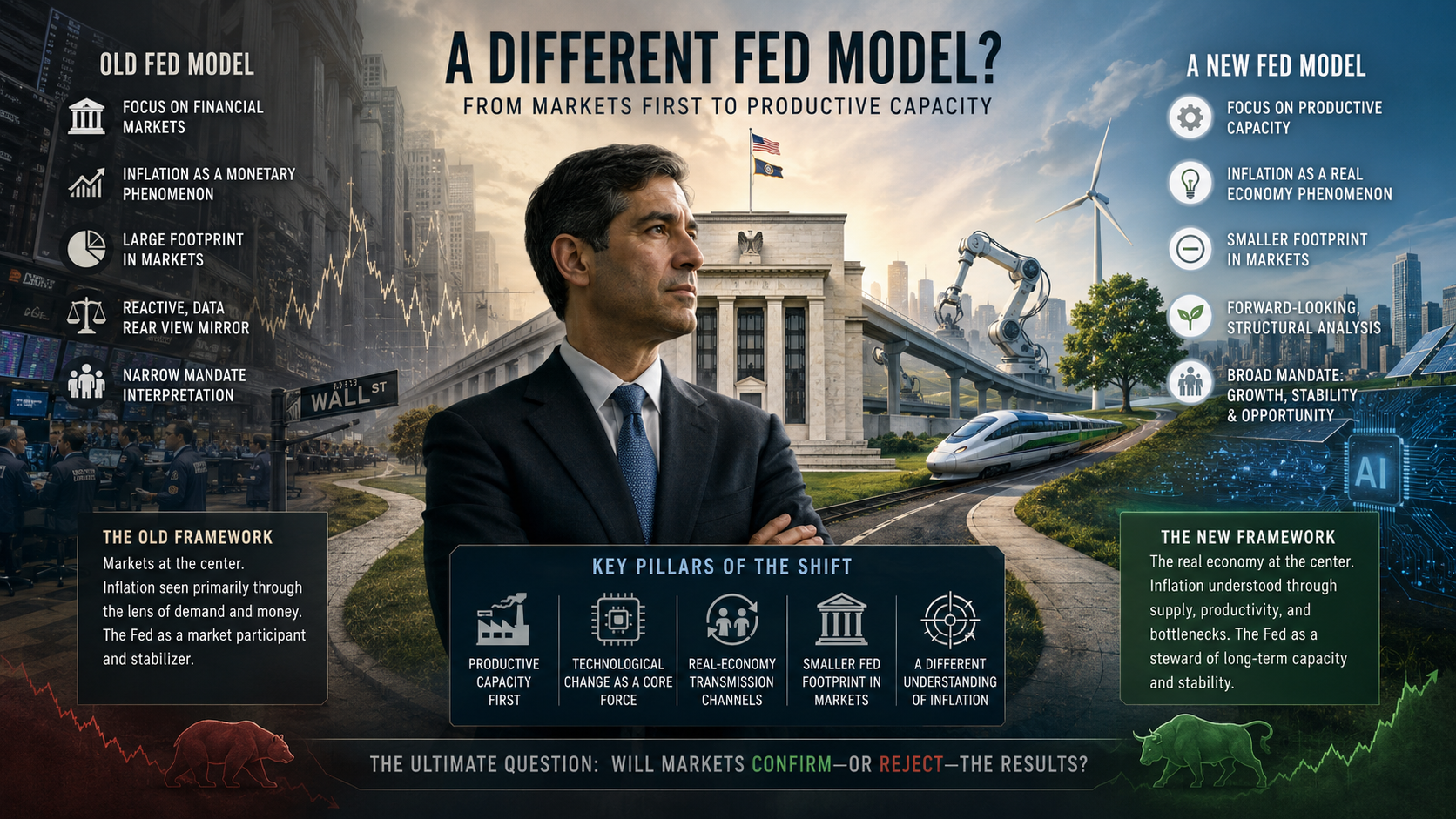
Federal Reserve Chairman Kevin Warsh has moved quickly to put his imprint on the central bank, creating five task forces to examine communications, balance-sheet policy, economic data, productivity and jobs, and inflation frameworks. The recent AP report on the task forces provides a timely news hook—the surface story—but the larger story is what they may reveal about the kind of Fed Warsh is trying to build—the deeper truth.
Under Powell, the Fed came to place enormous practical weight on financial conditions, liquidity, market expectations, and, most notably, the wealth effect as channels through which monetary policy supported the broader economy. Warsh’s earlier speeches and published statements suggest a distinctly different approach: skepticism toward a large Fed balance sheet, excessive forward guidance, backward-looking data, and the central bank’s deep involvement in financial markets.
Taken together, the task forces look less like five separate studies than the possible architecture of a broader plan. Warsh may be trying to shift the Fed away from the post-financial-crisis model that Powell inherited and, in important ways, reinforced, and toward one centered more on productive capacity, technological change, real-economy transmission, a smaller Fed footprint in markets, and a different understanding of inflation. If so, this would be more than a change in leadership style; it could represent a change in the Fed’s governing model, with consequences for the economy and financial markets that may not yet be fully foreseeable.
The key questions to ask are: What exactly does Warsh intend to build? What happens if that plan is put into action? And, as the consequences unfold, will the equity and debt markets ultimately confirm—or reject—the results?



Comments
Log in or sign up to join the conversation.