

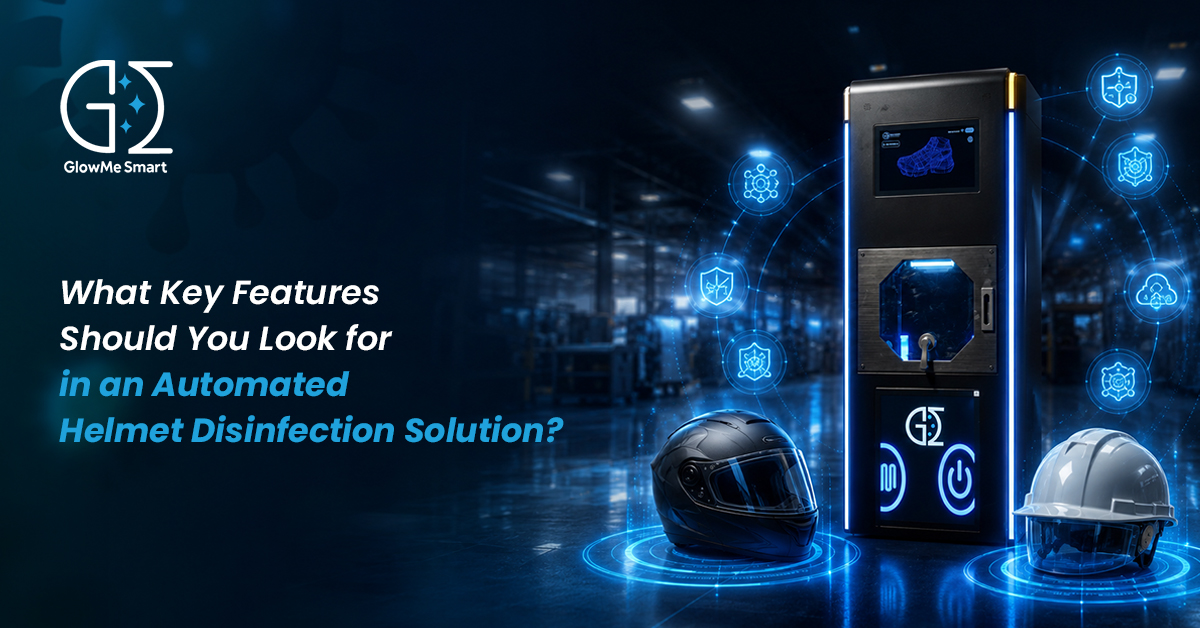
Helmet disinfection kiosk features are not all built equal - and in a market that is growing fast across India, that gap matters. Businesses investing in shared helmet hygiene today are facing a crowded product shelf with competing technology claims, cycle time promises, and disinfection stage counts that mean very little without context. The right question is not which machine sounds most advanced. It is the features that actually solve the contamination problem that builds up inside a shared helmet every single day. This article breaks that down without the sales language.
Does the Machine Treat the Interior or Just the Surface?
This is the first question any buyer should ask - and most marketing material avoids answering it directly. The contamination in a shared helmet does not live on the outer shell. It lives in the foam padding, the fabric liner, the chin strap, and the crown cushioning - surfaces that absorb sweat, dry slowly, and sit in a warm enclosed space between uses. A machine that focuses UV-C exposure at the visor opening or runs a mist across the outer surface is addressing the wrong part of the helmet entirely.
Any credible helmet disinfection machine specification should confirm interior cavity treatment as a primary function - not a secondary feature. If the product description does not specifically address foam padding and liner coverage, the interior is likely not being treated at all.
GlowMe Smart's HelmeTron uses 360° UV-C LED sterilisation combined with 3D fine mist atomisation precisely because surface treatment alone leaves the contamination cycle running. Both technologies work together to reach every interior angle, including surfaces that no manual spray or wipe can ever contact.
What Disinfection Stages Does It Actually Run?
A single-stage machine running only UV-C or only ozone is a partial solution. Each technology addresses a different part of the contamination profile. UV-C light disrupts bacterial and viral DNA on contact surfaces. Ozone gas reaches enclosed cavities and fabric fibres that light cannot penetrate at the right angle. Steam loosens embedded contamination in foam. Mist atomisation carries disinfectant into the full interior volume. A machine that combines all four runs a complete cycle. One that runs only one or two stages leaves gaps.
Here is what a complete helmet disinfection machine specification should include:
360° UV-C LED sterilisation: Targets bacteria and fungi on all interior surfaces simultaneously; single-angle UV exposure leaves shadow zones untreated in full-face helmet designs.
Ozone treatment: Penetrates foam padding and fabric lining where UV light cannot reach; effective against odour-producing bacteria and residual microbial load in helmet cushioning.
High-temperature steam: Breaks down embedded sweat residue and organic contamination in foam; particularly relevant for helmets used daily in hot and humid Indian riding conditions.
3D mist atomisation: Delivers disinfectant evenly across the full interior cavity; ensures coverage in curved and recessed surfaces that neither UV nor steam can treat completely on their own.
Does It Log Every Cycle or Leave You Guessing?
For any business deploying helmet disinfection kiosks in India - whether at a logistics depot, dealership, or rental counter - verifiable disinfection records are no longer optional. Workplace safety audits are becoming more thorough. Insurance documentation requirements are tightening. A machine that runs cycles without logging them gives a business no evidence of compliance and no trail to present when a hygiene incident is questioned. The right helmet disinfection kiosk features include automated cycle logging as standard - time-stamped, retrievable, and ideally accessible remotely without requiring staff to manually record each use. GlowMe Smart's HelmeTron logs every cycle automatically, giving businesses a documented disinfection record without adding any administrative load.
Can It Run Without Staff Dependency Every Cycle?
The reason manual cleaning and spray-based protocols fail in high-turnover environments is not that staff are careless. It is because consistent manual hygiene at scale is operationally unrealistic.
A delivery depot cycling thirty helmets across two shifts cannot depend on a staff member administering a disinfection spray correctly between every single handoff. The compliance breaks down, the contamination accumulates, and the hygiene protocol exists only on paper.
Helmet disinfection kiosks in India that operate in fully autonomous self-service mode remove this dependency entirely. The rider or staff member places the helmet, the machine runs the full cycle, and the result is the same every time - regardless of shift pressure, staff turnover, or peak-hour volume.
What Makes GlowMe Smart the Right Hygiene Choice for Riders?
GlowMe Smart designs for environments where helmet hygiene cannot be left to chance. HelmeTron's four-stage automated cycle - UV-C, ozone, steam, and mist - treats every surface, logs every cycle, and runs without staff management. For fleet operators, dealerships, and rental services across India, that is not a feature list. It is the baseline that a shared helmet environment requires. They are the ones that ensure a contaminated shared helmet does not reach the next rider's head. GlowMe Smart builds for that outcome specifically.
Still running shared helmets without a verified disinfection cycle? Contact GlowMe Smart Four-stage UV-C, ozone, steam and mist. Automated, logged, and built for Indian commercial environments.
Comments
Log in or sign up to join the conversation.