
Personal finance is the way an individual manages money over a lifetime, earning, spending, saving, borrowing, investing and protecting what they’ve built. It is less a skill and more a collection of habits that, done routinely, dictate whether money works for or against you.
It’s more important today than it was. There are fewer people with employer pensions to fall back on, costs are outpacing wages in many areas and the number of financial products on offer – from credit cards to apps to investment platforms – has multiplied far more quickly than financial literacy. The basics are more of a survival skill than a nice-to-have. The earlier you learn the basics, the more time compounding has to work in your favour.
The Core Pillars
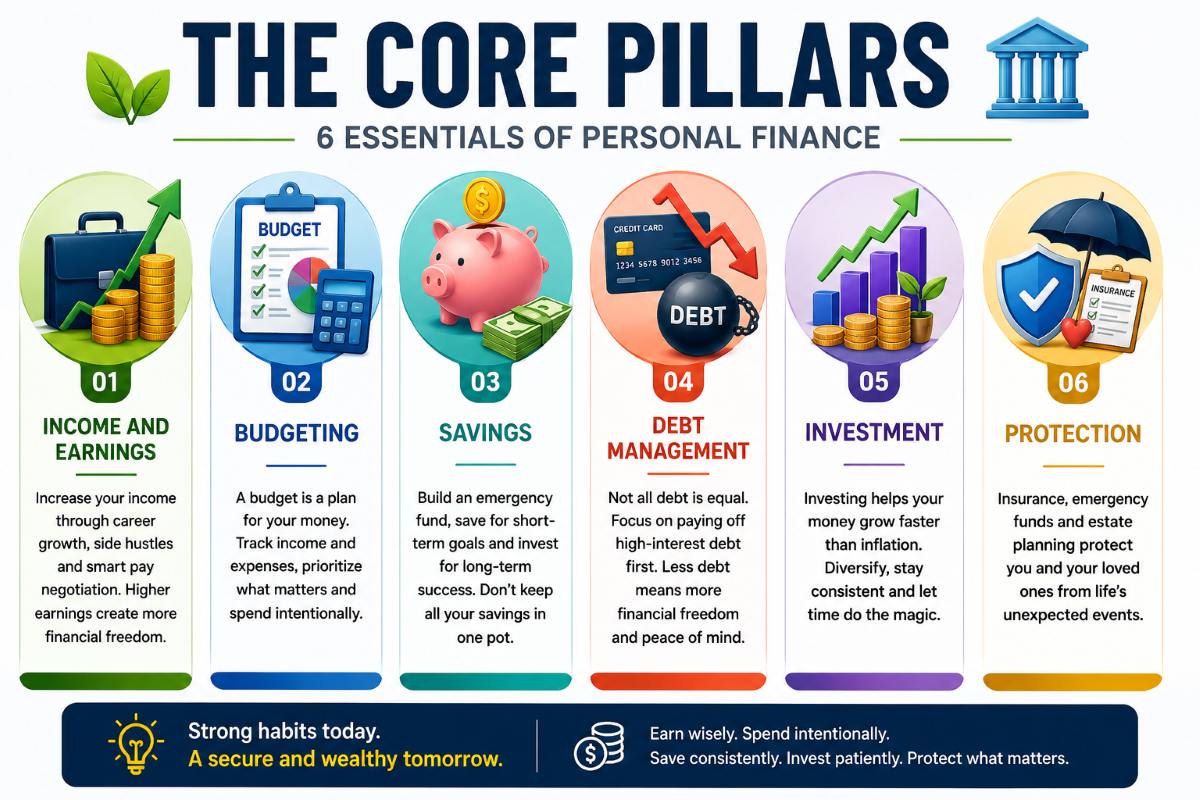
Income and earnings: Personal finance is not just what you do with money when you have it – it’s also about career growth, side income and pay negotiation. Increasing income is often the quickest lever to pull to improve financial health early in life.
Budgeting:- A budget is a plan for where your money goes before you spend it. It’s less about the method and more about the habit – a spreadsheet, a 50/30/20 split or an app. Spending has to be more aligned with real priorities and less of a default habit.
Savings:- An emergency fund (three to six months of essentials) takes the hit without having to incur high-interest debt. Short-term savings help pay for near-term goals. Long-term savings, often in the form of retirement accounts, compound over decades. A common mistake is treating all savings as one pot.
Debt management:- Every debt is different. A mortgage can actually create an asset, while high-interest credit card debt is much more corrosive and often the main barrier to building wealth. The most impactful habit in personal finance is to pay off your most expensive debt first.
Investment:- Saving is saving; investing is outpacing inflation. You don’t have to pick stocks Diversification reduces risk Your time in the market is more important than timing the market Lower fees can beat flashier funds by simply keeping more of your returns
Protection:- Insurance, estate planning and emergency funds protect the progress you’ve already made from being undone by one bad event. It’s the least sexy pillar, and the one people ignore the longest.
Why It Feels Harder Than It Should
Maths is usually not the hard bit – most personal finance calculations are basic addition, subtraction, multiplication and division. It’s a behaviour. Money decisions are tangled up with emotion, social comparison and present bias. the well-documented tendency to overvalue short-term rewards relative to long-term ones. This is why financial literacy is not a good predictor of good outcomes. You can know compound interest inside out and still find it hard to save regularly. The issue is not knowledge, but behaviour under the pressures of everyday life. Which is why the best advice is often to take decisions out of the moment completely – automating savings transfers and bill payments is usually more effective than relying on willpower alone.
Personal Finance vs. Financial Planning
They’re overlapping words, but not the same. Personal finance is the ongoing, day-to-day management of your individual money. Financial planning is often a more formalised and professionally assisted process of setting long-term goals – retirement, education and a home – and formulating a coordinated strategy to pursue them. Good personal finance habits make financial planning easy. Financial planning gives those habits a destination.
Frequently Asked Questions
What are the 5 principles of personal finance?
Most frameworks boil down to earning, spending, saving, borrowing and investing, with protection (insurance and planning) often as the sixth.
How much should I keep in an emergency fund?
A common rule of thumb is three to six months of essential living expenses, but the right number depends on job stability, dependents, and other income sources.
Is personal finance the same as accounting?
No. Accounting is the process of accurately recording and reporting financial transactions. Personal finance is the choices you make with your own money to achieve your goals.
Do I need a financial advisor to manage my personal finances?
Not really. A lot of people do the basics—budgeting, saving, basic investing—by themselves. A professional is more valuable when dealing with complex situations such as tax strategy, estate planning or major life changes.
What's the single most important personal finance habit?
There is no single solution, but consistently spending less than you earn and automating savings are two of the most frequently cited habits in financial research and advice.
Conclusion
Personal finance is not a one-time thing. It varies by income and life stage. What matters to someone paying off student loans in their 20s is very different than the things that matter to someone approaching retirement decades later. But the basic framework is remarkably consistent: earn deliberately, spend intentionally, save purposefully, borrow carefully, invest patiently and protect what you have built. Get the basics right, and the more sophisticated questions – tax strategy, asset allocation and estate structuring – can become refinements rather than rescues.
Comments
Log in or sign up to join the conversation.