


India is the world’s largest buyer of gold jewelry, and a big share of that demand comes from farming households who have historically converted cash into the yellow metal after a bountiful harvest.
The problem this year is that India is on track for its weakest monsoon since 2009. Rainfall is running well below normal, and the summer planting season got off to a rough start.
Weak monsoon, weak harvest, weak rural income, weak gold buying. That’s been the standard story for as long as I’ve been in the business. Indeed, gold inside India is trading at a steep discount to international prices right now.
But there’s more to the story than rainfall. In fact, when you look back at the data, government policies coming out of New Delhi have played a much larger role than the weather in moving the price of gold.
Follow the Tax, Not the Weather
On May 13 of this year, the Indian government more than doubled the customs duty on imported gold, from 6% to 15%. That was the single largest increase on record, and it wiped out the duty cut from July 2024 in one stroke. Within days, domestic gold went to a discount of more than $100 an ounce, according to Bloomberg data.
This wasn’t a one-off. Back in 2013, India hiked duties in steps and added new import restrictions. Indian gold went to a premium of more than $150 an ounce because supply got choked off. It was government policy, not rainfall, that moved prices.
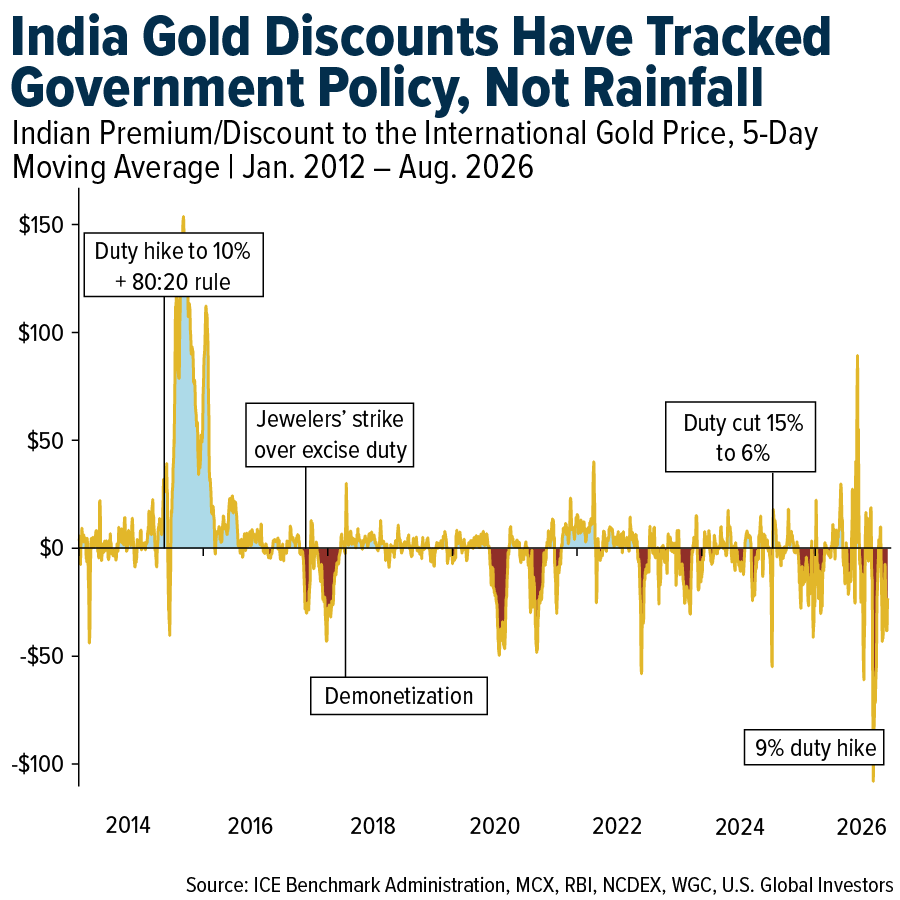
Then there was the 2016 monsoon, which I wrote about 10 years ago this month. The rain that year was fine. Rural incomes were healthy. And yet Indian gold demand still fell by roughly 148 tonnes compared to 2015, the biggest single-year drop in its records, according to the World Gold Council (WGC).
What happened? A nationwide jewelers’ strike over a new excise duty shut the trade down for weeks. New rules required tax ID numbers on larger purchases. And in November, the government voided as much as 86% of the country’s currency overnight in a controversial demonetization effort. (In 2023, the country’s Supreme Court upheld the legality of this policy.)
So once again, government policy trumped the monsoon, which delivered a decent amount of rain that year.
Why a Weak Rupee Is Keeping Gold Expensive in India
There’s another driver that helps explain the discount better than any farm report. Gold peaked in late January and then sold off hard. In dollar terms, it’s up around 6.6% for the year. But the Indian rupee has lost more than 7% against the dollar, so the international gold price in rupees is up nearly 12%. Add the new 15% import duty, and Indian buyers are looking at a domestic price up almost 20% on the year.
American investors got a chance to buy the dip this spring. Indian jewelry buyers never did.
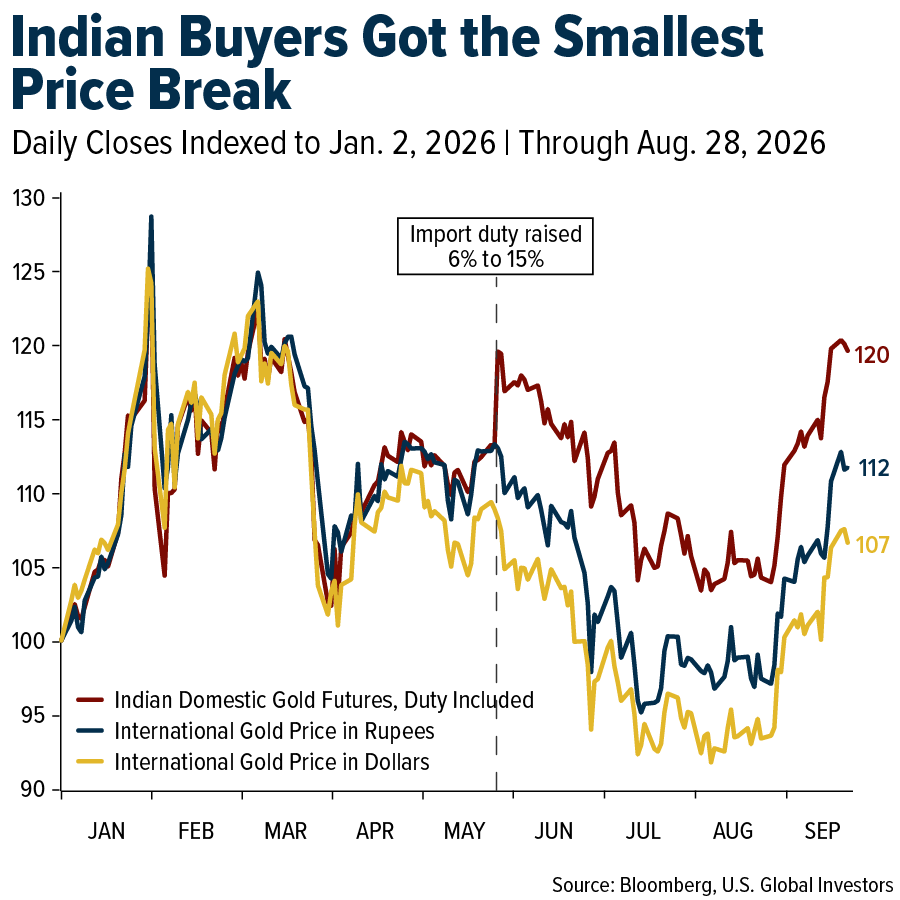
That’s a sufficient explanation for weak physical demand, I think. You don’t need a drought to explain why people stopped buying something that got 20% more expensive.
India Gold Demand by the Numbers
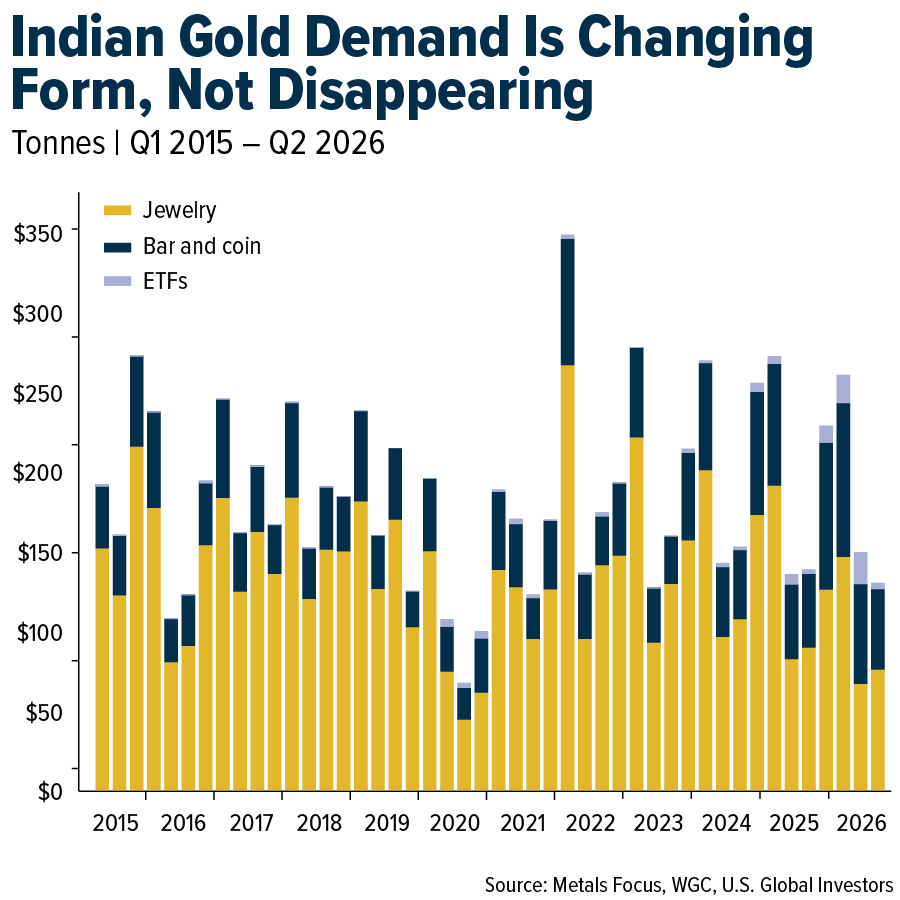
Indian jewelry demand in the second quarter was 75 tonnes, the second-weakest second quarter since 2000. Obviously that’s bad, but look at what Indian families did with their money instead.
Bar and coin demand in the first half of 2026 hit 113 tonnes, the highest in 13 years, and gold ETF holdings reached a record with more than 12 million accounts open, according to WGC data. Recycling, meaning gold sold back for cash, fell to a 19-tonne quarter, the lowest in nearly three years, even with domestic prices roughly 60% above where they were a year ago.
Think about it. Indian households are sitting on gold worth 60% more than last year, yet they still won’t sell.
What they’re doing instead is borrowing against it. Outstanding loans secured by gold jewelry reached about 5.1 trillion rupees at Indian banks as of late May, up 105% from a year earlier, plus another 3.3 trillion at non-bank lenders. Gold loans are now the second-largest category of retail lending in India, behind only housing.
A family that pledges its gold rather than selling it is telling you it thinks gold is worth holding. This is gold behaving as money in an economy where a lot of people don’t have access to traditional banking.
Is the Love Trade Turning into the Fear Trade?
Don’t get me wrong… the monsoon still matters for Indian gold volumes. A bad harvest means fewer weddings with less gold buying.
But the discounts are a customs duty and weak rupee showing up in the physical market. Underneath it, the world’s largest gold-owning population is borrowing against its holdings and shifting its buying to bars and funds.
I don’t think those are the actions of people who have lost faith in gold.
For years, I’ve described two engines behind gold. The Fear Trade, which runs on deficits, currency debasement and bad government policy. And the Love Trade, which runs on culture, weddings and gift-giving, mostly in Asia. What’s happening in India right now is the Love Trade converting into the Fear Trade inside the same household, driven by a government raising taxes on gold and a currency losing value.

Comments
Log in or sign up to join the conversation.