
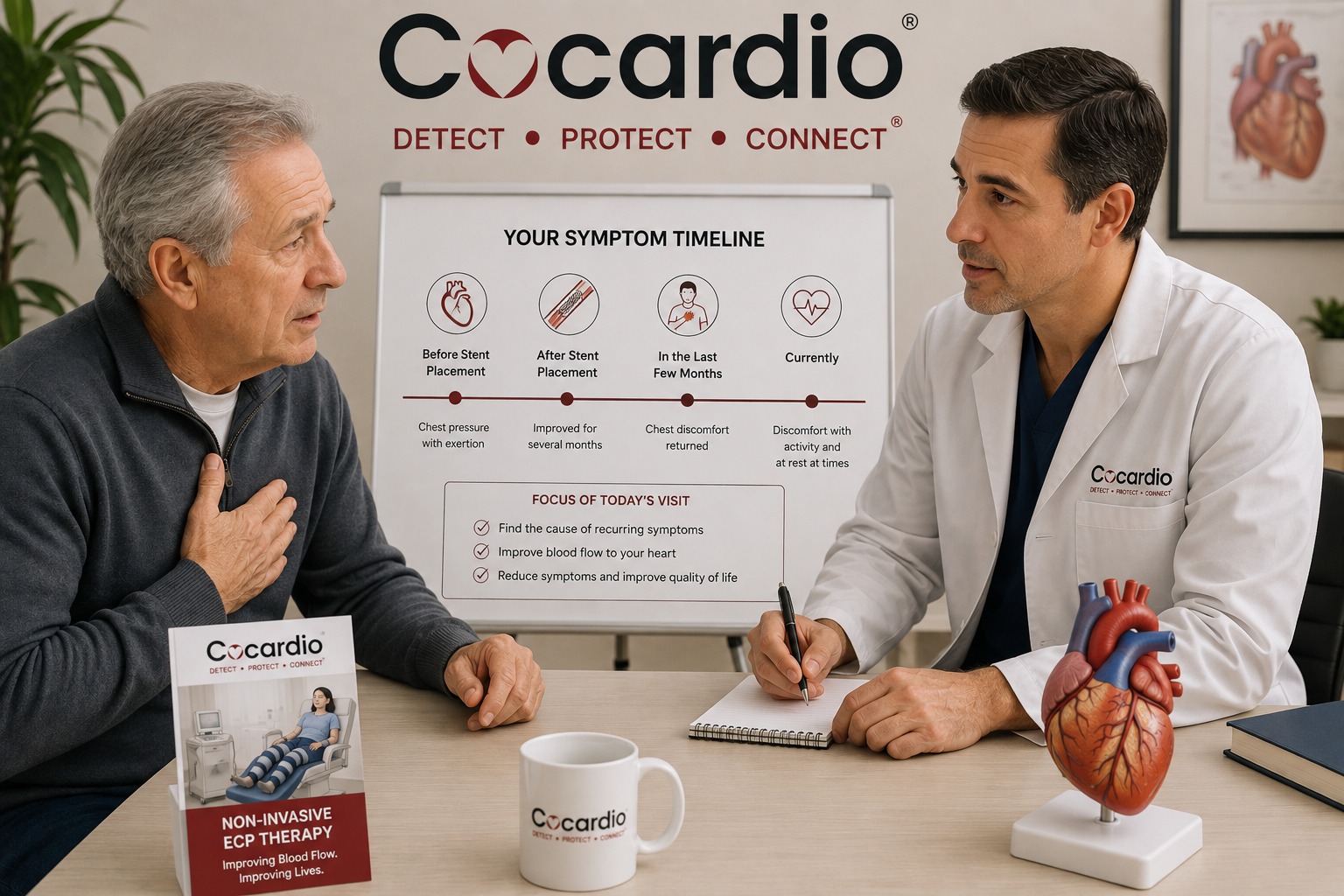
Medical disclaimer This article is for general educational purposes only and is not a diagnosis or individualized treatment recommendation. Sudden, severe, or worsening chest pain can be an emergency. Seek immediate medical care for urgent symptoms, and consult a licensed healthcare professional before starting, stopping, or changing treatment.
Recurring angina after medication or a stent deserves clinical reassessment; it should not be assumed to be harmless or treated only with another outpatient therapy. Once urgent causes are ruled out and the condition is considered stable, eecp therapy for angina may be discussed as a non-invasive, circulation-focused option for appropriately selected patients whose symptoms remain limiting. CoCardio® describes its role as complementary to standard care, not a replacement for a cardiologist, prescribed medication, or a medically necessary procedure.
The key question is not simply whether a prior treatment “failed.” Angina can recur for different reasons, and the next step should connect the current symptom pattern to a realistic treatment goal. A responsible evaluation asks what changed, whether symptoms are stable, and what existing tests and treatments already show.
Why chest pain can still matter after a stent or medication
A stent is used to address a specific coronary narrowing, but a prior procedure does not make every future episode of chest discomfort automatically safe. CoCardio® advises that sudden, severe, or worsening chest pain, especially when accompanied by shortness of breath, fainting, nausea, or pain spreading to the arm or jaw, requires emergency medical care. Outpatient evaluation is appropriate only after urgent causes have been ruled out.
For ongoing or recurring symptoms, the purpose of follow-up is to understand whether the heart is involved, whether the pattern is changing, and whether circulation-focused support could reasonably help. This is where eecp therapy for angina belongs in the conversation: after the safety questions, not before them.
How external counterpulsation therapy may support persistent angina
external counterpulsation therapy is a non-invasive treatment in which cuffs around the lower body inflate and deflate in coordination with the heartbeat. The supplied CoCardio® materials explain that this timing is intended to support blood flow during the heart’s resting phase. The supplied patient guide adds that the goal is to support coronary perfusion, symptoms, and functional capacity in appropriately selected patients.
This mechanism does not mean the treatment physically clears plaque or guarantees that another procedure will never be needed. It is better framed as symptom and circulation support for selected stable patients. That distinction protects patients from confusing “non-invasive” with “risk-free” or “curative.”
· Potential treatment goals may include fewer angina symptoms, better exercise tolerance, and improved daily function.
· Progress should be judged against a baseline rather than by a vague sense that treatment “must be working.”
· New or worsening symptoms during a course should trigger clinical review rather than automatic continuation.
Who should be evaluated before starting ecp therapy
The supplied educational guide recommends reviewing diagnosis, symptom pattern, medications, blood pressure, rhythm, vascular health, bleeding risk, and recent procedures before starting eecp treatment. Depending on the clinical picture, ECG, echocardiography, stress testing, coronary imaging, or other studies may be considered. The point is to connect the treatment to a documented problem and a measurable goal.
CoCardio® also describes its services as consultative and prevention-focused. For people with known coronary disease, an evaluation may include discussion of circulation, heart function, and risk factors alongside current cardiology care. If someone is searching for a non invasive heart treatment because they are afraid of another procedure, that concern should be discussed openly rather than used to bypass a necessary medical recommendation.
How a typical course is structured and what to track
CoCardio® states that its structured ECP program typically uses 35 sessions for a full course, with 10- and 20-session options available based on individual needs. The supplied SlideServe guide similarly describes a common full course as 35 one-hour outpatient sessions, often scheduled five days per week over about seven weeks. During sessions, lower-body cuffs are coordinated to the cardiac cycle while the patient lies on a padded table.
Response varies, so treatment should be paired with a simple follow-up plan. The supplied guide suggests tracking angina frequency, prescribed rescue-medication use, walking tolerance, and daily activity. Those measures can help the patient and treating clinicians discuss whether eecp therapy for angina is producing a meaningful functional change.
· Record how often chest discomfort occurs and what tends to trigger it.
· Track walking or activity tolerance in a consistent way.
· Note any new pain, skin irritation, dizziness, fatigue, or other symptoms and report them to the treatment team.
· Keep your cardiologist informed about symptom changes and treatment progress.
Cost, location, and choosing between eecp therapy centers
Price matters, but EECP therapy cost should be discussed only after candidacy, the proposed number of sessions, and the follow-up plan are clear. The supplied educational guide specifically recommends discussing total cost and coverage in advance. A lower headline price is not useful if screening, supervision, or follow-up are weak.
Likewise, a search for ECP therapy near me should be treated as the beginning of comparison, not the end. Ask who supervises therapy, how emergencies are handled, what testing is reviewed before treatment, and how progress will be shared with the physician managing your coronary disease.
For patients also focused on longer-term risk and prevention, CoCardio® provides information on eecp for coronary artery disease prevention. The purpose is not to bundle every service together; it is to understand how symptom relief and prevention-focused care may fit into the same long-term plan.
Still having recurring chest pain after standard treatment? Call +1(858) 500-1399 to speak with CoCardio® about an evaluation and whether non-invasive circulation-focused support may fit alongside your existing medical care.
Where Epigenetic biomarker testing may fit and where it does not
Epigenetic biomarker testing is a separate CoCardio® service and should not be presented as a diagnostic test for acute angina. Its role, based on the supplied clinic page, belongs to broader wellness and risk-related discussions rather than emergency chest-pain triage. Keeping those purposes separate helps prevent a prevention-oriented test from being mistaken for an answer to active symptoms.
For a patient with recurrent angina, the immediate priorities are symptom safety, clinical reassessment, and a clear treatment goal. Broader testing may be discussed later if it is relevant to the person’s overall care plan. This ordering keeps the article patient-centered and avoids overselling optional services.
Common mistakes to avoid
· Assuming chest pain cannot be serious because a stent was placed previously.
· Stopping prescribed medication or changing treatment without consulting the clinician managing your heart condition.
· Starting ecp therapy before the symptom pattern and candidacy have been reviewed.
· Treating a 35-session course as a guarantee of lasting relief.
· Choosing a center only by distance, price, or marketing claims without asking about screening and supervision.
Key takeaways
· Recurring or worsening angina requires reassessment, and urgent symptoms need emergency care.
· eecp therapy for angina may be considered for appropriately selected stable patients as a non-invasive adjunct to standard care.
· The treatment supports circulation; it does not physically clear plaque or replace a medically necessary procedure.
· A typical full course may involve repeated one-hour outpatient sessions, and progress should be tracked objectively.
· Candidacy, supervision, total cost, and follow-up matter when comparing centers.
Frequently asked questions
Can angina come back after a stent?
Yes, chest discomfort can recur after a prior procedure, and the cause should be reassessed rather than assumed. Sudden, severe, or worsening symptoms can require emergency care.
Can eecp therapy for angina be used after a stent?
The supplied CoCardio® materials present ECP as an adjunctive option for appropriately selected people with stable symptoms. Whether it is appropriate after a prior procedure depends on current symptoms, medical history, testing, and clinician review.
Does EECP replace heart medication?
No. The supplied materials state that CoCardio® services complement standard medical care. Patients should not stop prescribed medication or change treatment without consulting their clinician.
How do I know whether an EECP center is appropriate for me?
Look for transparent screening, trained supervision, clear emergency protocols, measurable treatment goals, and a plan for sharing progress with the physician managing your heart condition.
A practical next step
If medication or a previous stent has not fully resolved recurring angina, the next step is not to assume that another treatment will automatically solve it. Ask for a structured review of the current symptom pattern and whether eecp therapy for angina is a reasonable adjunct for your situation.
To discuss a CoCardio® evaluation in Encinitas Call +1(858) 500-1399 to speak with CoCardio® about an evaluation and whether non-invasive circulation-focused support may fit alongside your existing medical care.
For a deeper patient-education overview, see EECP treatment for persistent angina and poor blood flow.
Comments
Log in or sign up to join the conversation.