
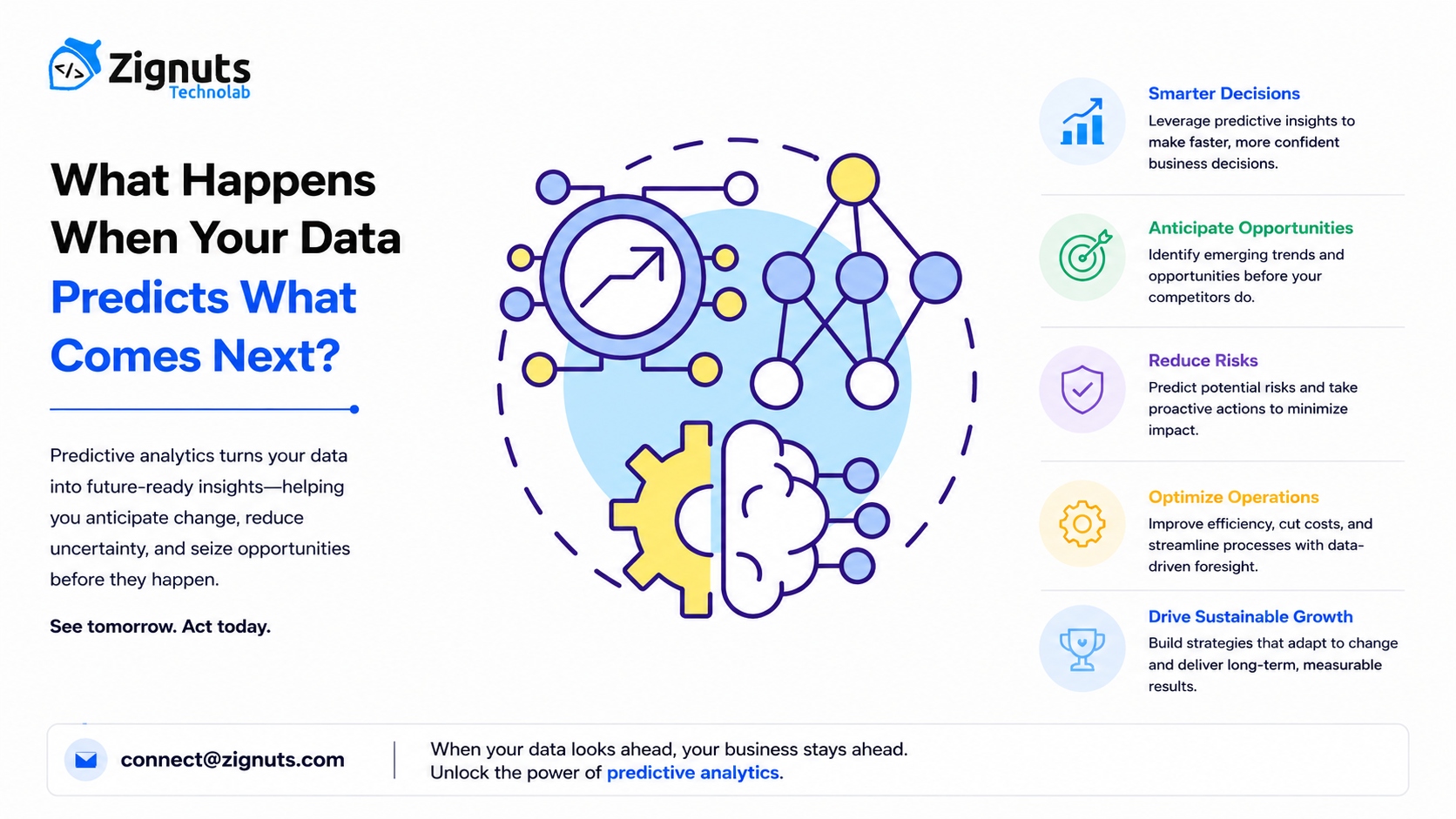
A business can have years of customer records, transactions, operational logs, marketing activity, and financial information without knowing what those signals mean for tomorrow. The real advantage begins when data can help leaders anticipate likely outcomes before they become obvious. AI Predictive Analytics gives organizations a way to identify patterns, estimate future behavior, and support decisions with forward-looking intelligence rather than relying only on historical reports.
2027 Insight | Business Impact | What Leaders Should Do |
|---|---|---|
Predictive intelligence will become more embedded in business applications | Teams can receive forward-looking signals while making everyday decisions | Prioritize predictive capabilities that fit existing workflows |
AI will support broader prediction use cases across departments | Sales, operations, finance, and customer teams can use predictive insights | Start with high-value use cases and expand after validation |
Data quality and governance will become more important | Poor inputs can reduce confidence in predictive outcomes | Establish data ownership, quality standards, and monitoring |
Human oversight will remain essential for important decisions | Predictions can guide decisions without becoming unquestioned instructions | Define approval, review, and escalation processes |
The shift is significant because businesses rarely make decisions with complete certainty. Sales leaders forecast revenue, operations teams estimate demand, finance teams assess risk, and customer teams decide which accounts deserve attention. AI Predictive Analytics can help these teams evaluate patterns across larger volumes of information and identify signals that may otherwise be difficult to detect manually.
The objective is not to make the business perfectly predictive. It is to improve the quality and timing of decisions where uncertainty has a meaningful business cost.
Why Predictive Intelligence Matters
Traditional analytics is excellent at answering questions about the past.
A dashboard might show that sales declined. A report may reveal that customer engagement decreased. An inventory system may show that a product is running low.
Those insights are useful, but leaders often need to know what happens next.
Predictive analytics adds a forward-looking layer by helping businesses explore questions such as:
Which customers may become inactive?
What products could experience increased demand?
Which sales opportunities may have stronger potential?
Where could operational problems emerge?
What financial conditions may require attention?
Which business patterns appear likely to continue?
These predictions are estimates rather than guarantees. Their value comes from giving decision-makers additional evidence before action is taken.
From Business Data to Predictive Action
A successful predictive initiative connects data with a specific business decision.
Business Question → Data Preparation → AI Predictive Model → Prediction or Risk Signal → Business Action
Each stage matters.
If the source data is incomplete, the model may produce unreliable results. If the prediction is accurate but never reaches the employee responsible for acting on it, its business value may remain limited.
This is why predictive analytics should be designed around the decision first and the technology second.
How AI Predictive Analytics Can Support Businesses
Customer Churn Prediction
Customer relationships often show behavioral changes before a customer officially leaves.
Predictive systems can analyze relevant signals such as purchase patterns, usage activity, engagement, service interactions, or other available indicators.
The resulting risk score can help customer success teams prioritize accounts that may need attention.
This does not mean every high-risk customer will leave. It means the organization has an opportunity to investigate and respond earlier.
Sales Forecasting
Sales forecasts influence hiring, budgets, inventory, production, and investment.
AI-driven predictive models can analyze historical sales activity alongside relevant business signals to support revenue forecasting.
Sales leaders can use these predictions as another source of evidence when evaluating pipeline health and future performance.
Demand Forecasting
Businesses that manage inventory or production need to estimate future demand.
Predictive systems can identify historical patterns and relevant variables that may influence purchasing behavior.
Better demand intelligence can support procurement, inventory, production scheduling, staffing, and distribution decisions.
Risk Detection
Predictive analytics can help identify patterns associated with potential financial, operational, or customer risks.
Instead of waiting until a problem becomes visible, organizations can use early signals to investigate situations that may require attention.
The appropriate application depends on the organization's industry, data, regulatory environment, and risk tolerance.
Marketing Prediction
Marketing teams generate large amounts of behavioral data.
Predictive models can help estimate likely engagement, identify customer segments with different behavioral patterns, and support campaign prioritization.
This can help marketers allocate attention and resources more selectively.
Where Prediction Can Create Measurable Value
Business Challenge | AI Predictive Opportunity | Expected Outcome |
|---|---|---|
Uncertain customer retention | Identify patterns associated with churn risk | Earlier and more targeted customer engagement |
Revenue uncertainty | Generate forward-looking sales forecasts | Better planning and resource allocation |
Changing demand | Estimate future purchasing patterns | Improved inventory and capacity decisions |
Operational disruption | Detect signals associated with potential problems | Earlier investigation and response |
Marketing inefficiency | Predict likely customer engagement | More focused campaign decisions |
The business value should ultimately be measured by what changes after predictive intelligence becomes part of the workflow.
A model may have strong technical performance, but if employees do not use its predictions or if the prediction does not affect a meaningful decision, the overall business impact may be limited.
Data Is the Foundation
Predictive models learn from available information. That makes data readiness one of the most important considerations.
Many organizations have valuable information distributed across:
CRM systems
Financial platforms
Customer support applications
E-commerce systems
Product databases
Marketing platforms
Operational tools
The problem is that these systems may not use consistent definitions or identifiers.
Common data challenges include missing records, duplicate information, inconsistent fields, outdated data, and fragmented customer histories.
Before developing a predictive system, leaders should understand what data is available and whether it is sufficiently reliable for the intended business question.
Integration Makes Prediction Useful
Predictive intelligence should not exist in isolation.
A churn prediction can be integrated into customer success workflows.
A sales forecast can appear within planning processes.
A demand prediction can inform inventory and procurement decisions.
An operational risk signal can trigger an investigation.
This connection between prediction and action is what turns analytics into an operational capability.
When predictive insights are delivered through systems employees already use, organizations can reduce friction and make adoption easier.
AI Predictive Analytics Requires More Than a Model
It is tempting to treat predictive analytics as a model-development problem.
In reality, several organizational elements determine whether the system succeeds.
Businesses need to consider:
System integration
Model monitoring
Security controls
Privacy requirements
User access
Human oversight
Business ownership
Change management
A prediction is only one component of a larger decision-support system.
Build or Buy?
Leaders should evaluate whether an existing platform can satisfy the business requirement or whether a more customized solution is justified.
Prebuilt capabilities can make sense when the use case is standardized and the business values faster deployment.
A custom approach may be more appropriate when the organization has proprietary data, specialized workflows, unique prediction requirements, or complex integrations.
Decision Area | Key Question | Business Consideration |
|---|---|---|
Use case | How unique is the prediction requirement? | Specialized needs may justify customization |
Data | How proprietary or complex is the data? | Greater data complexity may require deeper control |
Integration | Which systems need predictive intelligence? | Complex workflows can increase implementation requirements |
Long-term ownership | Who will operate and monitor the system? | Consider infrastructure, talent, maintenance, and governance |
The right choice should be based on total business value rather than development speed alone.
What Executives Should Evaluate
Before investing in predictive AI, business leaders should ask practical questions.
What business problem are we solving?
Avoid starting with a technology objective. Begin with a decision that needs improvement.
What should the prediction change?
If the prediction does not lead to a different action, its business value may be difficult to justify.
What measurable outcome matters?
Define whether success means improved forecasting, lower costs, higher retention, better productivity, reduced risk, or another business result.
Is the data sufficient?
Review historical depth, quality, accessibility, consistency, and ownership.
What happens when the prediction is wrong?
Understand the potential consequences of incorrect predictions and establish appropriate human oversight.
Who owns the decision?
The organization should define who interprets the prediction and who is accountable for the resulting action.
How will the system scale?
Consider data volume, infrastructure, integrations, monitoring, security, and organizational adoption.
A Practical Implementation Roadmap
Step 1: Choose a High-Value Prediction
Start with a specific problem where better forecasting could influence revenue, cost, risk, customer experience, or productivity.
Step 2: Define the Business Outcome
Establish a measurable objective before development begins.
Step 3: Assess Data Readiness
Review the relevant data sources, quality issues, historical information, access requirements, and governance considerations.
Step 4: Develop and Test
Create a focused predictive model and evaluate it against historical information.
Testing should consider both technical performance and the business consequences of incorrect predictions.
Step 5: Run a Pilot
Introduce the predictive capability to a limited workflow, team, or business segment.
Step 6: Connect Predictions to Action
Integrate relevant outputs into CRM systems, operational tools, dashboards, alerts, or other existing workflows.
Step 7: Monitor and Improve
Track model performance, business outcomes, data changes, and user adoption over time.
A model that works today may require adjustment when customer behavior, market conditions, or business processes change.
Risks and Limitations
Predictive AI should not be presented as an infallible decision-maker.
Data Quality Risk
Poor-quality information can reduce the reliability of predictions.
Model Drift
Patterns can change over time. A model trained on historical behavior may become less effective when conditions shift.
Privacy and Security
Organizations must carefully manage sensitive information used by predictive systems and apply appropriate access and security controls.
Bias
Historical data can contain patterns that should not automatically be repeated. Businesses need suitable evaluation and governance practices.
Human Overreliance
Employees may treat predictions as certain outcomes rather than probabilities. Clear explanations and appropriate oversight can reduce this risk.
Integration Complexity
Connecting predictive systems with existing enterprise applications can require significant technical planning.
These challenges do not eliminate the value of predictive analytics. They reinforce the importance of responsible implementation.
Preparing for Predictive Business Operations
The next stage of predictive intelligence is likely to involve deeper integration into everyday business systems.
Rather than asking employees to manually review separate analytics reports, organizations can deliver relevant predictions directly inside operational workflows.
A customer platform can surface accounts that may need attention.
A sales system can highlight opportunities with changing signals.
An inventory process can incorporate demand forecasts.
A finance workflow can identify emerging patterns that deserve review.
This approach makes predictive intelligence part of how work gets done rather than a separate analytical exercise.
The Strategic Question for Business Leaders
The most important question is not whether a company can build a predictive model.
It is whether prediction can improve a decision that matters.
A strong predictive initiative should connect four elements:
A clearly defined business problem
Reliable and relevant data
A prediction that provides useful evidence
A workflow that turns the evidence into action
If any of these elements is missing, the technology may struggle to create measurable value.
Conclusion
What happens when your data can help predict what comes next? The answer depends on what the organization does with that prediction.
AI Predictive Analytics can help businesses anticipate customer behavior, demand, revenue patterns, operational risks, and other outcomes that influence important decisions. But the technology becomes valuable only when those insights are connected to real workflows and measurable business objectives.
Executives should begin with one decision where uncertainty creates meaningful cost or missed opportunity. Define the desired outcome, assess the data, test a focused predictive capability, and connect the result to action.
The goal is not to eliminate uncertainty. It is to make better decisions while there is still time to influence the outcome.
FAQs
1. What is AI Predictive Analytics?
AI Predictive Analytics uses data and predictive modeling techniques to estimate likely future outcomes and provide insights that support business decisions.
2. How is predictive analytics different from traditional analytics?
Traditional analytics primarily explains historical and current performance. Predictive analytics adds a forward-looking layer by estimating what may happen next.
3. Can predictive analytics guarantee future outcomes?
No. Predictions are estimates based on available data and modeling assumptions. Changing conditions can affect their reliability.
4. What business functions can use predictive analytics?
Sales, marketing, finance, operations, customer success, supply chain, and strategic planning can use predictive capabilities when suitable data and clearly defined use cases exist.
5. How important is data quality?
Very important. Incomplete, inconsistent, or outdated data can weaken predictive results and reduce confidence in business decisions.
6. Should businesses automate decisions based on predictions?
Not always. The appropriate level of automation depends on the decision's risk, business context, regulatory requirements, and consequences of error. Human oversight may remain essential.
7. How should executives measure predictive AI success?
Measure the business outcome connected to the prediction, such as improved forecasting, increased retention, reduced costs, stronger productivity, or better resource allocation.
Comments
Log in or sign up to join the conversation.