
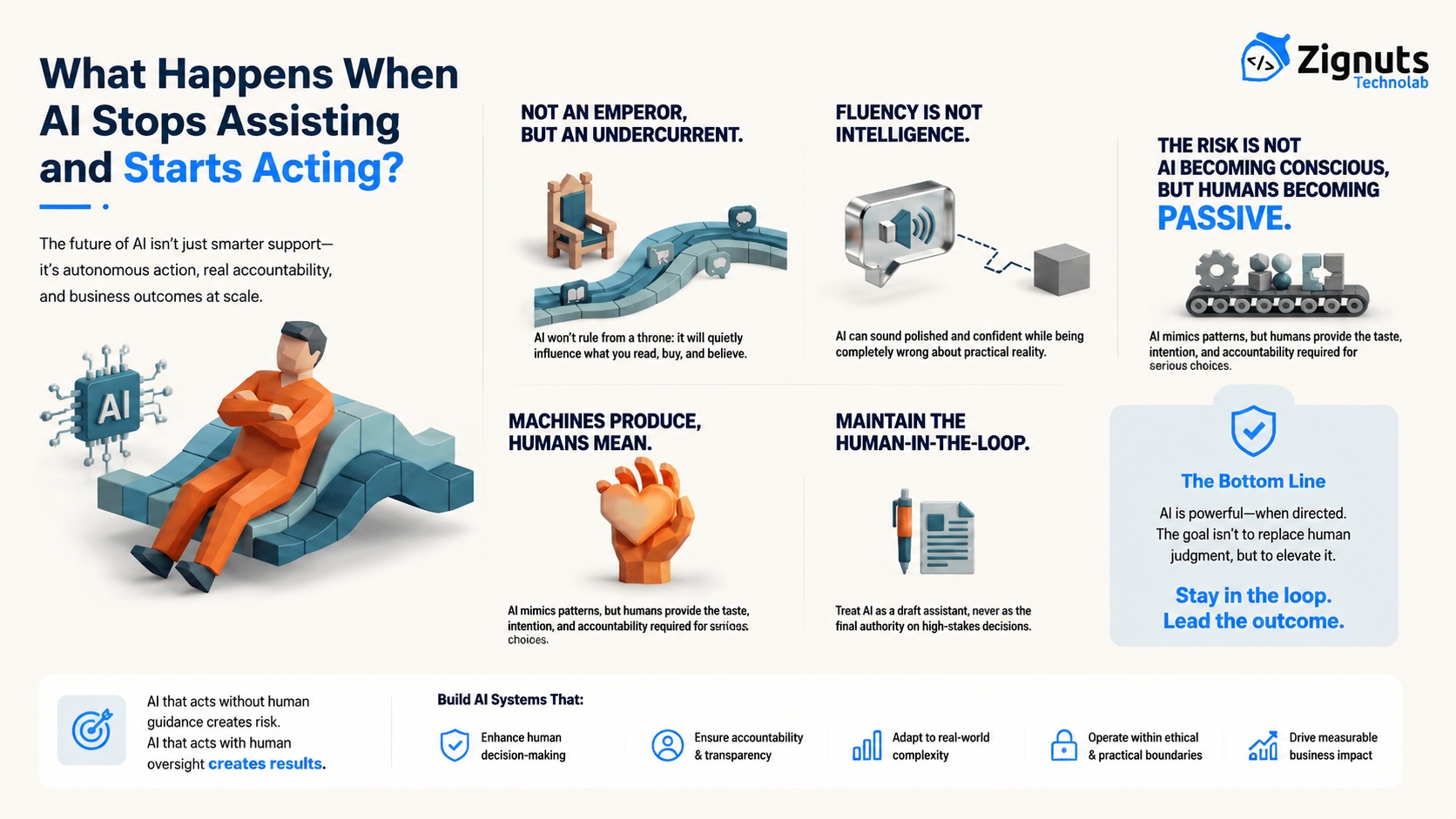
For years, most business AI systems have waited for a human to ask a question. The next shift is more consequential: AI services are increasingly being designed to monitor situations, make recommendations, initiate tasks, and coordinate actions across workflows. That raises a strategic question for every business leader: what happens when AI stops merely assisting employees and starts acting on their behalf? Many enterprise AI solutions are already moving in this direction, shifting from passive tools to active participants in daily operations. The opportunity is significant, but so are the implications for control, security, accountability, and organizational design. For executives considering agentic AI services, the goal should not be maximum autonomy. It should be appropriate autonomy tied to clearly defined business outcomes.
2027 Insight | Business Impact | What Leaders Should Do |
|---|---|---|
AI agents may take on more multi-step business workflows | Some routine processes could require less manual coordination | Identify processes where controlled autonomy creates value |
Human oversight is likely to remain important for high-impact decisions | Businesses will need clear boundaries between automation and judgment | Define approval thresholds and escalation rules |
AI systems may interact with multiple enterprise applications | Workflow automation could become more integrated | Strengthen APIs, identity controls, and system governance |
Agent performance may become a new management concern | Leaders will need to monitor actions, not just outputs | Establish logs, evaluation, and accountability mechanisms |
From Answers to Actions
Traditional business AI often works like this:
An employee asks a question.
The system provides an answer.
The employee decides what to do next.
Agentic AI changes the sequence.
An AI system may receive a goal, evaluate information, determine a sequence of tasks, interact with business systems, and report the result.
For example, instead of simply identifying that a customer order has been delayed, an AI service could potentially detect the issue, check inventory, review delivery information, prepare a customer communication, and escalate the case according to predefined rules.
That is a fundamentally different operating model.
Why Autonomous AI Matters to Business Leaders
The attraction is straightforward.
Businesses contain many processes where employees spend time coordinating information between systems.
Examples include:
Checking records
Updating systems
Sending routine communications
Creating reports
Following workflow rules
Monitoring exceptions
Gathering information
Scheduling actions
If AI can safely coordinate some of these activities, businesses may improve responsiveness and reduce manual effort.
But autonomy changes the risk profile.
An AI that only generates a draft can be reviewed before action.
An AI that executes an action can create an immediate business consequence.
That difference should shape executive decision-making.
The New Question: How Much Autonomy Is Appropriate?
Not every process should be fully automated.
A useful approach is to divide AI actions into levels.
Assist
AI recommends an action, but the employee performs it.
Approve
AI prepares the action, while a human approves execution.
Execute
AI performs predefined actions within strict boundaries.
Escalate
AI recognizes that the situation falls outside its authority and sends it to a human.
This creates a controlled model of autonomy rather than treating automation as an all-or-nothing decision.
Where Agentic AI Could Create Business Value
Customer Operations
AI services can monitor support queues, categorize issues, retrieve information, prepare responses, and route cases.
Human intervention remains important when situations involve sensitive complaints, financial decisions, or unusual circumstances.
Sales Operations
AI can assist with account research, identify follow-up opportunities, prepare sales tasks, and update relevant systems.
The objective is to reduce coordination work while allowing sales professionals to retain control over important customer relationships.
Finance
AI agents could support routine reconciliation, reporting workflows, document handling, and exception identification.
Financial controls should remain strong because automated actions can have direct monetary consequences.
IT Operations
AI can assist with monitoring, incident classification, knowledge retrieval, and predefined remediation workflows.
High-risk infrastructure changes should typically remain subject to appropriate approval mechanisms.
Supply Chain
AI services can monitor operational conditions, identify exceptions, and support planning decisions.
The value comes from faster detection and response rather than unrestricted automation.
The Autonomous Business Workflow
Business Goal → Real-Time Information → AI Reasoning → Controlled Action → Human Escalation → Business Result
This horizontal workflow illustrates an important principle: autonomy should exist inside boundaries.
The AI should know what it is allowed to do, what information it can access, what actions require approval, and when a human must intervene.
What Changes When AI Can Act?
The business risks shift significantly.
With an assistant, the primary concern may be whether the answer is accurate.
With an autonomous service, leaders must also ask:
Was the correct action selected?
Did the AI have appropriate permissions?
Could the action create financial loss?
Could the action affect customers?
Can the decision be reconstructed?
Who is accountable?
What happens when systems provide conflicting information?
This means AI governance needs to cover actions as well as outputs.
Executive Decision Framework
Decision Area | Question | Business Consideration |
|---|---|---|
Autonomy | What actions should AI perform independently? | Limit autonomy according to risk |
Permissions | Which systems can the AI access? | |
Oversight | When must a human approve? | Define clear escalation thresholds |
Accountability | Who owns AI decisions and actions? | Establish operational ownership |
Security Becomes More Important With Autonomous AI
When AI can access business systems, identity and access controls become critical.
Organizations should consider:
Authentication
Authorization
Permission boundaries
Action logging
Monitoring
Data protection
Emergency shutdown procedures
An AI agent should not automatically receive broad access simply because access makes its workflow easier.
Permissions should match the business task.
For example, an AI service responsible for preparing customer communications may not need authority to change financial records.
Data Quality Determines Decision Quality
Autonomous systems depend heavily on the information available to them.
If customer records are incomplete, inventory data is outdated, or business rules are ambiguous, AI may take inappropriate actions.
Organizations therefore need strong data foundations.
Before granting autonomy, leaders should evaluate:
Data accuracy
Data freshness
Data ownership
System consistency
Access permissions
Exception handling
Autonomy without reliable information can amplify operational problems rather than solve them.
Where Human Judgment Should Remain
Human oversight should remain particularly important when decisions involve:
Significant financial consequences
Legal or regulatory implications
Sensitive customer situations
Employment decisions
Safety
Irreversible actions
Strategic commitments
The goal is not to remove humans from the workflow.
It is to use humans where judgment adds the greatest value.
Measuring Autonomous AI
Businesses should not measure agentic AI simply by the number of tasks completed.
Useful metrics may include:
Completion rate
Exception rate
Human intervention rate
Processing time
Cost per workflow
Error frequency
Customer outcomes
Revenue or operational impact
Executives should also monitor whether autonomy creates hidden costs through increased exceptions, rework, or oversight requirements.
Build Versus Buy
Companies considering autonomous AI services should decide which layer they need to control.
External platforms may provide:
AI models
Agent frameworks
Workflow tools
Monitoring capabilities
Integration components
Internal development may focus on:
Proprietary business rules
Specialized workflows
Unique data
Internal controls
Industry-specific requirements
A hybrid strategy can allow businesses to use external infrastructure while maintaining control over critical business logic.
Implementation Roadmap
Step 1: Identify a Controlled Workflow
Start with a process that is repetitive, measurable, and relatively low risk.
Step 2: Define the AI's Authority
Specify exactly what the system can and cannot do.
Step 3: Establish Approval Rules
Determine which actions require human authorization.
Step 4: Connect Required Systems
Provide only the data and application access necessary for the workflow.
Step 5: Test Failure Scenarios
Evaluate what happens when data is missing, systems fail, or the AI reaches an unfamiliar situation.
Step 6: Launch With Monitoring
Track actions, exceptions, and human interventions.
Step 7: Expand Carefully
Increase autonomy only after the system demonstrates reliable performance.
Risks and Organizational Challenges
Autonomous AI introduces several challenges.
Incorrect Actions
A wrong answer can be corrected. A wrong action may require remediation.
Excessive Permissions
Broad system access can increase security exposure.
Unclear Accountability
Organizations need clear ownership when AI makes or executes decisions.
Employee Concerns
Employees may worry about job changes or loss of control.
Vendor Dependency
Businesses may become dependent on external AI infrastructure.
Governance Complexity
As AI gains authority, organizations need stronger policies and monitoring.
These issues make controlled implementation essential.
What Executives Should Decide Now
Before deploying autonomous AI services, leadership teams should establish:
Which workflows are appropriate for automation
Which actions require approval
What information AI can access
How actions will be monitored
How failures will be handled
Who owns the system
How performance will be evaluated
When autonomy should be expanded or reduced
These decisions should be made before the system receives meaningful operational authority.
Conclusion
The transition from AI assistance to AI action could change how businesses design workflows, allocate employee time, and operate digital systems.
But autonomy should not be treated as the objective.
The objective is better business performance.
An AI service that independently completes a low-value task may be less important than one that reliably improves a critical workflow while remaining within carefully defined boundaries.
For C-Suite executives, founders, and business owners, the strategic question is therefore not "How autonomous can our AI become?"
It is "Where can controlled AI autonomy create measurable value without creating unacceptable risk?"
That is the question that should guide the next generation of AI adoption.
FAQs
1. What is agentic AI?
Agentic AI refers to AI systems designed to pursue defined goals by planning or coordinating multiple actions rather than simply responding to individual prompts.
2. Is autonomous AI safe for business use?
It can be used safely in appropriate contexts when organizations establish permissions, monitoring, human oversight, governance, and clear boundaries.
3. Should AI be allowed to make decisions independently?
It depends on the decision. Low-risk, reversible tasks may be suitable for controlled autonomy, while high-impact decisions may require human approval.
4. What is the biggest risk of autonomous AI?
The major concern is that an incorrect decision can become an incorrect action, potentially creating financial, operational, customer, or compliance consequences.
5. How can companies start using agentic AI?
Start with a narrow, measurable, low-risk workflow. Define the AI's permissions and escalation rules before allowing it to perform actions.
6. Does agentic AI replace employees?
Not necessarily. It can automate coordination and repetitive tasks while allowing employees to focus more heavily on judgment, relationships, and complex decisions.
7. What should executives monitor after deployment?
Leaders should monitor action accuracy, exceptions, intervention rates, costs, security events, customer outcomes, and overall business impact.
Comments
Log in or sign up to join the conversation.