

In case of failure of the grid, solar systems shut down automatically. This is done as a safety measure, not because your solar panels have stopped functioning. During a power outage, your solar system generates electricity only when there is either a battery or a hybrid inverter connected.
Key Takeaways
Solar cells are disconnected from the grid when there’s a power outage. This is known as anti-islanding to safeguard utility workers.
The panels will be collecting energy from the sun; however, the inverter will not allow it to pass through. Without a battery, you will have no electricity at home.
The off-grid and hybrid solar panel systems continue operating as they store the electricity in the batteries.
Indian homes suffering from load shedding find hybrid systems with battery storage most beneficial.
Selecting superior-quality solar PV panels from a reputable solar manufacturing company in India will increase reliability in the long run.
An adequately sized backup battery can power your fridge, fan, lights, and WiFi router for many hours.
Why Do Solar Panels Switch Off During a Power Cut?
This is confusing for many homeowners. Panels are harnessing the sun’s energy throughout the day. So, where does this energy go?
The catch here is that most residential solar systems are grid-connected. They are directly connected to the utility grid.
As soon as there is any problem with the utility supply, the inverter immediately detects it and shuts down the whole system within seconds. This feature is known as anti-islanding.
The line technicians can be mending the wires during this power outage. If your solar system continued to deliver power in the reverse direction, then it could harm them. Hence, the shutdown is not a flaw; it is an obligatory safety requirement.
The situation is even stricter in India. The Indian Electricity Rules mandate the automatic disconnection of your on-grid system in case of any blackout.
The Three Types of Solar Systems, and How Each One Behaves
Every solar system does not behave in the same manner when there is an electricity cut. It all depends on the type of system that you have installed in your house.
On-Grid Solar Systems
It is the most widely used system in India. Your panels are directly connected to the grid without a battery.
During the day, your panels will generate electricity and send extra energy to the grid, for which you receive credits through net metering.
However, once there is a power outage, this system turns off completely. There is nothing to fall back on because there is no backup facility.
Off-Grid Solar Systems
Such types of systems do not connect to the utility grid. Instead, they are completely dependent upon batteries, which are charged through your solar panels.
Since there is no connection to the utility grid, the off-grid system will continue to work in spite of any power outages. Appliances that you have connected to the off-grid system will continue to work without any break.
The only disadvantage of such systems is their high cost.
Hybrid Solar Systems
Hybrid systems incorporate the best features of both these systems. The hybrid system remains tied to the grid for the benefits of net metering.
In addition, there is also battery storage that provides a backup. So, in case of a power outage, the hybrid inverter disconnects your house immediately.
The battery powers your appliances, and your solar panels continue charging the battery in case there is sunshine.
Solar Generators, a Smaller Alternative
Some homeowners like to use a solar generator rather than a battery bank. The generators are portable units with built-in panels.
They serve well in case one needs to charge phones and laptops for a short period of time. However, they are not suitable for home backup.
In case of a prolonged power outage, a battery backup or a hybrid system performs much better.
Battery Backup vs Diesel Generator: Which One Makes Sense
Most Indian homes have a diesel generator for emergencies. There are a few aspects to consider in this comparison with solar battery storage.
The battery is noiseless, smoke-free, and requires very little maintenance.
A generator requires fuel, regular servicing, and cannot be used inside the house.
The battery charges for free during daytime using sunlight through your current panels.
The generator will be useful when there is a power failure, but your battery will also reduce your electricity bills.
Diesel prices continue to rise, but the solar battery uses the energy produced by the solar panels.
For any urban or semi-urban homes, batteries along with solar panels make more sense economically.
Quick Comparison Table
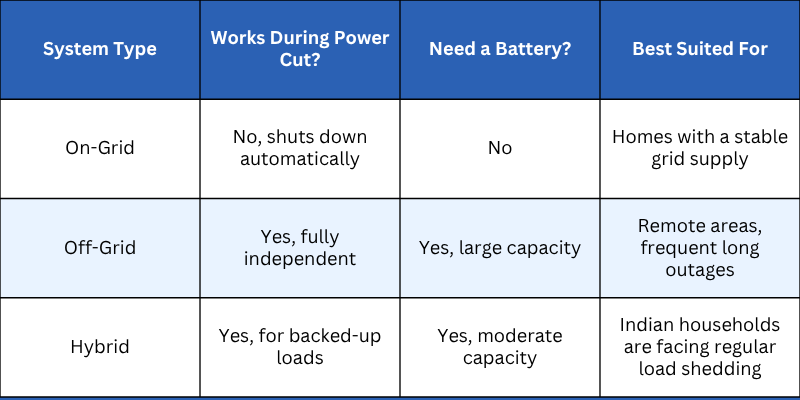
What This Means for an Indian Household
Power failures are a common phenomenon in most Indian urban areas. Storms during the monsoon period, overload of the power grid, and maintenance are some of the reasons behind these power failures.
The majority of Indian households have an inverter with batteries for this very purpose. The addition of solar panels to the equation makes logical sense.
The following is what usually takes place in an ordinary Indian household during a power cut:
The ceiling fans stop, making the environment very hot within a few minutes.
The refrigerator stops working, resulting in the spoilage of milk, vegetables, and other food items.
The WiFi connection stops working, interrupting work calls and children's online classes.
The water motor stops working, and the overhead tanks remain dry for the next cycle of water supply.
It is hard to charge your mobile phone, particularly during night outages.
Hybrid solar power systems with battery backup can overcome most of these challenges effectively. Your fans, lighting, router, and refrigerator work fine without a diesel generator.
This kind of energy supply system is being used by many housing complexes as well as individual houses in states such as Maharashtra, Gujarat, and Rajasthan.
Areas outside the city experience power cuts for much longer periods compared to urban areas. A hybrid energy supply system with sufficient battery backups is sufficient to tackle them.
As for urban apartments, they always face shorter and more unpredictable blackouts. A small battery suffices to fill in those brief outages.
No matter what type of house you live in, make sure that your battery capacity fits your electricity usage patterns. In the long term, it will save you from buying extra batteries and cut down on high electricity bills.
How to Keep Your Solar System Working During an Outage
If you want power during grid outages, do the following -
Have a solar battery backup installed with your current on-grid system.
Select an inverter that can handle a mains outage; this is also known as a hybrid inverter.
Select the size of the battery according to your essential load requirements.
Instruct your installer to give priority to the fridge, fans, lighting, and Wi-Fi when it comes to backups.
Have your system checked every year to see if the anti-island feature is working properly.
The cost of battery storage depends on the capacity and the brand of the battery. The minimum requirement for backup of the essential appliances is much cheaper compared to a whole-home battery bank.
Choosing the Right Solar PV Panels for Reliability
Your battery is important, but your panels are equally important. Low-quality solar PV Panels are not durable and generate less energy in the long run.
Go for panels that have been tested for performance in Indian weather conditions. Cheap panels will wear out faster in such harsh conditions. It is always recommended to go for a well-known solar power manufacturer in India, such as Inter Solar. Such manufacturers know regional weather patterns and grid requirements inside out.
Furthermore, the warranties given by such manufacturers are easier to claim compared to others. This is more important than most people think.
Ask your installer about the efficiency of panels, the coefficient of temperature, and warranty periods before you finalise the purchase. They influence the performance of your system during the hot summer months in India.
Conclusion
The solar power system will not stop working during a power outage because it has shut down intentionally to ensure safety. The installation of a battery or having a hybrid system ensures that you have backup energy even during a power outage in India.
Comments
Log in or sign up to join the conversation.