

Animals seem to make even the most mundane topics far more interesting, and I certainly feel like that's the case with the stock market. You often hear the terms bull and bear thrown around on TV all the time, but do you really know what each means? A while back I discussed what constitutes a bear market, so today I decided to talk about the much more fun and happy, bull market.

What Exactly is a “Bull Market”?
This occurs when a financial market, index, or group of securities, demonstrate that prices are rising or are expected to rise in the near-term (or long-term). While it is generally used to describe the stock market, it can also be applied to any group of financial securities that are traded - like bonds and currencies.
Bull markets are usually characterized as being optimistic, indicative of consumer and investor confidence, and indicate that expectations of strong price rises now and in the future. However, as with most things in life, predicting optimism in the long-term is very difficult to do, especially today when the world is constantly changing. Yet there are some tell-tale signs that despite many external factors, market will still hang on and be strong.
Bulls vs Bears
The opposite of a bull market is a bear market; which is characterized by a falling prices largely thanks to investor/consumer pessimism about the near-term and future. Using bears and bulls to describe market movements stems from the way that each animal attacks a threat.
Bulls always sweep their horns up to attack, while bears swipe their paws down to attack. These motions serve as metaphors for the market movements: a bull market goes up, a bear market goes down.
Additionally, bull and bear markets usually coincide with the “economic cycle” which is made up of four phases:
-
Expansion
-
Peak
-
Contraction
-
Trough
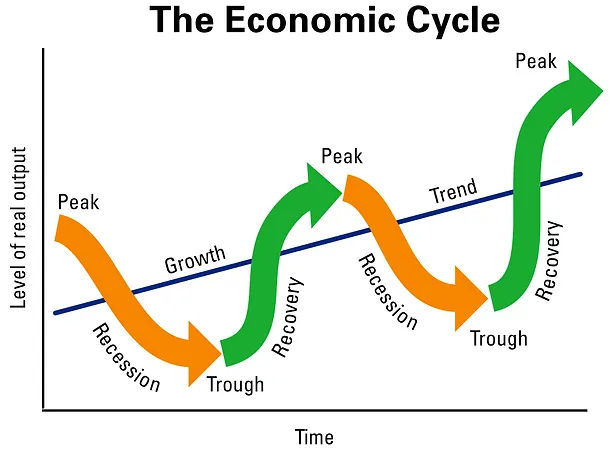
A bull market is an indicator of the expansion period, while a bear occurs in the contraction period. These four phases usually coincide with sentiment around broader economic measures and indicators - like gross domestic product (GDP).
Why is it Important to Know About the Bull and Bear Markets?
Historically, sentiment of the stock market usually serves as a pre-indicator of how good or bad GDP numbers will be in a given quarter or a given year. Just about every economic recession in the United States was predicted by the stock market well before any major economic data indicated weakness. So being able to see the writing on the wall early is what helps investors get ahead of the curve.
What is a Classic Bull Market Example?
Probably the most prolific bull market in modern American history started at the end of the stagflation era in 1982, and concluded during the dotcom bust (or tech bubble) in 2000. During this secular bull market - a term that gives an indication of a bull market lasting for multiple years - the Dow Jones Industrial Average (DJIA) averaged 16.8% annual returns. The NASDAQ, a tech-heavy exchange, increased its value five-fold between 1995 and 2000, rising from 1,000 to over 5,000.
Then, a protracted bear market followed the 1982-2000 bull market. From 2000 to 2009, the market struggled to establish footing and delivered average annual returns of -6.2%.There is a cycle to all of these markets, the key to making profits in the stock market long-term is timing with each of these economic dips and lifts.



Comments
Log in or sign up to join the conversation.