
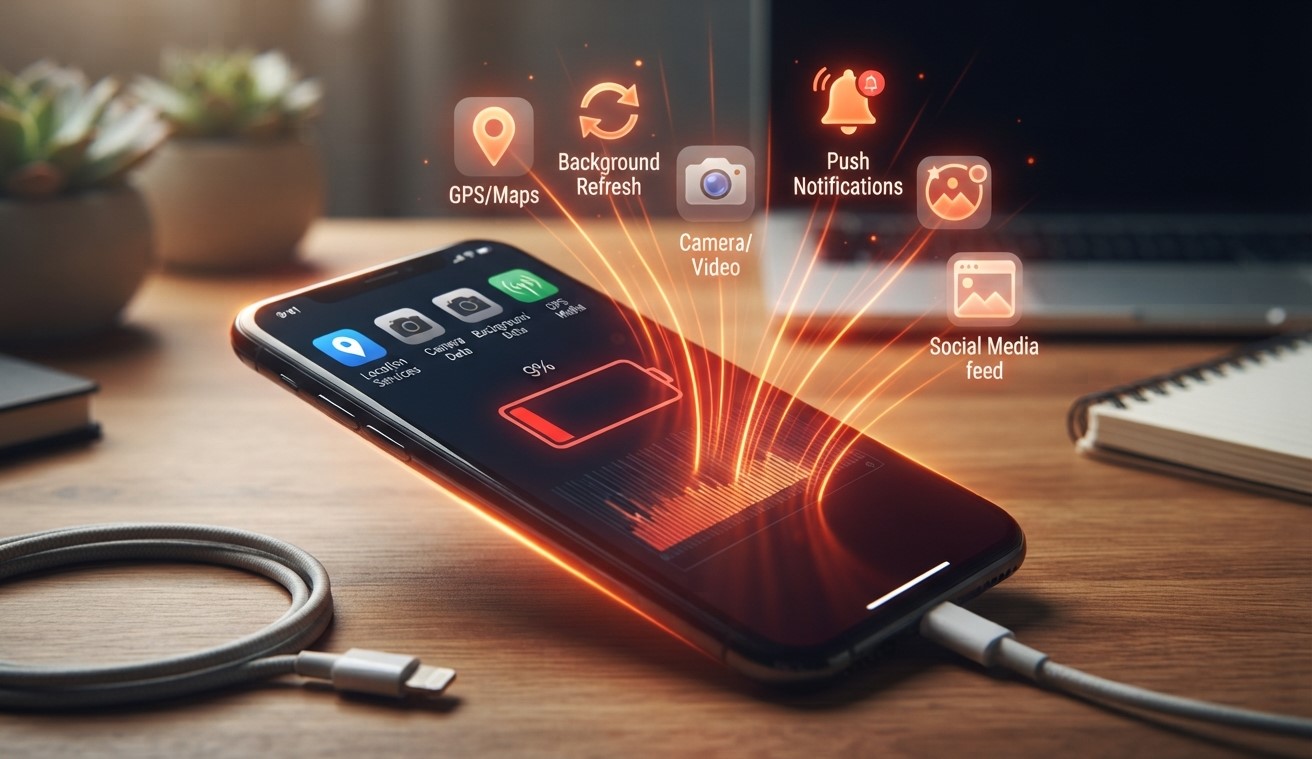
Smartphone apps make everyday life easier. We use them for messaging, social media, navigation, online shopping, entertainment, work, banking, and much more. However, one common problem many smartphone users experience is unusually fast battery drain. You may start the day with a fully charged phone, only to notice that the battery percentage has dropped significantly after just a few hours.
While battery age can contribute to poor battery life, apps are often another major factor. Some applications use considerable processing power, access your location, send notifications, refresh content in the background, or continuously connect to the internet. When several apps perform these activities at the same time, your smartphone battery can lose power much faster than expected.
Understanding what causes apps to drain your battery can help you identify the problem and make simple changes. In many cases, you do not need to replace your phone immediately. Adjusting app settings, updating software, and managing background activity can make a noticeable difference.
If your battery continues to drain quickly even after troubleshooting, professional assistance may be useful. Customers searching for iphone repair near me or phone screen repair near me may also discover that battery-related problems can sometimes occur alongside other hardware issues.
1. Apps Running in the Background
One of the most common reasons apps drain battery is background activity. Many applications continue performing tasks even when you are not actively using them.
For example, a messaging app may check for new messages, a social media application may refresh its feed, and a weather app may update information periodically. These processes require power even when the app is not visible on your screen.
Having several apps running background processes can gradually consume a significant amount of battery throughout the day.
Check your phone's battery settings to see which applications are using the most power. If an app consumes a large percentage of your battery despite limited use, consider restricting its background activity.
2. Location Services Can Increase Battery Usage
Location-based features are useful for navigation, food delivery, weather updates, ride-sharing, and many other services. However, applications that frequently access your location can consume additional battery power.
Some apps may request location access even when you are not actively using them. Continuous or frequent GPS activity can require more energy because your smartphone must communicate with location systems and process that information.
Review location permissions for your installed apps. If an application does not need your location all the time, consider changing its permission to allow location access only while the app is being used.
This simple adjustment can reduce unnecessary battery consumption.
3. Push Notifications Keep Apps Active
Notifications are convenient because they allow you to receive messages, alerts, updates, and reminders instantly. However, every notification can require some communication between the app, your phone, and the internet.
Apps that send frequent notifications may contribute to battery drain, particularly when you have many applications installed.
You do not necessarily need to disable every notification. Instead, review your notification settings and turn off unnecessary alerts.
Reducing notifications from apps that you rarely use can help your phone spend less energy checking and displaying unnecessary updates.
4. Social Media Apps Can Consume Significant Power
Social media applications are among the apps that can use considerable battery power. These apps often load images, videos, advertisements, messages, stories, and other constantly changing content.
Some social media platforms also use background refresh, location services, notifications, and mobile data. Streaming videos or scrolling through media-heavy feeds can place additional demands on your phone's processor and display.
If you notice that your battery drops quickly after spending a long time on social media, the app itself may be responsible.
Reducing screen time, disabling unnecessary background refresh, and limiting automatic media downloads can help reduce battery consumption.
5. Video Streaming and Gaming Use More Power
Not all apps consume battery at the same rate. Video streaming, gaming, video editing, and other demanding applications can use much more power than basic apps such as calculators or simple note-taking tools.
Games may place heavy demands on the processor, graphics system, display, speakers, and network connection. Streaming high-quality video also requires continuous data processing and screen activity.
It is normal for your battery to decrease faster during intensive tasks. However, unusually fast battery drain even when performing simple activities may indicate another issue.
If your phone becomes extremely hot while using a particular app, close the application and allow the device to cool down.
6. Poor Network Connections Can Drain Battery
Your smartphone may consume more battery when it struggles to maintain a reliable cellular or Wi-Fi connection.
When the signal is weak, your phone may work harder to maintain communication with nearby network equipment. Apps that continuously use mobile data can therefore contribute to increased battery consumption when network conditions are poor.
For example, streaming a video while traveling through an area with weak cellular coverage may cause your battery to drain faster than usual.
When possible, connect to a reliable Wi-Fi network or move to an area with better cellular coverage. If your phone consistently struggles to maintain a signal, the problem may involve network settings, the SIM card, software, or hardware.
7. Automatic App Refresh Uses Battery
Many smartphones allow apps to refresh their content automatically. This means an app can retrieve new information even before you open it.
Automatic refreshing is useful because it makes apps feel up to date. However, having dozens of apps refreshing regularly can result in unnecessary battery usage.
Review your background app refresh settings and disable the feature for apps that do not need frequent updates.
You can usually keep background activity enabled for important applications while limiting it for less important ones.
8. Outdated Apps Can Cause Excessive Battery Drain
Developers regularly release updates to improve performance, fix bugs, and address compatibility problems. An outdated application may sometimes contain bugs that cause excessive processor or network activity.
If one specific app suddenly starts consuming much more battery than usual, check whether an update is available.
Keeping your applications and smartphone operating system updated can help prevent certain performance and battery problems.
However, if battery drain begins immediately after an update, monitor the phone for a while. Some devices may temporarily perform additional background tasks after major software updates.
9. Apps With Bugs or Memory Problems
Sometimes an application may malfunction and continue running processes that it should have stopped. A poorly functioning app may repeatedly attempt to connect to a server, refresh content, or perform another task.
This can result in unusual battery consumption.
If your battery settings show that one particular application is using an unusually high amount of power, try closing the app and restarting your phone. If the problem continues, update or reinstall the application.
You can also temporarily remove the app to determine whether battery performance improves.
10. Too Many Apps Installed
Having a large number of applications does not automatically mean your battery will drain quickly. However, problems can arise when many of those applications have permission to operate in the background.
Unused apps may still send notifications, synchronize information, use location services, or perform background tasks.
Take some time to review the apps installed on your phone. Remove applications you no longer need and restrict unnecessary permissions for the ones you keep.
A cleaner app environment can also make it easier to identify which application is responsible for unusual battery consumption.
How to Find Which Apps Are Draining Your Battery
Modern smartphones usually provide built-in battery usage information. This feature can show which apps have consumed the most battery over a specific period.
Open your phone's battery settings and look for the battery usage section. You may see applications ranked according to their battery consumption.
Pay attention to apps that consistently appear near the top.
If an app you rarely use is consuming a significant amount of power, investigate its background activity, location permissions, notifications, and other settings.
This approach is much more effective than simply closing every application without knowing what is actually causing the problem.
What You Can Do to Reduce App-Related Battery Drain
Several simple habits can help improve battery life:
Restrict background activity for unnecessary apps.
Turn off location access when an app does not need it.
Reduce unnecessary push notifications.
Keep apps and your operating system updated.
Delete applications you no longer use.
Avoid excessive use of high-performance games and video apps.
Use Wi-Fi when it is reliable and available.
Reduce screen brightness when practical.
Turn off unnecessary connectivity features when they are not needed.
Restart your phone occasionally if an app appears to be malfunctioning.
Check battery usage regularly to identify unusual activity.
These steps can help you understand how your phone uses power instead of simply assuming that the battery itself is failing.
When Fast Battery Drain May Indicate a Hardware Problem
Sometimes an app is not the real cause of rapid battery drain. If your phone loses power quickly even when you are barely using it, the battery itself may have degraded.
Older batteries naturally lose their ability to hold a full charge. Physical damage, excessive heat, liquid exposure, or charging problems can also affect battery performance.
Other warning signs can include unexpected shutdowns, significant heating, a battery percentage that changes unusually quickly, or a phone that struggles to stay powered on.
If troubleshooting apps and settings does not improve the situation, professional inspection can help determine whether the problem is software-related or hardware-related.
For local customers, Mobile Repair Albany can be a useful search term when looking for smartphone repair assistance. People searching for iphone repair near me may also be looking for help with battery, charging, screen, or other device problems.
How to Prevent Apps From Draining Your Battery Too Quickly
Preventing battery drain starts with regularly reviewing how your apps behave.
Every few weeks, check battery usage and remove applications you no longer need. Review location and notification permissions, especially after installing new apps.
Avoid downloading applications from unreliable sources, as poorly designed or malicious software can potentially create performance and battery problems.
It is also helpful to keep your phone away from extreme heat. High temperatures can negatively affect battery performance and may make battery drain appear worse.
Most importantly, pay attention to changes. If an app that normally uses very little power suddenly becomes one of your highest battery consumers, investigate the issue rather than ignoring it.
Final Thoughts
Smartphone apps can drain battery quickly for many reasons, including background activity, location services, notifications, automatic refreshing, video streaming, gaming, weak network connections, outdated software, and application bugs. Identifying the specific cause is the first step toward improving battery life.
Before assuming that your smartphone needs a new battery, check your battery usage settings and review the apps consuming the most power. Simple changes to permissions and background activity can often make a noticeable difference.
However, persistent battery problems may point to a hardware issue that requires professional attention. Whether you are searching for Mobile Repair Albany, iphone repair near me, or phone screen repair near me, understanding the difference between an app-related problem and a hardware fault can help you take the right next step for your smartphone.
Comments
Log in or sign up to join the conversation.