

The Apple Card (AAPL) is reflective of both the increasing propensity of technology companies to venture into financial products as well as Apple's own increasing diversification into services and ancillary products.
The Apple Card may have some immediate and direct revenue impact as a financial product on its own. However, it may also have a just as essential ripple effect on Apple's ecosystem in driving usage, brand stickiness, and adoption for the company's other hardware and services products.
Apple Jumps Deeper Into The Financial World
The Apple Card is Apple's first official credit card. While the company had a variety of financial services that have debuted bit by bit in recent years - such as Apple Pay and Apple Cash - the Apple Card is a significant merger of many of these together into a serious play into financial services for the company.
As I described earlier this year, Facebook's (FB) potential cryptocurrency's major boon to the company may not come in the direct impact of fees or revenue generated from the product itself, but rather, from the externality impact of people using the platform more due to it now offering significant financial services and making potentially using other aspects of the platform smoother and easier.
With Apple, I believe it is the same way. From both public information and my own experiences with the card as of far, it is distinct in that on its face it appears to be a poor fee-generating product. The card features an interest rate range lower than what is generally expected for a mass consumer credit card, and contains seemingly "no fees," whether annual, late, over-the-limit or otherwise.
This initially seems counter-intuitive for a profit-generating product. Credit card revenue data shows that it primarily comes from interest charges and merchant charges. However, the various punitive and other fees still account for about a large - a third in 2016 - of credit card revenue. Combined with Apple's lower interest rates and relatively generous rewards programs, this initially does not seem to bode well for the product as a boon to the company.
The Apple Card Will Fuel Other Apple Revenue Streams
However, the card appears to be designed to rather increase user adoption of Apple products, including financial and other services, as well as to increase entrenchment in the company's ecosystem of items and revenue streams in a way similar to the above-described Facebook cryptocurrency.
We see this, in particular, in the Apple Card's rewards program, which has a 1% rate for its request-only physical card but 2% for using the card electronically only through Apple Pay. The company also offers, as many company-specific cards do, 3% for its own Apple Store and iTunes products but also 3% for some company partnerships such as Uber (UBER).
This is a clear push for users to utilize the "card-less" version of the Apple Card, which means using an Apple Pay-compatible product such as the iPhone, Mac, iPad, and Apple Watch to do their financial transactions. At a time when the company has been seeing volatile, and in many cases flat or declining, iPhone sales, this may be part of an attempt to boost iPhone interest by centralizing more and more onto the hardware product.
The Apple Card also brings the distinction of offering what appear to be user-friendly analytics for spending and payment to the app, as well as advertising how its digital-centered existence and number-free physical card (although it still has a real credit card number like any other) provide greater security against fraud and theft.
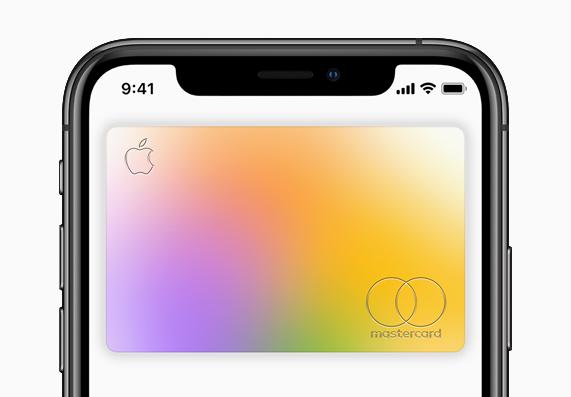
(Figure: How Apple seems to want you to use the Apple Card - on an Apple product. Image Source: Apple)
The analytics and security features, in combination with Apple advertising how it made the Apple Card open to all U.S. customers and accepting subprime borrowers despite low rates and fees, appear to show that the company is attempting to make this a mass appeal product rather than a targeted credit card. It is clear and obvious this is not a card meant to be evaluated on its own in terms of its profitability, but rather must - and I believe does - have a larger risk-reward gamble for the company's bottom line.
As I described last month, Apple is currently at a place in which it is both struggling to find new avenues for growth as well as broadening further into the services world. I believe the Apple Card seems to be a worthwhile attempt into that strategy of increasing adoption of the company's products and its ecosystem, which can have a derivative impact of increasing hardware sales as well as use and purchase of its various other products and services.
It wouldn't be hard to imagine too the Apple Card as not the end but another step in Apple's journey into financial services. Were the company to further expand its financial services offerings into the natural next steps - such as deposits and lending - that would further create both individual product line benefits to Apple's bottom line as well as larger ecosystem impacts. The Apple Card may be another part in setting the playing field for building further into an "Apple Bank" world.
Conclusion
I believe the Apple Card will be a positive and notable boon for the company. However, that benefit will not be primarily as a financial services product within itself, for which the Apple Card appears poorly designed, but rather in the ripple effects of the card on the rest of the company's sales, whether in core hardware products such as the iPhone or in Apple's increasingly essential spectrum of services.


Comments
Log in or sign up to join the conversation.