


Inspector Gregory: Is there any point to which you would wish to draw my attention?
Sherlock Holmes: To the curious incident of the dog in the night-time.
Insepctor Gregory: The dog did nothing in the night-time.
Sherlock Holmes: That was the curious incident
The Adventure of The Silver Blaze, 1892
You can observe a lot by just watching.
Yogi Berra
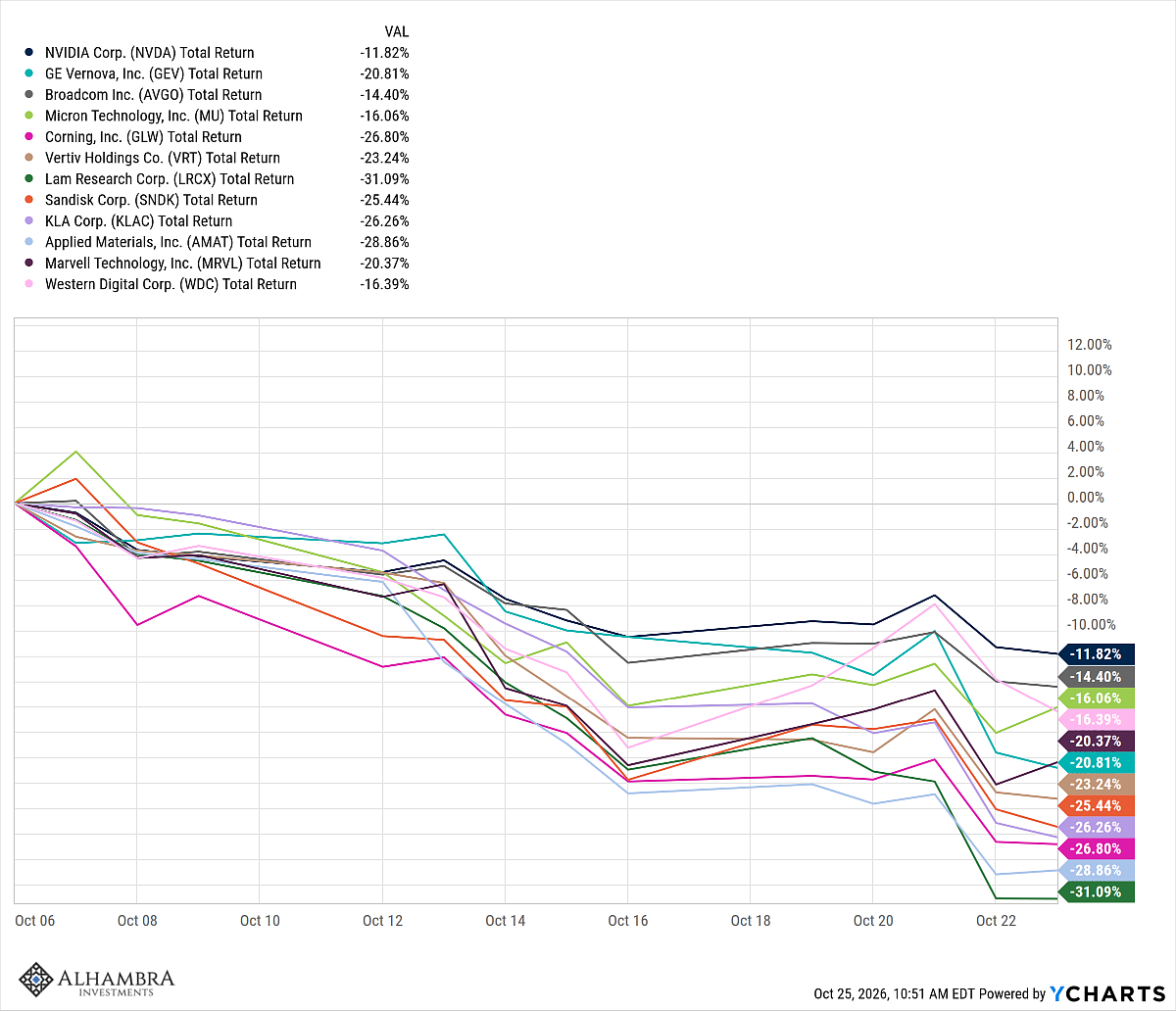
The focus of the financial press over the last 2 to 3 weeks has been the sell off in AI-related stocks. It has been a quick, vicious sell off that started in early October and has now pushed most of the big AI names down by double digit percentages:
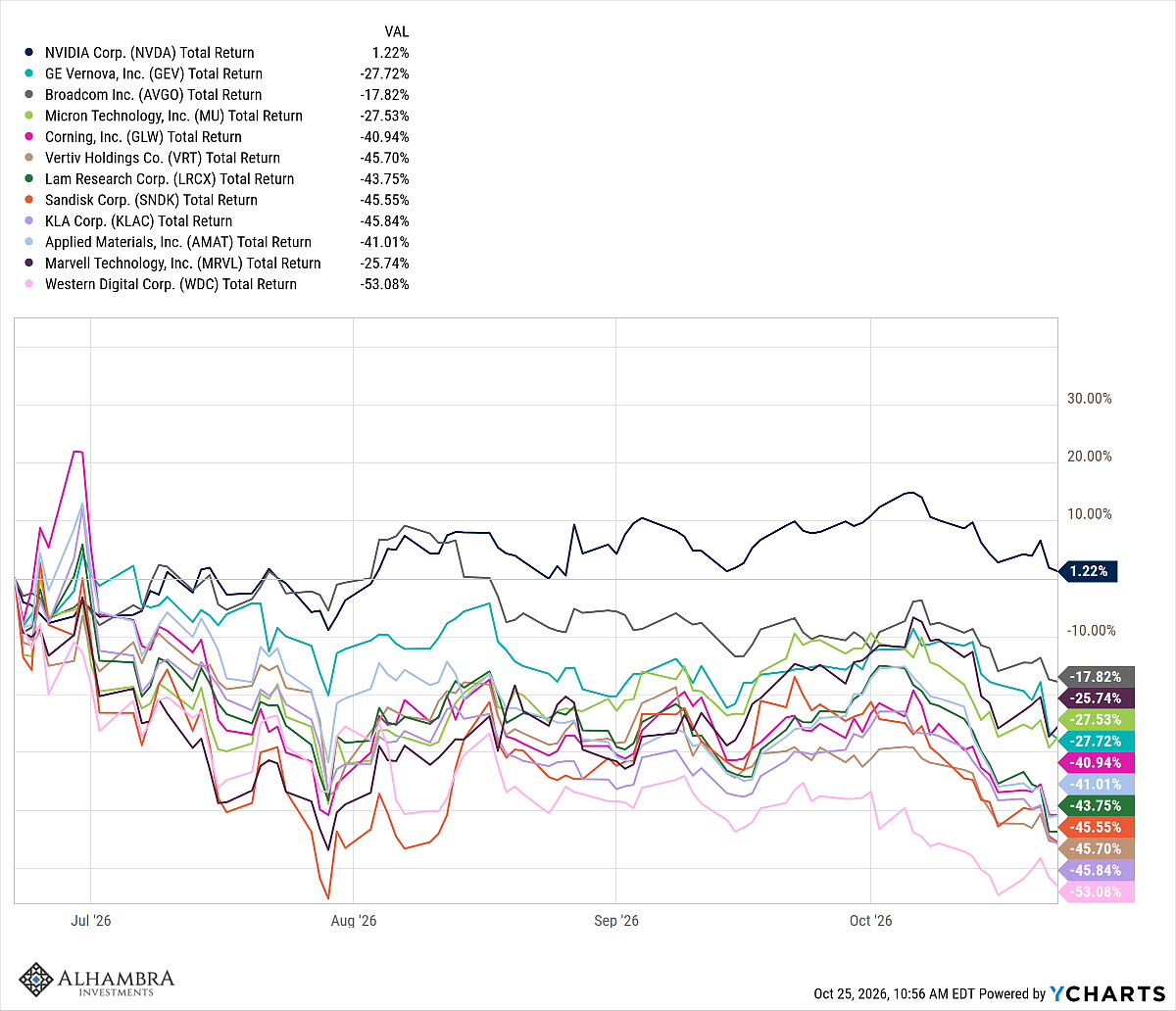
What’s more interesting, in my opinion, is that these stocks actually peaked four months ago and the press is still talking about them like they are the most important thing going on in markets:
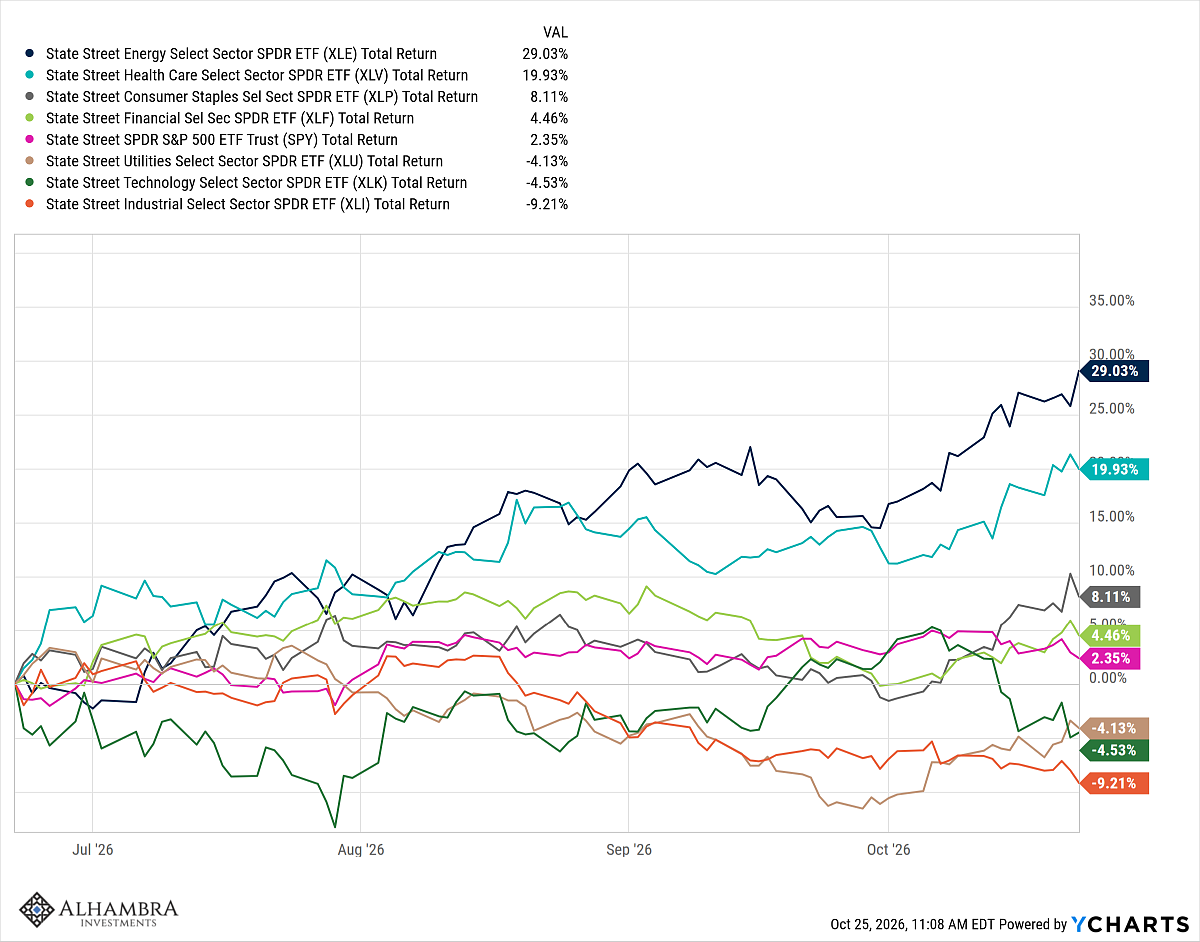
Even more interesting than that are the sectors that are outperforming the technology sector since its early summer peak. Energy, healthcare, consumer staples, and financials have all outperformed the S&P 500 and the technology index since late June, some by a large amount. Healthcare and energy are up 19.9% and 29.0% respectively in just four months. We track the worst 5 and 10-year performers over time and healthcare and energy show up in both of those lists the last few years. Healthcare was in the bottom five of each category as recently as last year. Energy, even after the big rally, is still the 5th worst performer over the last 10 years. Bob Dylan probably didn’t know he was writing about markets when he sang “for the loser now will be later to win, for the times they are a-changin'”.
I am not a momentum investor. Buying high and selling higher is not a game I care to play. It is a legitimate factor strategy though, and one of only three that pass our factor test:
It has to work across time, regions, and asset classes
It has to work across different formulations of it. For example, value works however you define it: price/book, price/sales, etc.
It has to have a logical explanation – why does it work?
It has to keep working after it is well known; it has to work out of sample
The only three factors we think pass that test are Value, Quality, and Momentum, which also is the name we gave our stock picking methodology. So, yes, momentum is something we use but probably not the same way most investors do. As I said, I’m not a momentum investor, by which I mean I am not really a price momentum trader. The idea of buying something at an all-time high offends me. But momentum definitely plays a role in how I invest. Most momentum investors get their ideas by looking at stocks (or sectors) that have already done well, in anticipation that they will continue to do so; they go shopping on the new high list. We, on the other hand, look for future winners in the things that haven’t done well, with the expectation the condition will not be permanent. We want things that are cheap with momentum turning positive.
Right now, the previously out of favor sectors gaining momentum are energy, healthcare, and consumer staples. It probably isn’t coincidence that two of those are considered defensive sectors: healthcare and staples. The questioning of AI’s potential is fully underway – and way overdue in our opinion. If the AI buildout slows, that likely means the entire economy slows because that’s where most of recent growth is coming from. And if the economy slows, healthcare and staples aren’t usually affected as much as companies that are more dependent on economic growth.
As for energy, it is obvious that part of that is from the Iran War but how much? Will that get resolved soon? Good question for which we don’t have much of an answer right now. But if you are reluctant to buy energy stocks because you are worried that a resolution will be found and oil prices will drop rapidly, you should be aware that you have a lot of company. The energy sector ETF (XLE) has seen outflows over the last 1, 3, and 6 months even as the sector has made new highs. It also shows outflows over the last 3, 5, and 10 years. Not exactly well loved.
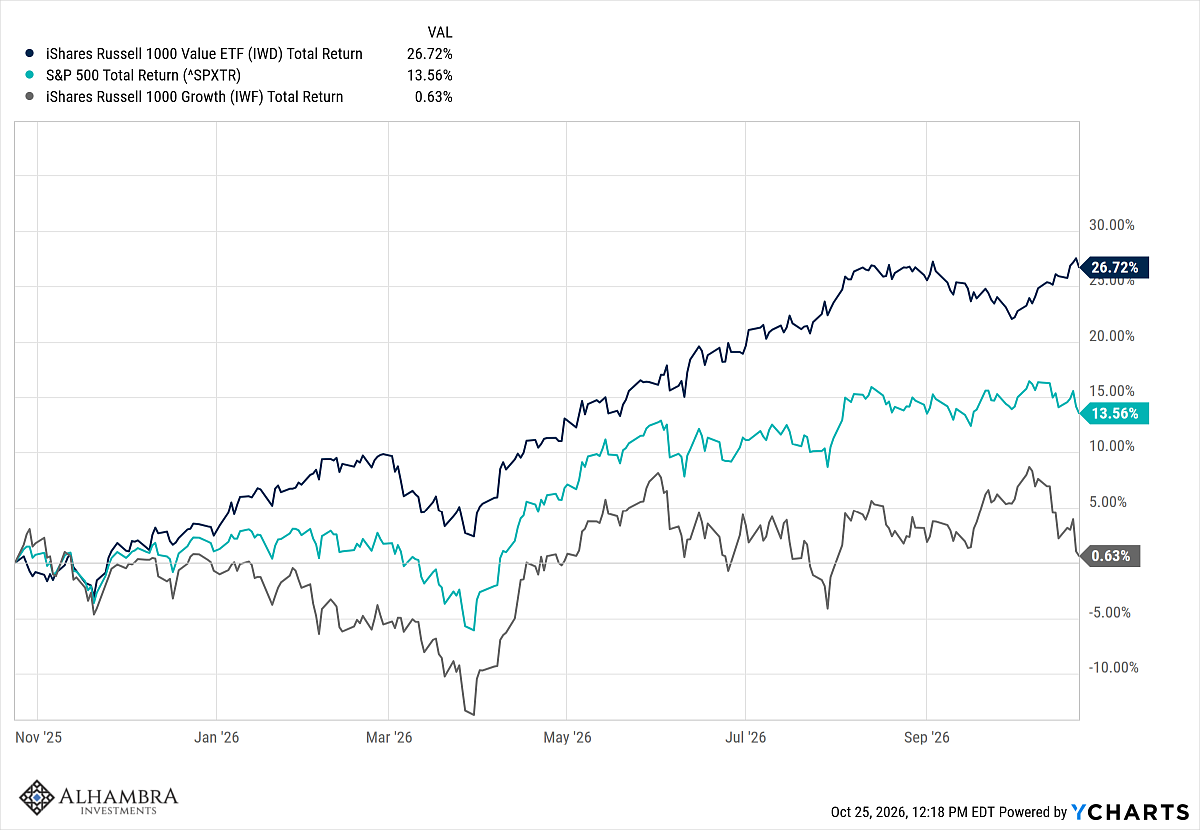
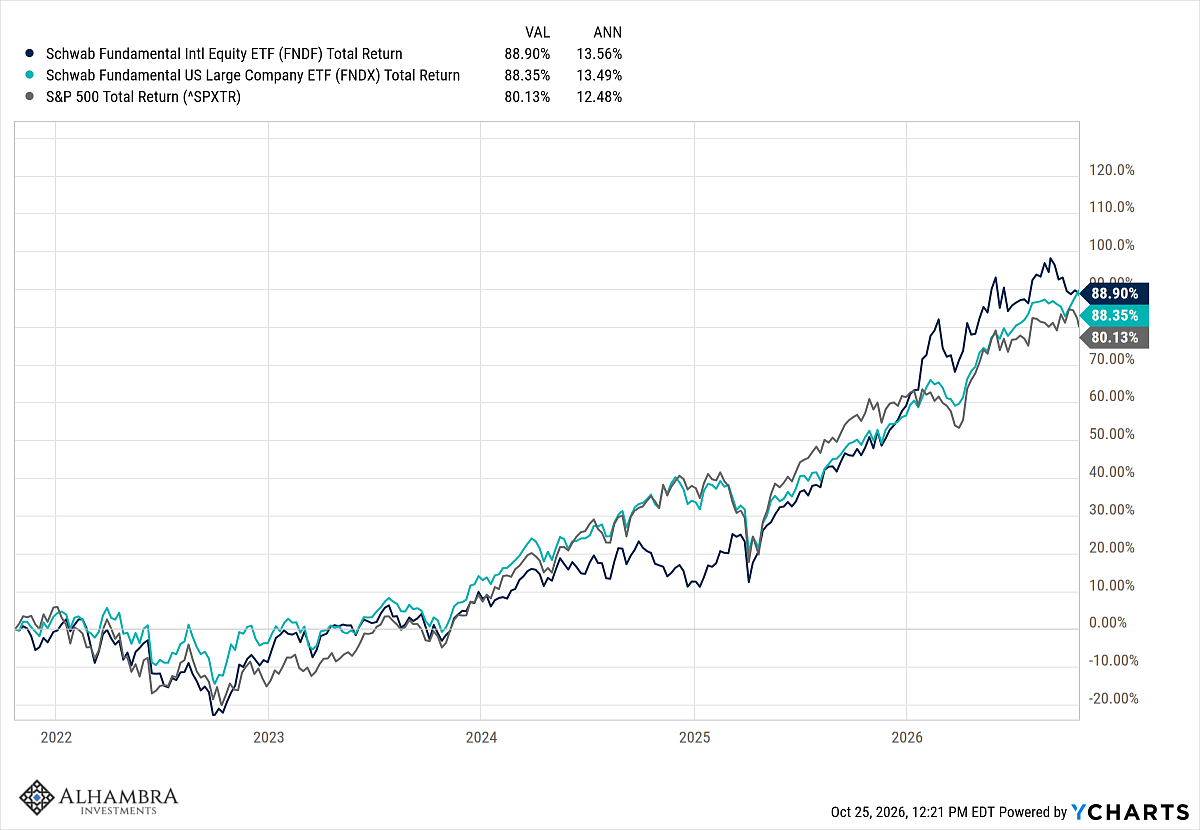
The perception this year has been that the market is all about AI and you have to own the S&P 500 because that’s where you can pretend to be diversified while putting 40% of your money in tech. The only problem with that narrative is that it isn’t true except that last part about exposure to technology; you do get an extra helping with the S&P 500. Meanwhile, large and small cap value, Schwab Fundamental US Large Cap and Schwab Fundamental International, high dividend, dividend growth, and the equal weight S&P 500 index have all out-performed the S&P 500 and the NASDAQ over the last year.
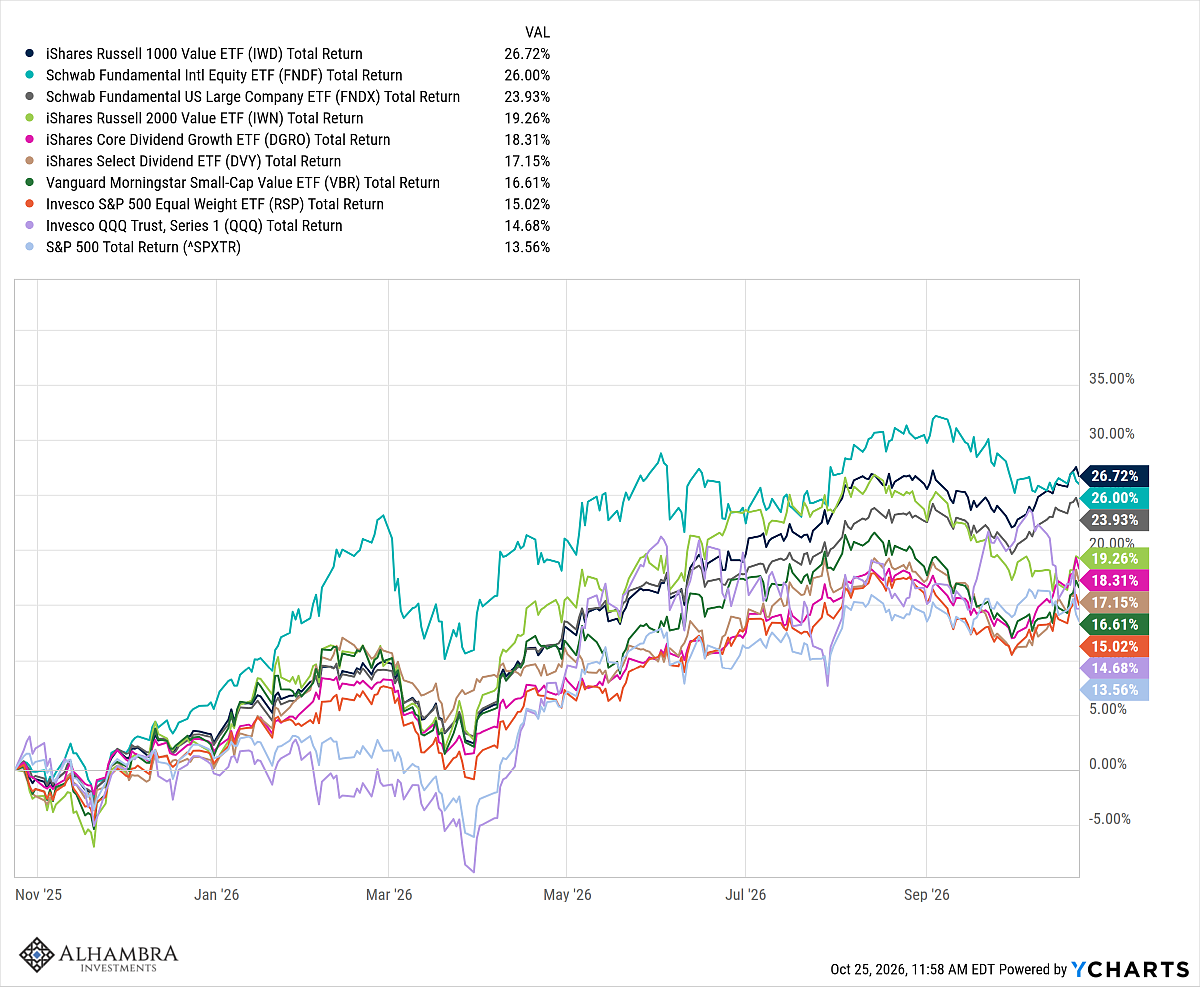
Of course, AI has produced some incredible winners over the last 3 years and they have, in some ways, dominated the US investment conversation. Stocks like Nvidia, Micron, Broadcom, Palantir, and Sandisk have put up stunning returns over the last three years but owning the S&P 500 was not sufficient to capture that effect, even though the index had a large allocation to technology stocks. The rest of the index has mostly made up for the tech losses although it appears to be more by luck than design. There are, however, widely diversified options that have performed as well or better than the S&P 500 over the last three years. The Russell 1000 value index has outperformed the Russell 1000 growth index over the last 5 years; value more generally is still outperforming. The two Schwab fundamental index funds in the chart above – which are essentially value funds – have outperformed the S&P 500 over the last 5 years. The US large cap version has also done that with lower volatility than the S&P 500. There are lots of alternatives.
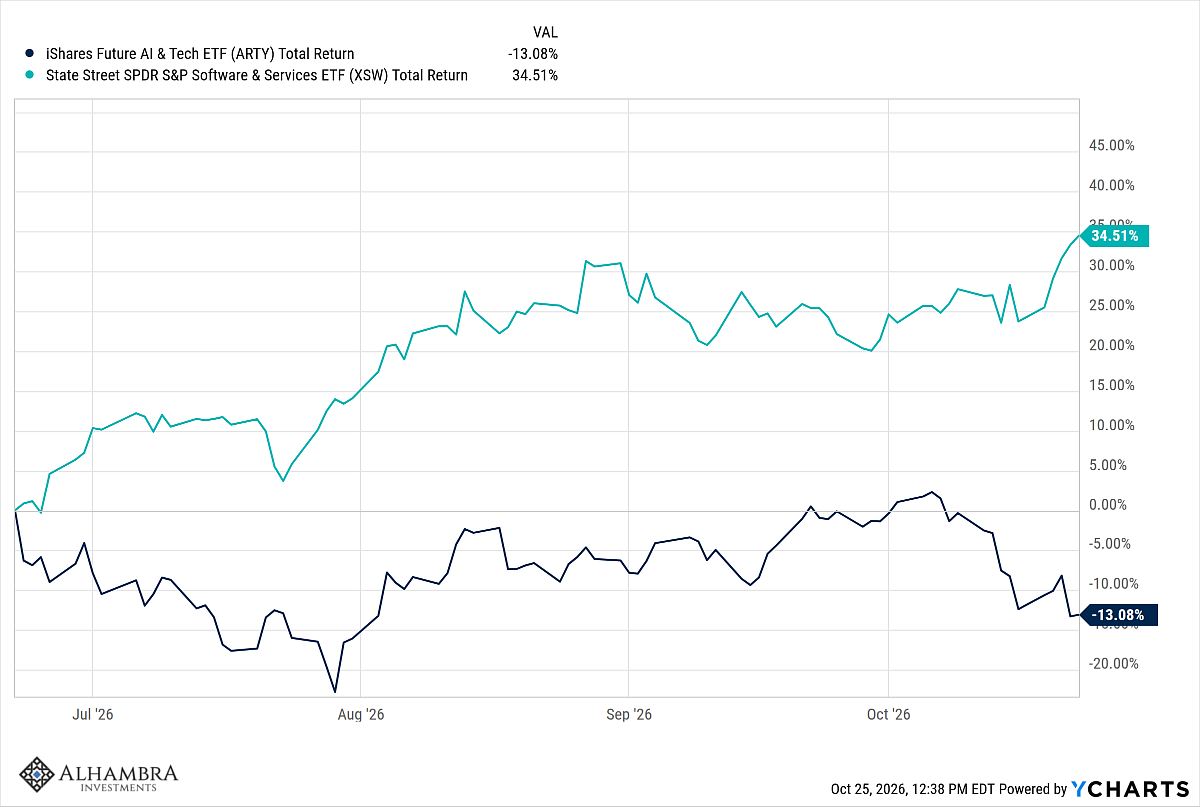
Okay, one more comparison that will probably surprise you. Remember last spring when all the software stocks sold off because, supposedly, companies would use AI to just write their own software? Since the AI stocks peaked in late June, those stocks have outperformed the AI stocks by 47.5%. The AI stocks still lead YTD but it seems to have dawned on investors that maybe the software companies aren’t just going to give up their businesses to idiots writing slop software.
There’s always a lot going on beneath the surface level view of the financial media and there always is. The media is interested in what’s hot, not what’s cheap. AI is important to the future economy – and therefore markets – so of course the media should cover it. And they want to because writing (and reading) about a technology that could end mankind is more interesting than the story of Mondelez shuffling its cookie lineup because of GLP-1s. In the end, despite reading a million articles about AI and its consequences, we still find ourselves wondering if it’s more than just a better search engine. Will AI be the productivity boon everyone – sort of – hopes it will be? Will it get built out on schedule? Or will bottlenecks slow or stop development? A small sampling of what we don’t know:
Economics: Spending on the buildout is growing much faster than the revenue being produced from it. Will end-user spending grow fast enough, at high a enough price, to save the highly indebted players? Do they even have a chance of making a decent return on investment? Can the AI companies like Anthropic and OpenAI continue to raise capital – debt or equity – at acceptable (profitable) costs?
Physical: Can enough new electrical capacity be added fast enough to meet expected AI demand? What about other physical constraints, other shortages? Will these supply chain issues continue to push up prices for other products (PCs, etc.)?
Technical: If each new model brings smaller and smaller improvements, will the cost of improvement be too great to justify further spending? What about reliability? Hallucinations? Training data?
Regulatory/legal: Copyright infringement, regulations, and consumer backlash (NIMBY)
Financial: Will the shift to more debt financing prove to be a mistake? When will Oracle debt get downgraded to junk?
I don’t know the answers to those questions and I don’t think anyone else does either. I also don’t think it matters for investors; markets have already spoken. The acceleration of expected earnings in the technology sector – the second derivative of earnings expectations – peaked in Q2 right when the stocks peaked. The opposite is true of healthcare stocks, the deterioration of earnings estimates slowed in Q2 just as stock prices in the sector started stabilizing. That’s what I mean by finding sectors that are starting to exhibit momentum. Moving from “estimates are falling fast” to “estimates are falling, but not as fast as they were” is a positive change that will eventually be reflected in stock prices. And when it changes from “estimates are falling” to “estimates are rising”, stock prices will likely already reflect those improving fundamentals.
Markets move when expectations change and it is clear that expectations for AI started to change in June when all the stocks peaked. We don’t really know why those expectations changed but we can see the effect in earnings estimates which stopped accelerating higher around the same time. In fact, history says that the second derivative of earnings estimates will peak before stock prices and that is indeed what happened this year. If you think the recent correction was bad, wait until the rate of change, the first derivative, turns negative.
In the Sherlock Holmes book quoted above, the passage about the dog that didn’t bark is about the clue that no one noticed, the thing that no one was watching that turned out to be important. Markets change direction when something changes sufficiently that people notice, first a few, then a lot, then everyone. A few technology companies lowering their expected growth rate from “astounding” to “still great but less than we thought last quarter” doesn’t sound like a big deal but it is when everyone has bet the farm on “astounding”. I don’t know how the AI boom will end. It may have already ended and we just don’t know it yet. Or it may be that this is just a resting point before AI really does change everything. You probably won’t find the answer in the headlines but you can observe a lot by watching, if you know where to look.


Comments
Log in or sign up to join the conversation.