As I learned years ago, you can take two different kinds of hikes on the trails around Jackson Hole. I can sum up my hikes with former Vice Chairman Don Kohn in two words: I survived. These steely marathon death marches revealed a side of Don I wasn’t ready for.
There’s another kind of hike—one I associate with Chairman Ben Bernanke, my old colleague. With Ben, it’s a much more leisurely pace, an easy stroll along the wandering trails at the Rockefeller Preserve.
– Kevin Warsh, In Our Time, remarks at the annual Jackson Hole monetary conference
Say what you will about our new Fed chief but he does have a sense of humor. After a shift in the dot plot in June that was decidedly hawkish and 3 dissents for higher rates at the July meeting, all the folks who get excited about such things were hoping this speech would give some clue about Warsh’s thinking – despite the fact that the only notable thing he’s said since becoming chairman is that he won’t. Nevertheless, there has been a growing consensus that Warsh will to have to relent at some point and hike rates, even if his boss doesn’t like it. So, using the word “hike” three times in the first paragraph of his speech was, maybe, Warsh’s cheeky way of poking fun at those who hang on the Fed chairman’s every word. Or maybe he was just testing to see if the algorithms that run trading today would key off that word and start selling bonds.
Mr. Warsh has made it clear – and not just recently – that he is uncomfortable with forward guidance as it has been practiced by the Fed. More open communication has had an impact and we can see that in how the market reacts to changes in Fed policy. Prior to 1994, changes in Fed policy were not announced. Back in the olden days, traders had to watch the Dow Jones Newswire after a Fed meeting to see if the NY Fed did something in the market; we could only infer the policy change through their market actions. They started announcing policy changes in 1994 and started announcing Fed Funds targets in 1995. In 1998, the FOMC started announcing their “bias” for future policy and in 1999 that was changed to the “balance of risks”. In 2002, FOMC votes started to be announced and then 2003 is when real forward guidance started. That is when the Fed started using the language of the post-FOMC statement to guide the markets on future Fed changes with phrases like “considerable period” and “measured pace”.
And “measured pace” certainly described the rate hiking campaign that followed the Fed’s cut to 1% during the dot com bust. The FOMC hiked rates by 0.25% at 17 consecutive meetings between June 2004 and June 2006, one of the slowest rate hiking campaigns ever. There are a lot of people who blame that slow pace of hikes for the housing “bubble” that eventually popped and created the 2008 financial crisis, but I think the evidence on that is pretty thin. But what we do know is that the market reacted differently to Fed moves before and after the Fed changed its communication policies. We know that from the late 90s to now the Fed was a follower, that the market moved first and the Fed moved later. But that wasn’t always true in the pre-1994 period. The market still did a pretty good job of sniffing out Fed changes, but their moves did sometimes catch the market off guard. After that and especially after 2004, and even more so after Bernanke started the post FOMC press conference and the “dot plot” after 2011, the market was never caught off guard. The Fed telegraphed its intentions, the market took the hint and by the time the Fed made a move, it was already priced in.
But what did that accomplish? Warsh hinted at the problem in his speech when he said:
In normal times, the role of forward guidance should be limited and circumscribed. Otherwise it risks creating ambiguity in the name of clarity. Oversharing policy deliberations and overcommitting to future decisions can lead markets, businesses, and households astray. And I believe when policymakers make quasi-commitments on interest rates through the cycle, we inhibit our own freedom to make the right calls when it’s time to decide.
…
Providing forecasts to illustrate the Fed’s reaction function works better in theory than in practice, better in the lab than in the field. I’m not alone in noticing that forward guidance in 2021, to cite one example, might well have slowed the policy response to high inflation.
…
The economic literature has long described the distorting effects: a hall-of-mirrors problem. If markets rely materially on the Fed’s guidance and the Fed relies on market prices, we are all more likely to be blinded to new developments . . . more likely to be caught unprepared for a turn of events . . . and more likely to commit errors in policymaking.
It is still incomprehensible to me that the Powell Fed continued QE until the spring of 2022. It was obvious well before they finally got with the program that the Fed was behind the curve. Warsh – and a lot of other people – say that was due to the Fed’s prior forward guidance. They had committed to a course of action and had to stick to it even if the evidence pointed the other way because if they changed course it would hurt their credibility. Well, the Fed stuck to their course of action, continuing QE throughout 2021 even as inflation ran up to nearly 7% by the end of that year. Of course, Jerome Powell had convinced himself and others at the Fed that the inflation was “transitory” which in retrospect was pretty obviously wishful thinking. Did their previous forward guidance affect their thinking? Of course it did. The members of the FOMC are only human and no human likes admitting a mistake.
So, how should the Fed operate? How will they get policy right (or as right as they can get it)?
To get policy right, we also need to get the relationship right between financial markets and the central bank. The Fed needs clear market signals, as unfiltered as possible . . . from market internals . . . the level and change in asset prices across sectors . . . the prices and trading volumes of Treasury securities. . . the foreign exchange value of the dollar . . . the cost and availability of credit . . . and the price of a broad set of commodities.
In his speech Warsh turned to Key Principles next and the one most important to investors is the first one:
Turning to principles . . .
First, I’ve noticed that, in this line of work, yesterday’s news has a way of getting mistaken for what is happening right now. The challenge is to know the difference. In other words, we must interrogate reality to make sure we are not setting forward-looking policy based on stale or inaccurate data. Nor should we rely on isolated data points. Trends matter most. The Fed is a decisionmaking agency. We make choices amid uncertainty, and the data upon which we draw must be as relevant, contemporaneous, accurate, and actionable as possible.
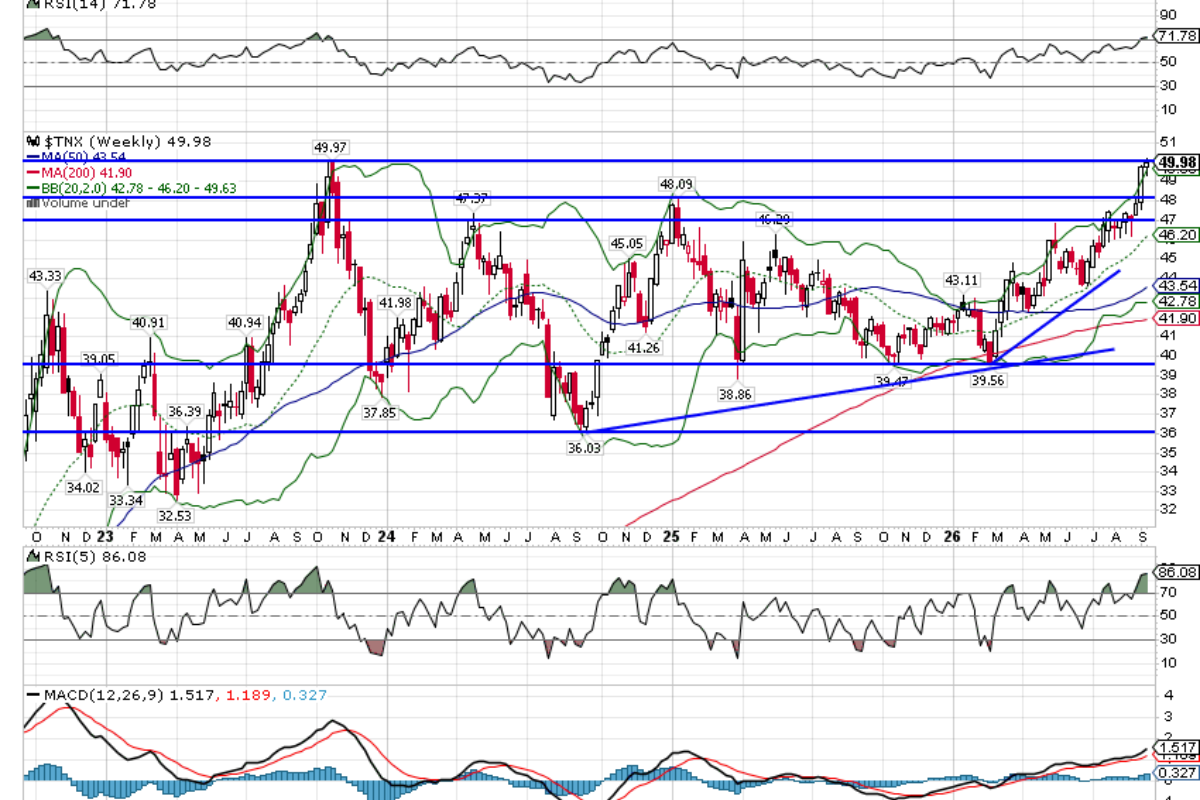
If you take this paragraph and remove any reference to the Fed and monetary policy, it is exactly how investors need to think. If you’ve been reading these weekly notes for any length of time, you know this is what I’ve been preaching for years. We can’t know and can’t predict the future, focus on the present; trends matter; economic data tells you about the past, markets tell you about the future. Our main economic indicators are market based and we even have a name for it – Dollar and Rate Paradigm. We monitor interest rates, real and nominal (“the prices and trading volume of Treasury securities”), the value and trend of the dollar (“trends matter” and “the foreign exchange value of the dollar”), credit spreads (“the cost and availability of credit”) and commodity prices, particularly gold (“the price of a broad set of commodities”) among other items.
In another part of the speech Warsh talked about the impact of AI, mostly in the form of questions, some of which are the same ones with which investors are struggling:
Will the application of AI cause a significant, sustained rise in productivity across the economy? And if so, when?
Will token usage be complementary or competitive to labor?
Early on, how much of the surplus goes to owners of scarce assets—AI labs, chipmakers, energy producers, and cloud providers? Over time, how much of that value accrues to businesses and consumers? What are the broad implications for workers and for…employment?
He also spoke about the current economy. This should sound familiar:
For my part, today I am impressed by the overall performance of the economy, which appears to have strengthened. One indicator of strength is how well an economy holds up to shocks. On that score, both Main Street and Wall Street have been remarkably resilient.
Business capital expenditures—the seed corn of future economic growth—are rising rapidly. The four-quarter change in investment in equipment and intangibles has been around 9 percent, its highest growth rate since 2021.
Expectations for growth in both cap-ex and corporate earnings are running quite high. I will continue to watch the change in their growth rates, the second derivative.
Credit spreads on corporate bonds and leveraged loans are near the low ends of their historical ranges.
Certain sectors—like housing and agriculture—are showing strains. But, on balance, I would be hard pressed to describe broad financial conditions as restrictive.
When labor supply is barely growing, monthly job gains are naturally going to run low.
But on the price-stability side of our mandate, the numbers are more concerning. The Fed’s preferred measure of inflation, the 12-month change in the PCE price index, stands at 3.7 percent, while the six-month change is 4.1 percent. The comparable measures from the consumer price index (CPI) are also elevated, as are the core measures of both PCE and CPI inflation. None of these measures are perfect, but they all tell a similar story: Inflation is running above our 2 percent target.
The recent rise in overall commodity prices also bears watching
The good news is that measures of inflation expectations in the medium term, by and large, look stable.
The Fed’s Board of Governors employs about 500 researchers, 400 of them PhD economists. The regional Federal Reserve Banks also have their own research departments. Total, the Federal Reserve system employs somewhere around 800 economists. What Warsh just told you in this speech is that, even with all that intellectual horsepower, the Fed can’t predict the future course of the economy. He tells us that the best way to understand the current state of the economy and gain clues about the future is to…watch the markets.
Obviously, it is gratifying to see the Chairman of the Federal Reserve validate Alhambra’s approach to the economy and its impact on investing. It is comforting to know that we are watching almost the exact same set of variables. I bolded a number of passages above because they are things I have written about recently or that we have discussed internally here at Alhambra. Oddly enough, we spoke about the second derivative of forward earnings expectations in our weekly investment team meeting just last week. I suspect it made Warsh’s list because he knows what we do – the acceleration (second derivative) of earnings expectations has peaked.
I am not, however, naive. Warsh has said the right words – in my opinion – but we have yet to see whether he can make the hard decisions when the time comes. And Mr. Warsh may soon face some very difficult decisions. Should the Fed hike at the September meeting? Honesly, I don’t know. I can certainly see both sides of the argument. There are reasons to believe inflation will fall back toward the target and probably an equal number of reasons to think it won’t. He has the additional pressure of a President who wants lower rates and mid-term elections coming up in 65 days. If he doesn’t hike, he will get accused of trying to help the Republicans in the elections. If he does hike, he may be next on the President’s enemies list. Not an enviable position. Let’s hope he chooses wisely.
Disclosure:
This material has been distributed for informational purposes only. It is the opinion of the author and should not be considered as investment advice or a recommendation of any particular security, strategy, or investment product. Investments involve risk and you can lose money. Past investing and economic performance is not indicative of future performance. Alhambra Investment Partners, LLC expressly disclaims all liability in respect to actions taken based on all of the information in this writing. If an investor does not understand the risks associated with certain securities, he/she should seek the advice of an independent adviser.
Click here to sign up for our free weekly e-newsletter.

Comments
Log in or sign up to join the conversation.