


I have followed the oilfield services sector very closely, especially the goings on at Weatherford WFT. I have taken issue with Weatherford's accounting treatment for goodwill and other items. Below is a synopsis of those issues.
Background
Weatherford provides equipment and services for oil and gas exploration and production. The price of Brent oil recently closed at $38, more than 65% below its Q2 2014 peak. Weatherford's revenue and earnings have been in free fall alongside the price of oil.
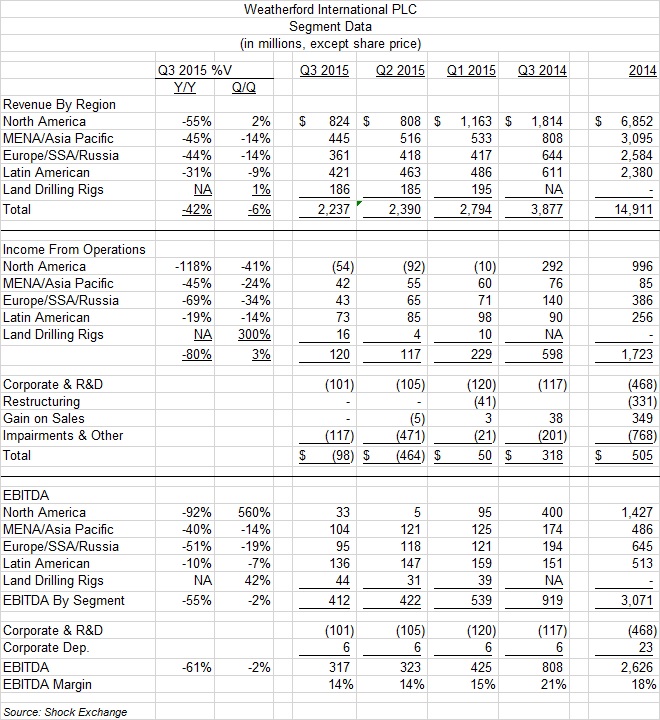
Weatherford's respective Q3 2015 revenue and EBITDA (ex-items) were off Y/Y by 42% and 61%. North America, where the company derives the lion's share of its revenue fared even worse; North American revenue and EBITDA were down 55% and 118%, respectively. Meanwhile, income from operations was negative for three consecutive quarters. These figures do not include allocations for corporate costs and R&D which were a combined $120 million, $105 million and $101 million in Q1, Q2, and Q3 2015, respectively.
$3.2 Billion Goodwill And Intangibles Could Be Impaired
Weatherford has grown its operations via acquisition. Many of those acquisitions were made when oil prices were much higher than they are today. At Q3 2015, the company had goodwill of $2.8 billion and intangible assets of $380 million. $1.9 billion of the company's $3.0 billion goodwill at year-end 2014 was attributed to North American operations.
Through year-to-date Sept. 30, 2015 ("September YTD"), North American operations have generated revenue of $2.8 billion, EBITDA of $133 million, and a pretax loss of $156 million. These figures do not include allocations for corporate costs and R&D which were a combined $326 million for September YTD. If corporate allocations were based on percentage of revenue, North America's percentage would be about 38% or $124 million; September YTD EBITDA and pretax loss would have been $9 million and $280 million, respectively. That said, the approximate $1.8-$1.9 billion in goodwill associated with it could be impaired.
North American Operations Appear Worthless
My previous article, "Weatherford: Wait For $4," valued Weatherford's equity from $0-$4 per share via the following steps:
- The company's September YTD EBITDA of $1.065 billion (after corporate allocations) was annualized to derive run-rate EBITDA of $1.42 billion.
- An EBITDA multiple of 5.0x-7.0x was applied to derive an "enterprise value" of $7.1-$9.9 billion.
- After subtracting net debt of $7.2 billion, the equity value was deemed to be negative $85 million to $2.8 billion.
North America's September YTD EBITDA (after allocations) of $9 million was only about 1% of total EBITDA of $1.065 billion; North America's value could be miniscule. The valuation could support the thesis that $1.8-$1.9 billion goodwill for North America could be impaired; it also calls into question the value of total goodwill and intangibles of $3.2 billion.
Weatherford's $2.8 Billion Inventory Could Be Overvalued
At Q3 2015, the company had approximately $2.8 billion in inventory. This is about 10% less than the $3.1 billion inventory balance at year-end 2014 and 14% less than the $3.2 billion balance at year-end 2013. While revenue and cost of sales have declined precipitously since 2013, inventory has not declined at a similar rate. That could imply that inventory is stale or overvalued.
Moreover, tt appears that Weatherford's inventory days outstanding for finished goods increased from 80 days at year-end 2013 to 88 days at year-end 2014 to 102 days at Q3 2015. Inventory days outstanding was calculated by dividing finished goods inventory by total cost of sales and multiplying by 365.
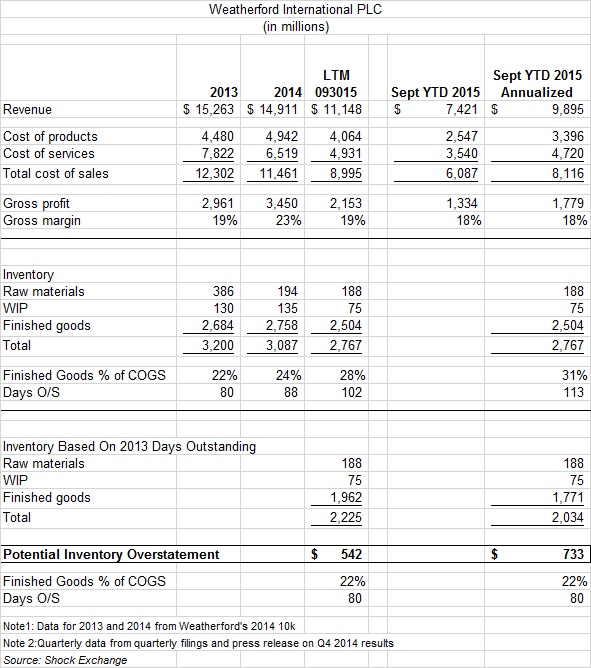
Revenue and cost of sales for the last 12 months through Q3 2015 were $11.1 billion and $9.0 billion, respectively. Had finished goods remained at the same 22% of cost of sales (80 days) that was reflected in 2013, total inventory would have been about $2.2 billion-$542 million less than the $2.8 billion actually recorded.
Inventory days outstanding began to tick up in 2014. This coincided with the decline in oil prices and Weatherford's revenue. The company's products may have become more difficult to sell or the market value of finished goods may have become overstated.
$2 Billion In Asset Write-Offs Could Jeopardize Weatherford's "Going Concern" Status
If Weatherford's assets were written down to fair value, it could cause the company to breach its debt covenants and/or jeopardize its ability to remain a going concern. The company has about $1.7 billion in short-term debt with a JPMorgan Chase-led bank syndicate. The debt covenant requires Weatherford to maintain debt-to-capitalization of less than 60%.
The aforementioned balance sheet shows debt-to-capitalization of 57% at Q3 2015. However, on the Q3 earnings call, Weatherford's CEO divulged that the ratio should include an add-back for "foreign exchange currency translation adjustments on non-monetary assets." This adjustment would have increased net assets by $1.4 billion, bringing the ratio down to about 52%.
The following chart adjusts Weatherford's equity for the $1.4 billion FX currency translation, a $1.8 billion goodwill mark and a $542 million inventory mark.
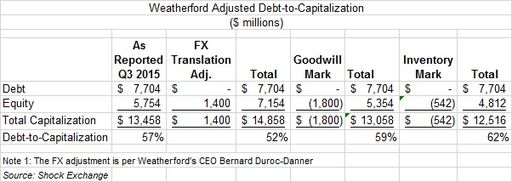
After the company's equity is adjusted for FX translations and goodwill, its debt-to-capitalization is about 59%. An additional adjustment for the overvalued inventory increases the ratio to 62%. In effect, Weatherford could have breached its debt covenant(s) had its balance sheet been marked-to-market for the aforementioned adjustments. JPMorgan could have then decided to accelerate the company's debt, bringing into question Weatherford's ability to continue operating as a going concern.
The analysis does not include any adjustments for the company's $6.4 billion in PP&E. At Q3, about 73% of Weatherford's total assets were tied up in PP&E, inventory and intangible assets which could have been illiquid, overvalued or both.



Comments
Log in or sign up to join the conversation.