

Despite the relatively low jobless claims in March, the ADP report showed private sector job creation was only 129,000 which missed estimates for 165,000. It was below the low end of the estimate range which was 150,000. It’s interesting that the February reading was revised higher to 197,000 from 183,000. That just increases the massive difference with the BLS report which initially stated there were only 20,000 total jobs created and 25,000 private sector jobs created. The February BLS report was a one-off on the negative side and the January report was a one-off on the positive side. Friday’s March report could break the tie. We will figure out if job growth is truly slowing.
Weak ADP Report
The ADP report showed only 6,000 jobs were created by small businesses, 63,000 were created by midsized firms, and 60,000 by large firms. The chart below shows very small businesses with 1-19 employees lost 9,000 jobs which was worse than last month and the worst reading in at least 5 years. Last month we said it wasn’t a big issue. This month we say it’s worth watching closely because it could be the start of a slowdown.
Chart: Small business payrolls - pic.twitter.com/jvTjlBPhyS
— (((The Daily Shot))) (@SoberLook) April 4, 2019
Business activity fell from 64.7 to 57.4. New orders fell from 65.2 to 59. This report is consistent with 2.6% GDP growth. That would be solid growth, but we must consider how optimistic the ISM had been. For example, if the biggest bull on Wall Street suddenly moved close to the consensus, you’d wonder what changed.
Business Activity in this month's ISM Services report swung from a 10+year high to a 52-week low. https://t.co/CyBnkoYVi0 pic.twitter.com/eMsfP9DPdc
— Bespoke (@bespokeinvest) April 3, 2019
Even though there was a sharp decline in the ISM PMI, the quotes aren’t negative. For example, a firm that manages companies and provides support services stated, “There is a sense of relief in our industry with the temporary reprieve of the additional tariffs. As of now, we feel this will help us maintain competitive prices and steady margins over the next quarter.” The end of the trade war could help boost growth in Q2.
Massive Increase In Refinancing
The MBA mortgage applications index in the week of March 29th was very strong mostly because of the growth in refinancing due to the drop in interest rates. The composite index increased 18.6% on top 8.9% growth in the prior week. Weekly purchase index growth was 3% on top of 6% growth. The spring selling season is in solid shape. The purchase index is near its cycle high. The refinance index increased 39% on top of 12% growth. As you can see from the bottom chart below, the 5-month decline in 30-year interest rates was the largest since 2010. (Rates increased 2 basis points in the week of April 4th to 4.08%.)
Folks,,, pic.twitter.com/yxUmePqyfA
— George Pearkes (@pearkes) April 3, 2019
Worst Economic Surprises Since Financial Crisis
As the chart below shows, the latest economic reports out of America, emerging markets, and the G10 nations have been missing estimates.
The Global Economy is Slowing! This chart shows the Citi Data Change Indices for emerging markets (orange), the U.S. (blue) and the G10 (green). These series, which measure economic data versus one-year averages, are currently at their lowest levels of the post-crisis period. pic.twitter.com/jDAz13REdl
— Bianco Research (@biancoresearch) April 3, 2019
The surprise indexes for the G10 and U.S. are at post-recession lows. Missing estimates by the most since the financial crisis isn’t the same as growth being the slowest since then, but it’s far from a positive. The good news to counter such a bad reading is the global services PMI increased from 53.3 to 53.7 in March which was the best reading since last November. It’s not 100% clear if the global slowdown expanded from manufacturing to services. Markit’s reports don’t indicate it has.
Weak Durable Goods Orders Growth
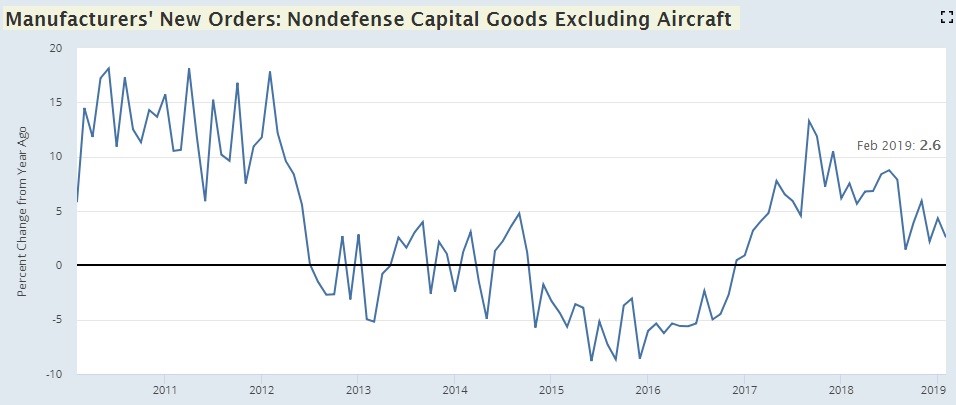
One of the most disconcerting American economic reports this week was February’s durable goods reading. Core capital goods orders fell 0.1% which missed estimates for 0.2% growth. Non-defense capital goods orders excluding aircrafts had 2.6% yearly growth which was down from 4.3% growth in January. As you can see in the chart below, the acceleration that started in 2017 looks to be ending. Looking at the headline results, new durable goods orders fell 1.6% monthly because of the volatile aircraft orders. There was a 4.8% decline in transportation equipment and a 31.1% decline in non-defense aircraft orders.
Conclusion
The ADP report missed estimates, but it was significantly higher than the February BLS reading, so it doesn’t have predictive value. Let’s see if the labor market’s growth slowed. Markit suggests the service sector is stronger than manufacturing. The Markit services PMI fell in America but rose globally. The delayed durable goods orders report signals manufacturing activity was weak in February. That’s consistent with the March ISM and Markit manufacturing PMI declines.

Comments
Log in or sign up to join the conversation.