

Finally an exciting market!
Yesterday, we used our fabulous 5% Rule™ to call the weak bounce line we expected on the S&P at 2,127.50. As it turns out, the S&P finished to day at 2,127.02, so back to the old drawing board to find out why our model is misbehaving, I suppose...
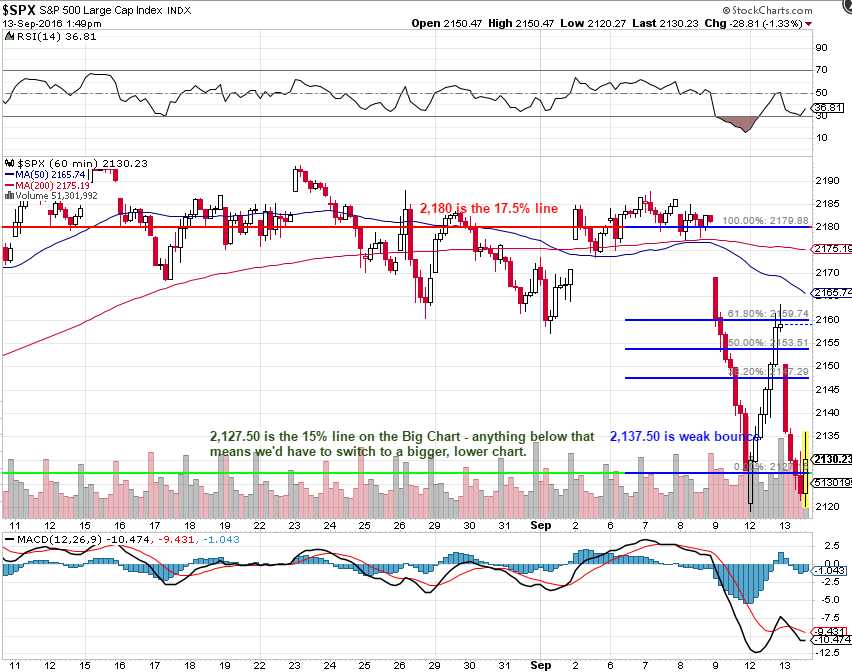
If you think calling market moves within 0.48 (0.025%) is useful for Futures trading – you're right, it really is! A friend of ours said yesterday:
Good day for me too on the futures. Much easier when the market moves pretty much one way all day and that is the direction you are trading. thanks again Phil. I may be getting the hang of this. Made more today because there were more times when I wasn't trading, which Phil has been telling us (me in particular) for quite some time.

Today, in case you can't see the chart it's 2,142.50 or bust on the S&P as it NEEDS to take back that strong bounce line to show any real strength. If we get there and it fails, we can short at that line (2,140 would do) with tight stops above or, if 2,125 fails, we can short there too. We expect at least a head fake higher in the morning, in the very least.
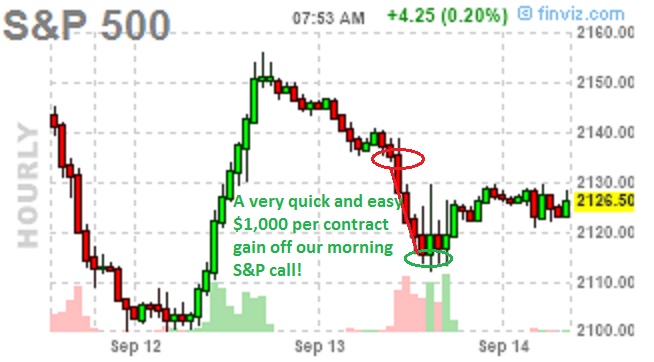
Notice the word "short" keeps coming up and Craigs made his money on the short side as we were all shorting yesterday because we knew Monday's move was BS (see yesterday's post) and the call I made in the morning that the S&P would head lower from 2,137.50 was good for an extra $1,000 per contract at 2,117.50 but we took that money and ran as it is goaaallllllllllllll on our chart and, as noted above, now we have our next two entry points.
Keep in mind that, even though we draw you a pretty picture, our 5% Rule has NOTHING to do with TA. We are not TA people, TA is complete and utter BS. Nonetheless, we use TA all the time because 90% of the traders out there are using it so it becomes a factor in our Fundamental Analysis but, frankly, if 90% of the people sold Apple when the moon was full – we'd factor that in too, so it's nothing special about TA – we're always looking for idiotic crowd behavior to bet against.
In fact, that's what our bounce lines are all about. They are a measure of the degree of idiocy as people rush in to "buy the dips" at various pullback lines beause, as Lincoln taught us, you can fool all of the people some of the time and some of the people all of the time but you can't actually fool all the people all of the time and, ladies and gentlemen – we are those fools! ;)
Well, we try not to be anyway. This morning, for example, I put out a note to short oil at $45 and already we're back to $44.50 for a $500 per contract gain – enough to pay for our Egg McMuffins, so we're very happy to take that and run ahead of the inventory report. This was not a complicated bet – we read the API report and discussed it and decided it was bearish for oil and the traders buying it up were wrong and our bias for oil was bearish anyway, so it was an easy bet.
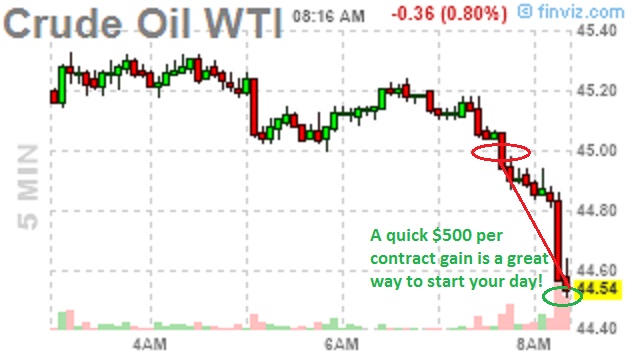
Any time you make a quick (40 minutes) $500 per contract like that in the Futures, it's best to take at least half off the table to lock in gains. That way, even if oil went all the way back over $45, you could stop out and still be up $250 or, if oil continues back down to $44, you would be up an average of $750 so taking half off locks in 50% of your gain and still gives you 75% of the upside you would have had if you risked the whole bunch.
Smart decisions like that are what makes a good Futures trader and the same techniques are also applied to stock and options trading – the advantage to Futures trading is you get to practice hundreds of times a month while it may take a stock or options play many months to make those kinds of moves and practice is what it's all about if you want to be a professional trader (or as good as one).
Goldman Sachs has finally caught up to our long Dollar (/DX) premise and we're still sitting on 4 longs at 95 on the Dec 31st contracts (DXX6) with a goal of hitting 100 (but we'll take 99.50 for $4,500 per contact gains for the holidays). We're expecting a bit of a repeat of last October's action and, until then, we'll just need to be patient. As I was saying to our Members yesterday, we don't know WHEN enough people will realize we're right to move the Dollar higher but we do know it won't take much of a catalyst to get it going – a Fed hike next week would be a good start.
(Click on image to enlarge)
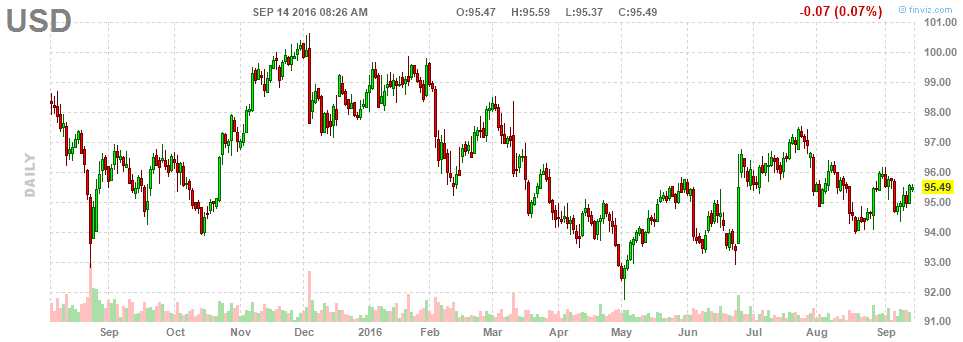
If you are futures challenged, the Dollar ETF (UUP) is a nice way to play, now $24.64 and you can buy the Jan $24 calls for 0.85 and sell the $25 calls for 0.35 for net 0.50 on the $1 spread which is already 0.64 in the money so, if UUP stays flat through January expirations, you make 28% but the potential is 100% gain if up moves up just 2% to $25 – that's nice leverage!
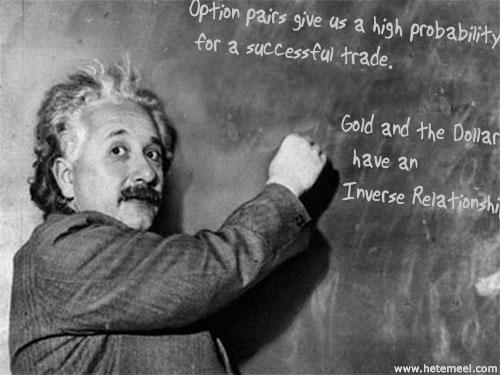
As an offset, you can say, "What happens if the Dollar stays weak and I lose my 0.50?" Well, gold comes to mind and you can sell Barrick Gold (ABX) Jan $15 puts for 0.90 so let's say you don't mind owning 500 shares of ABX for $15 ($7,500) – it's now $17.30 so that would be a 13% discount so you can sell 5 puts, collect $450 and buy 20 of the spreads for $1,000 and, if things work out, the Dollar will be stronger and you'll get $2,000 back so, even if you have to buy ABX, your net drops to $6,050 or $12.10 per share, which is a 30% discount.
So if the Dollar is too strong, you may end up owning ABX and if the Dollar is too weak, it may cost you net $550 but, in between, you have a good chance of making $1,450 (263% gain on cash) in 4 months – that's a fun way to play!


Comments
Log in or sign up to join the conversation.