

The Paydirt book editor is back with an installment on gold’s reaction to the Fed rate hike. There’s an important message here for gold and gold stock investors…
Will he or won’t he?
That’s been the question bedeviling Wall St. Referring, of course, to the question of whether new Fed Chair Kevin Warsh would defy his patron and announce a hike of the Fed funds rate at the September FOMC meeting.
He will.
Warsh is Just Following the Trend
At 2 p.m. on 9/16, Warsh proclaimed a quarter-point tightening, a move that usually injects pure strychnine into the gold market. Sure enough, the gold price immediately plunged from $4404/oz. to $4286/oz. in just the next hour and a half. And then … but more about that in a moment.
First, what other forces are impinging on the gold market as I write on September 22?
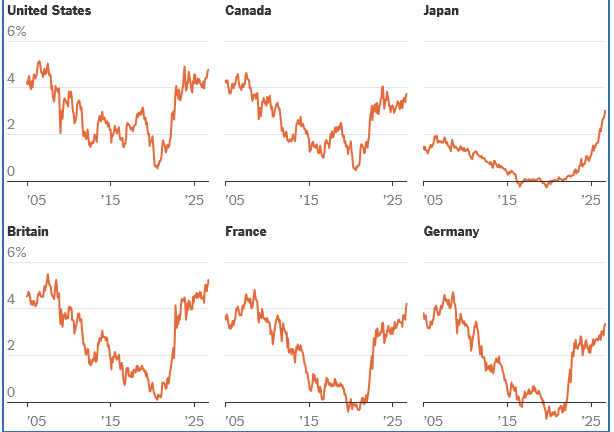
Remember that the Fed only sets the overnight funds rate. Other rates do tend to follow, but the long-term bond market is its own beast, and it’s been howling for six years now.
In 2020, the four-decade long bull market in bonds decisively turned. It’s been a bear market ever since: the price of bonds is falling as buyers demand a better return on their investment—in the form of higher interest rates.
This trend is not U.S.-specific. It also went global six years ago.
Bessent Counters Warsh
Higher rates mean a reduction in the perceived strength of the currency involved. Take Japan. Its bond market was artificially propped up for decades by a government willing to become the buyer of last resort.
The value of the yen has declined 50% from its peak and sat at a 40-year low in June. This affects us because Japan is now the largest holder of U.S. debt. If it was forced to defend the yen by selling off American bonds, that would put even more upward pressure on interest rates, which is anathema to the Trump administration.
Thus, at the end of July, Treasury Secretary Scott Bessent announced an intervention in the Japanese currency market: Treasury would partner with the Bank of Japan to buy yen, drawing down U.S. international reserves for the financing.
Bessent didn’t mince words. “I am the house now,” he declared defiantly on September 8. “So when we intervene with the Japanese yen, I have pretty good insight [into] what Japanese policymakers are going to do. Bet against me if you want.”
Then, in mid-August, Bessent announced a new “debt management” policy. Funds from short-term bond sales would be used to buy back long-term bonds, to the tune of $4 billion (expanded in September to $6 billion). Again, the intent is to elevate the price of long bonds, and depress interest rates—with no new currency creation.
It’s a very risky play. For one thing, buying back our own debt to prop up the market is a tacit acknowledgment that we have lost the confidence of foreign investors, who have been lightening their stockpiles of Treasury reserves for years. Bessent’s basically betting (his word) that the government can drive Treasury yields more effectively than the market. He’s declaring war on the “bond vigilantes,” whom I wrote about for The Gold Advisor here. And he’s double daring the bond market to challenge him.
Neither of Bessent’s moves had much effect. Legendary investor Stanley Druckenmiller took him on directly, writing for the Wall Street Journal: “Governments defending prices against fundamentals always lose… The U.S. shouldn’t put itself on the wrong side of that trade, not with the most important price in the world, and not when that price is trying to say the one thing Washington most needs to hear: Let the bond market speak.”
It Has
30-year Treasuries have pushed higher, and the yield sits at 5.30% as I write, a level unseen since 2004. The more closely watched 10-year edged above the 5% level on September 15 and today sits just below it. 5% is not a magical number. But it’s a critical marker in terms of market sentiment. It has a powerful effect on mortgage rates, which recently blew past 7%.
What 5% on the 10-year says is that the cost of capital is no longer cheap. And that it’s likely to get even more expensive. This affects everything from real estate to private equity to government financings. Businesses cancel expansion plans and see profits squeezed; the most leveraged firms fall into financial holes and may default; government has to scramble to re-finance lower-coupon debt as it comes due; and the stock market tends to go stagnant, at best.
Investors look at a safe 5% return and see something attractive when inflation is at 3.5% or so, especially when an overheated stock market looks increasingly dangerous. It should make holding gold—an asset with no yield, and a cost to store it—relatively unattractive. But it hasn’t.
Warsh Really is Different
Another key message Warsh is sending is that he is breaking with the line of Fed Chairs that stretched from Greenspan through Powell. All believed that easy money was the ticket to economic prosperity and were terrified of deflation.
Their playbook: create new currency out of thin air, lower interest rates to near zero, encourage borrowing, create an economy fueled by debt, watch as different asset classes exploded. Going long the bond market was a great strategy. Stocks overall provided excellent returns. Even gold caught a tailwind in an inflationary environment.
Warsh, supported 100% by the other members of the FOMC, signaled that that era is over. Inflation is now the Fed’s primary economic bête noire. If recession comes, as inflation is subdued by raising the cost of money, then so be it. Price stability is the Fed’s new mandate.
What Does All This Mean for Gold?
Clearly, there are plenty of factors working against the resumption of the bull market in gold that foundered in February, with the advent of war with Iran.
However, to return to the fallout in the gold market from Warsh’s tightening: There wasn’t any. True, the gold price did quickly plummet on September 16, dropping to $4286/oz., losing about 3%. But then … it ended. By the 17th open, it had recovered all the lost ground. Today it sits slightly above where it was before Warsh spoke—almost exactly where it was in January. That’s resilience.
It’s way too early to declare that gold is re-igniting. The more salient question is whether gold can do well confronted with rising interest rates, declining inflation, and potential deflation.
The answer, perhaps counterintuitive, is yes. Problem is that it’s become exceedingly difficult to disentangle the crosscurrents in today’s age of uncertainty. Consider that we have:
Rising interest rates, which are deflationary
A slowing housing market and 7% mortgages, also deflationary
Soaring energy costs, inflationary
High CPI readings, indicating marketplace inflation is not coming down
A stock market with a tiny handful of tech stocks levitating the whole shebang, with a potentially deflationary correction (or worse) looming
Foreigners increasingly freaked by federal debt and the actual stability of the USD
As far as gold goes, it aligns with bonds as a safe haven from financial volatility, such as the conflict between Treasury and the Fed, as well as the potential for a meltdown in a stock market at nosebleed levels. It is well positioned to provide stability in the age of uncertainty. Frightened investors will always go there.
Gold could get caught in a near-term downdraught, especially if there is a major correction in stocks—where a meaningful decline usually results in speculators selling some of their liquid gold holdings to cover their losses. But it will likely recover with a prolonged upmove, as it did after the crash of the Great Financial Crisis.
Two Charts to Watch
For gold investors in general, watch gold/stock market charts that show how much gold is required to buy an index. One good example is the gold/Dow ratio. It strips out the effects of currency inflation, instead depicting what stocks are selling for in terms of real money. Gold. Forget dollar values, the Dow has fallen 78% since 2000, priced in gold.
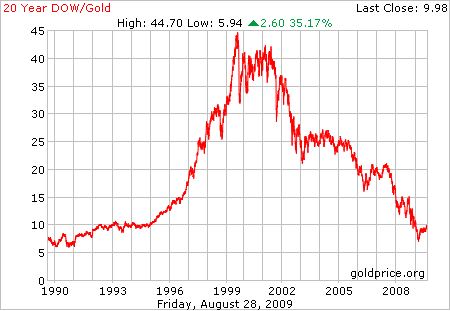
Some related stats: The 1999 median household earned 145 ounces of gold per year. Now, it earns barely 20. Also, the Case Shiller Home Price Index tells us that, in gold terms, housing has fallen around 80% in the last 25 years.
For our investors in the equities covered in The Gold Advisor, the 2nd chart to watch is the GDXJ. This tallies the cumulative value of the junior miners. At first, these stocks were hammered by the initiation of the Iran War, just like gold, down 40% from January to late July. They haven’t totally recovered, but are up nicely, down only 20% from January and 33% higher since the July lows. Importantly, they were completely unaffected by Kevin Warsh, up over 6% since September 16.
Gold will do fine, even in a deflation or recession. As other assets decline, gold preserves value.


Comments
Log in or sign up to join the conversation.