

Working on commercial and industrial rooftops involves more than simply reaching the roof safely. Workers may need to move between access points, mechanical equipment, storage areas, maintenance zones, and roof edges. Without clearly identified boundaries, workers can unintentionally enter areas where fall hazards or other risks are present.
This is where warning line systems provide an important layer of rooftop safety. By creating highly visible boundaries between designated work areas and restricted zones, these systems help workers recognize where they can move safely and where additional precautions may be necessary.
For construction, maintenance, inspection, and industrial facilities, properly planned roof warning line systems can improve work-zone organization while supporting a broader rooftop fall-protection strategy.
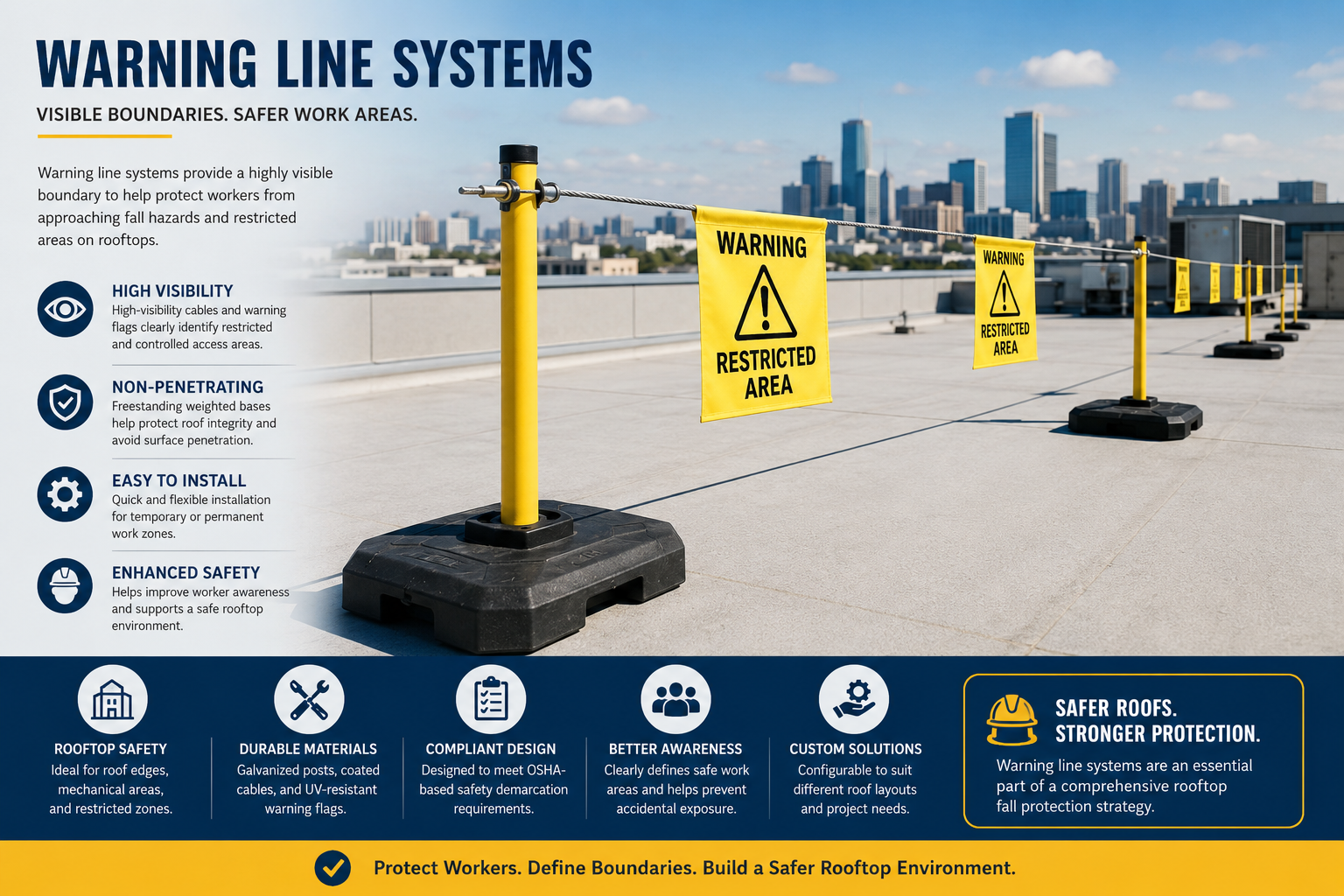
What Are Warning Line Systems?
Warning line systems are visual demarcation systems designed to identify controlled access areas, restricted zones, roof-edge hazard areas, and other locations where worker movement needs to be managed.
Unlike a guardrail or personal fall-arrest system, a warning line does not physically stop a worker from falling. Instead, warning line fall protection works primarily by increasing awareness and clearly identifying boundaries that workers should not cross without appropriate authorization or additional protection.
A typical warning line barrier system may include freestanding weighted bases, upright posts, high-visibility cables or lines, and warning flags. Freestanding configurations can also avoid unnecessary penetration of the roof surface, helping preserve roof integrity.
How Warning Line Systems Work
Understanding how warning line systems work is relatively straightforward.
The system is positioned around a designated working area or hazardous location to establish a visible boundary. Workers operating inside the defined area can immediately identify the limits of their controlled work zone.
High-visibility cables and warning flags make the boundary easier to recognize, while weighted bases and upright posts keep the system stable without requiring permanent attachment to the roof in freestanding configurations. Hitech Barrier, for example, describes its system as a non-penetrating solution using rubber bases, galvanized posts, coated stainless-steel cable, and visible warning flags.
The result is a simple but effective visual communication system that helps separate normal work areas from locations requiring greater caution.
Why Warning Line Systems Matter for Rooftop Safety
Rooftops often contain several potential hazards at the same time. These may include:
Open roof edges
Leading-edge work areas
Mechanical equipment
Restricted maintenance zones
Material storage areas
Rooftop access routes
Areas requiring authorized entry
Using warning line systems for rooftop safety helps organize these spaces and makes hazardous or restricted areas easier to identify.
For maintenance contractors in particular, clearly marked routes can help teams move between rooftop equipment without unnecessarily approaching exposed edges.
However, warning lines should be viewed as one component of an overall safety strategy. Because they provide visual demarcation rather than physical fall arrest, certain activities or locations may also require guardrails, anchors, lifelines, personal protective equipment, or other fall-protection measures depending on the applicable regulations and risk assessment.
Important Warning Line System Requirements
Effective Warning line system requirements depend on applicable safety standards, the type of work being performed, roof configuration, site conditions, and the location of hazards.
Several considerations should form part of the planning process.
1. Clear Visibility
The warning line must be easy for workers to recognize. High-visibility cables and contrasting warning flags can help workers distinguish controlled work zones from restricted areas.
2. Appropriate Placement
Warning lines should be positioned according to the roof layout, work activity, access routes, and identified hazards. They should not be placed arbitrarily without considering actual site risks.
3. Stable Support
Freestanding systems require properly positioned bases and secure upright posts. The system should remain stable under normal site conditions.
4. Correct Configuration
Post spacing, cable arrangement, warning flags, and safe distances should follow the project's approved design and applicable requirements.
5. Routine Inspection
Before workers enter the area, the system should be checked to ensure bases remain stable, posts are properly positioned, cables are secure, warning flags are visible, and the designated boundary has not been disturbed.
6. Integration With Other Safety Measures
A warning line is not automatically a substitute for guardrails, lifelines, anchors, or personal fall-arrest systems. The required protection should be determined through the project's safety assessment and relevant regulations.
Hitech Barrier states that its rooftop warning line solutions are designed around OSHA-based safety demarcation requirements and controlled-access applications.
Planning Warning Line System Installation
Correct installation is essential if the system is expected to provide clear and consistent zone control.
Professional warning line system installation should begin with an assessment of roof edges, access points, machinery, maintenance routes, storage areas, and restricted locations.
Once these areas are identified, the installation route can be marked and the system configured around the required controlled-access zone.
For a freestanding system, the general installation process may include:
Surveying the rooftop and identifying hazardous areas.
Marking the required warning-line route.
Positioning weighted bases at approved locations.
Installing upright posts securely into the bases.
Connecting the warning cable between posts.
Attaching visible warning flags along the cable.
Completing a final safety inspection before use.
The final inspection is particularly important because rooftop layouts and working conditions can change throughout a project.
Advantages of Rooftop Warning Line Systems
Properly designed rooftop warning line systems can provide several practical advantages.
High Visibility
Visible cables and flags provide an immediate indication that workers are approaching a controlled or restricted zone.
Non-Penetrating Options
Freestanding systems can be installed without permanently penetrating certain roof surfaces.
Flexible Configuration
Posts and warning lines can be arranged around different rooftop layouts, equipment areas, and work zones.
Improved Worker Awareness
Clear boundaries help workers understand designated movement areas and locations requiring additional precautions.
Faster Setup
Compared with many permanent structural systems, freestanding warning lines can often be positioned efficiently for temporary or changing work areas.
Work-Zone Organization
The system creates defined boundaries that can help contractors organize rooftop construction, maintenance, inspection, and repair activities more effectively.
Choosing a Warning Line System Supplier
Selecting the right warning line system supplier involves more than comparing the individual components.
A suitable supplier should be capable of assessing the application and recommending a configuration appropriate for the site's roof layout, restricted zones, working conditions, and applicable safety requirements.
Buyers should consider factors such as:
System stability
Material durability
Corrosion resistance
Visibility of warning components
Ease of installation
Ability to adapt to different layouts
Technical documentation
Project-specific compliance requirements
Availability of installation and technical support
For projects in Saudi Arabia, environmental conditions should also be considered when selecting components intended for long-term rooftop or outdoor use.
Warning Lines as Part of a Complete Rooftop Safety Strategy
No single product can address every rooftop hazard.
Effective rooftop safety often requires several systems working together. Warning lines may define controlled zones, while roof safety rails provide physical edge protection. Horizontal lifelines and anchor points may provide additional protection where workers need to operate in exposed locations.
A comprehensive strategy can therefore include:
Warning lines for visual zone control
Guardrails for physical edge protection
Lifelines and anchors for worker attachment
Skylight protection for fragile rooftop openings
Safe access systems for roof entry and movement
This layered approach allows safety measures to be selected according to the actual risks present in each area.
Applications Beyond Roof Edges
Although roof warning line systems are strongly associated with rooftop fall protection, their usefulness is not necessarily limited to roof perimeters.
Warning line systems can also help establish visible boundaries around:
Mechanical equipment
Restricted industrial zones
Material storage areas
Temporary construction zones
Machinery
Controlled-access locations
Maintenance work areas
This versatility makes the system useful for facilities where work zones regularly change or where temporary visual demarcation is necessary.
Conclusion
Warning line systems offer a practical way to improve awareness, define controlled-access areas, and organize worker movement across commercial and industrial rooftops.
When properly designed, positioned, inspected, and combined with other required fall-protection measures, a warning line barrier system can become an effective component of a wider rooftop safety program.
From temporary maintenance areas to industrial facilities and construction projects, clear warning boundaries allow workers to identify restricted zones before they enter hazardous locations. For businesses evaluating rooftop safety improvements, selecting the correct system, following relevant safety requirements, and ensuring professional installation are essential steps toward creating a safer and better-organized work environment.
#WarningLineSystems #RoofSafety #RooftopSafety #FallProtection #WarningLineFallProtection #RoofWarningLineSystems #RooftopWarningLineSystems
Comments
Log in or sign up to join the conversation.