

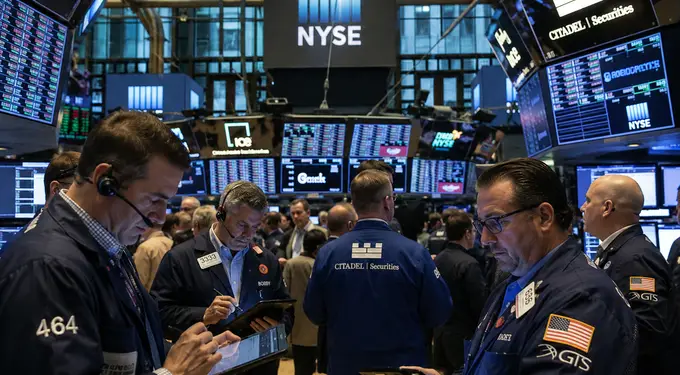
Wall Street will enter the July 6-10 week with less room for error after a choppy start to the second half.
The S&P 500 (SPY) is still sitting near record territory, but the market is carrying a tricky mix of stretched valuations, a cooling labour market, fragile oil prices and fresh pressure in semiconductor stocks.
The centrepiece will be Wednesday’s FOMC minutes, the first deeper look at Kevin Warsh’s debut meeting as Federal Reserve chair.
With investors already debating whether the June jobs slowdown reduces the odds of a near-term rate hike, every data point next week could matter more than usual.
5 factors investors can’t ignore next week
1. FOMC minutes: First real read on Warsh’s Fed
The biggest event lands on Wednesday, when investors get the minutes from the Fed’s June meeting.
That meeting was Warsh’s first as chair, and it left markets with a hawkish dot-plot message: nine of 18 officials projected that rates would end 2026 above the current 3.5%-3.75% range.
The minutes will be parsed for how strongly officials debated inflation, oil prices and the timing of any hike.
The June jobs report gave the Fed some cover to wait, with payrolls rising by just 57,000 and rate-hike odds falling after the data.
Evercore ISI’s Krishna Guha said Warsh sounded “relaxed” about the labour market.
2. ISM Services PMI: Week’s first economic test
Before the Fed minutes, Monday’s ISM Services PMI will set the tone.
ISM has scheduled the June services report for 10 a.m. ET on Monday, July 6, after the July 3 market holiday shifted the calendar.
The May reading rose to 54.5, showing the services side of the economy was still expanding.
A softer print would support the argument that growth is slowing enough to keep the Fed patient.
A stronger reading, especially if prices remain firm, would make the minutes feel more dangerous for rate-sensitive stocks.
3. Chip-sector aftershocks: Reset or warning sign?
Semiconductors remain the market’s most crowded trade, and that makes next week important.
The sector has been rattled by sharp swings in Korean memory names and US chip stocks.
The Kospi index surged on Friday after a two-day decline, helped by bargain-hunting in chipmakers, while US tech weakness had weighed on sentiment earlier in the week.
Samsung and SK Hynix rebounded strongly on July 3 after Thursday’s selloff, while Micron (MU) remained under pressure following a sharp drop.
The question for investors is whether this is a healthy reset after a huge AI rally, or the first sign that positioning has become too leveraged.
4. Levi Strauss (LEVI) and PepsiCo: Early consumer checks
Q2 earnings season does not fully accelerate until mid-July, but Levi Strauss and PepsiCo will offer early signals on the US consumer.
Levi will discuss second-quarter results on Wednesday, July 8, while PepsiCo has confirmed it will release second-quarter results on Thursday, July 9.
Levi offers an early read on discretionary spending and demand for apparel, while PepsiCo provides a staples-side check on consumer tolerance for higher snack and beverage prices.
Together, they will help show whether earnings strength is broadening beyond AI and mega-cap technology.
5. Oil and the fragile Iran ceasefire
Oil’s retreat has helped ease inflation anxiety, but the market is not treating the calm as permanent.
Brent is trading around $71.87 and WTI near $68.63, with prices close to pre-conflict levels as peace efforts held and some Strait of Hormuz traffic resumed.
That cooling helps consumers and the Fed. But it also depends on the diplomacy holding.
The oil prices have returned to pre-war levels even though shipping disruption, insurance costs and geopolitical risk have not fully disappeared.
That is why next week matters as Goldman Sachs has lifted its year-end S&P 500 target to 8,000, but valuations are already rich by long-term standards.
With stocks priced for good news, a hawkish Fed surprise, weak consumer readout or renewed chip volatility could hit harder than usual.
Comments
Log in or sign up to join the conversation.